
Close Menu
    Facebook X (Twitter) Instagram
    SciTechDaily
    • Biology
    • Chemistry
    • Earth
    • Health
    • Physics
    • Science
    • Space
    • Technology
    Facebook X (Twitter) Pinterest YouTube RSS
    SciTechDaily
    Home»Chemistry»Janus Graft Block Copolymers, A Breakthrough in Nanostructured Materials
    Chemistry

    Janus Graft Block Copolymers, A Breakthrough in Nanostructured Materials

    By SEAS, Yale UniversityJuly 9, 2018No Comments3 Mins Read
    Facebook Twitter Pinterest Telegram LinkedIn WhatsApp Email Reddit
    Share
    Facebook Twitter LinkedIn Pinterest Telegram Email Reddit
    Breakthrough in Nanostructured Materials
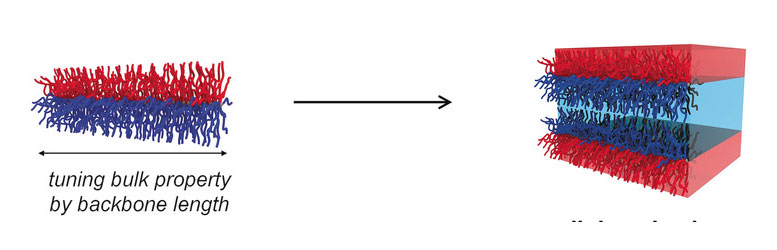
    The GBCPs can be tuned by adjusting the length of the material’s backbone or selecting different sidechains. By doing so, the researchers can achieve different thermomechanical properties without sacrificing their command of critical properties.

    Block copolymers (BCPs) have been of great interest to researchers in recent years. These nanostructured materials, made from blocks of chemically dissimilar polymers, self-assemble to form microdomains of various morphologies and sizes. They could potentially be used for everything from cleaner water to the next generation of computing.

    Researchers, however, have been limited by the inability to regulate the nanostructural and material properties of these materials. For instance, there’s interest in developing BCPs with very small nanodomain sizes to make them more versatile. But various approaches to doing so can interfere with other valuable properties, such as thermomechanical behaviors and processability. As a result, achieving useful materials with domain sizes below 10 nanometers is extremely difficult.

    To get around this problem, Mingjiang Zhong is studying a subset of these materials known as Janus graft block copolymers (GBCPs) in collaboration with the teams of Jeremiah Johnson at MIT and Yale’s Chinedum Osuji, associate professor of chemical & environmental engineering. When designed a certain way, GBCPs can be used to make nanostructured polymers with ultra-small nanodomains with diverse morphologies and bulk properties. Zhong, assistant professor of chemical & environmental engineering, published his findings in the journal Angewandte Chemie as a Very Important Paper (VIP)

    With a larger backbone and several smaller branches, the structures resemble bottlebrushes. The GBCPs can be tuned by adjusting the length of the material’s backbone or selecting different sidechains. By doing so, the researchers can achieve different thermomechanical properties without sacrificing their command of critical properties. And critically, Zhong was able to achieve a domain size of less than three nanometers.

    “That could have huge potential in microelectronics,” Zhong said, adding that it could mean the development of higher-density chips. The field of environmental engineering could also benefit, since smaller domain sizes could allow for the development of more selective membranes for water filters. Zhong is currently collaborating with other Yale researchers on developing applications in both of those fields.

    Other co-authors of the study include Zi-Hao Guo, An N. Le, Xunda Feng, Youngwoo Choo, Bingqian Liu, Danyu Wang, Zhengyi Wan, Yuwei Gu, Julia Zhao, Vince Li, Chinedum O. Osuji, and Jeremiah A. Johnson.

    Reference: “Janus Graft Block Copolymers: Design of a Polymer Architecture for Independently Tuned Nanostructures and Polymer Properties” by Zi-Hao Guo, An N. Le, Xunda Feng, Youngwoo Choo, Bingqian Liu, Danyu Wang, Zhengyi Wan, Yuwei Gu, Julia Zhao, Vince Li, Chinedum O. Osuji and Jeremiah A. Johnson, 26 April 2018, Angewandte Chemie.
    DOI: 10.1002/ange.201802844

    Never miss a breakthrough: Join the SciTechDaily newsletter.
    Follow us on Google and Google News.

    Materials Science Nanomaterials Nanoscience Yale School of Engineering & Applied Science Yale University
    Share. Facebook Twitter Pinterest LinkedIn Email Reddit

    Related Articles

    Scientists Discover Structural Change in Manganese Steel

    Pillared Graphene Structures Gain Strength, Toughness and Ductility

    Yale Engineers Believe Cornstarch Could Lead To Better Protective Gear

    Engineers Develop New Temperature Switchable Membrane to Regulate Flow

    First Experimental Evidence of Boron “Buckyball”

    New Observations Reveal the Inner Workings of Lithium-Ion Batteries

    Experimental Evidence Shows New Boron Nanomaterial is Possible

    Nanomaterials Actively Self-Regulate in Response to Environmental Change

    SLIPS Prevents Ice From Sticking on Metal Surfaces

    Leave A Reply Cancel Reply

    • Facebook
    • Twitter
    • Pinterest
    • YouTube

    Don't Miss a Discovery

    Subscribe for the Latest in Science & Tech!

    Trending News

    Monster Storms on Jupiter Unleash Lightning Beyond Anything on Earth

    Scientists Create “Liquid Gears” That Spin Without Touching

    The Simple Habit That Could Help Prevent Cancer

    Millions Take These IBS Drugs, But a New Study Finds Serious Risks

    Scientists Unlock Hidden Secrets of 2,300-Year-Old Mummies Using Cutting-Edge CT Scanner

    Bread Might Be Making You Gain Weight Even Without Eating More Calories

    Scientists Discover Massive Magma Reservoir Beneath Tuscany

    Europe’s Most Active Volcano Just Got Stranger – Here’s Why Scientists Are Rethinking It

    Follow SciTechDaily
    • Facebook
    • Twitter
    • YouTube
    • Pinterest
    • Newsletter
    • RSS
    SciTech News
    • Biology News
    • Chemistry News
    • Earth News
    • Health News
    • Physics News
    • Science News
    • Space News
    • Technology News
    Recent Posts
    • Scientists Discover a New Meteor Shower From a Mysterious Crumbling Asteroid
    • This Simple Fruit Wash Could Make Produce Safer and Last Days Longer
    • These Tiny Robots 50x Smaller Than a Hair Can Hunt and Move Bacteria
    • Simple Blood Test May Predict Alzheimer’s Years Before Brain Scans Show Signs
    • Scientists Say Adding This Unusual Seafood to Your Diet Could Reverse Signs of Aging
    Copyright © 1998 - 2026 SciTechDaily. All Rights Reserved.
    • Science News
    • About
    • Contact
    • Editorial Board
    • Privacy Policy
    • Terms of Use

    Type above and press Enter to search. Press Esc to cancel.