
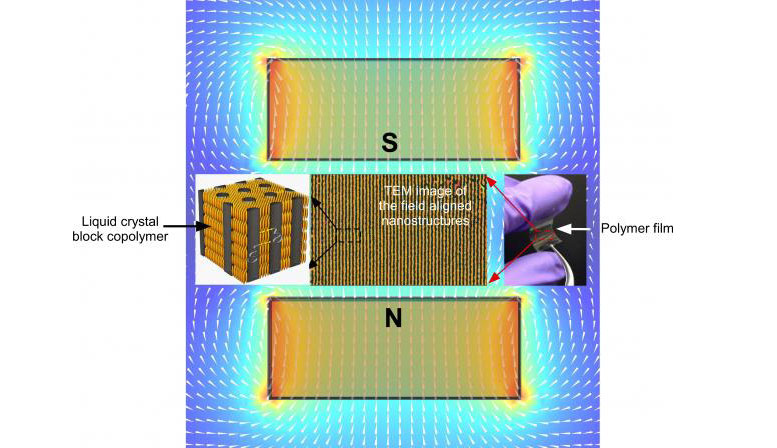
Engineers at the School of Engineering & Applied Science at Yale have discovered a technique for modifying self-assembled polymers that allows their structure to be controlled precisely using small low-cost magnets. The result means that they can replace a high-field $200,000 magnet with one purchased for $20 at a hobby store, but still achieve the same level of structural control.
Controlling the orientation of the self-assembled nanostructures formed by materials known as block copolymers is critical for the realization of a broad range of applications, such as the development of a new generation of high performance filtration systems that make clean water more accessible. Magnetic fields offer promise in this regard, but field alignment of block copolymers has to date been costly and complex, as it required the use of very large fields of about 5 tesla. That’s not quite as intense as the fields used to steer particle beams at the Large Hadron Collider, but stronger than a typical MRI.
But with a new technique developed in the lab of Chinedum Osuji, associate professor of chemical & environmental engineering, the same structural control can now be achieved with small $20 permanent magnets, instead of much larger and costlier superconducting electromagnets. The results of their research were published this week in Proceedings of the National Academy of Sciences (PNAS).
When any material or substance undergoes an ordering transition, it tends to produce small crystals – known as grains – with different orientations. Think, for example, of water freezing into ice. Osuji’s lab has helped to pioneer the use of high-intensity magnetic fields to uniformly align such grains in block copolymers to tailor existing properties or to create new useful properties for various applications. The response of the grains is similar to a compass needle’s alignment in a magnetic field.
For a particular type of block copolymers known as liquid crystalline block copolymers (LC BCPs), however, there appears to be a much easier way to achieve alignment. Researchers in Osuji’s lab found that by adding small liquid crystal molecules known as mesogens into the system, they could significantly increase the size of the grains that enabled the material to respond, or align, to much lower strength magnetic fields.
“From past experience, we knew that these LC BCP materials got softer when we add the mesogens, and that they respond faster to magnetic fields as a consequence,” said Manesh Gopinadhan, an associate research scientist in Osuji’s lab and lead author of the paper. What they didn’t know was that mesogen addition would enlarge the grains and reduce the need for high-intensity magnetic fields. The amount of the mesogen additive needed is small enough that it doesn’t otherwise change the nature of the material.
“So if you want to control the self-assembled structure to make a membrane, instead of using a $200,000 magnet and all the complexities entailed with that, you can potentially use a $20 magnet instead,” Osuji said.
That’s a factor of 10,000 times less. The ease of conducting studies using low-cost permanent magnets will go a long way to making this kind of research more widespread.
“Doing these sorts of experiments has traditionally required big and costly magnets paired with other analytical tools,” Osuji said. “Such requirements limit the level of activity in the field as only a small number of people have access to the specialized high-field magnets. We hope that other researchers will adopt the approach we developed once they realize that they can use it with their materials to explore new properties or applications.”
Reference: “Controlling orientational order in block copolymers using low-intensity magnetic fields” by Manesh Gopinadhan, Youngwoo Choo, Kohsuke Kawabata, Gilad Kaufman, Xunda Feng, Xiaojun Di, Yekaterina Rokhlenko, Lalit H. Mahajan, Dennis Ndaya, Rajeswari M. Kasi and Chinedum O. Osuji, 23 October 2017, PNAS.
DOI: 10.1073/pnas.1712631114
Never miss a breakthrough: Join the SciTechDaily newsletter.
Follow us on Google and Google News.