

Inspired by the way termites build their nests, scientists at the California Institute of Technology (Caltech) developed a framework to design new materials that mimic the fundamental rules hidden in nature’s growth patterns. The researchers demonstrated that by using these rules, it is possible to create materials designed with specific programmable properties.
The research was published in the journal Science on August 26. It was led by Chiara Daraio, G. Bradford Jones Professor of Mechanical Engineering and Applied Physics and Heritage Medical Research Institute Investigator.
Termites’ Nest Architecture and Its Implications
“Termites are only a few millimeters in length, but their nests can stand as high as 4 meters (13 feet) —the equivalent of a human constructing a house the height of California’s Mount Whitney,” says Daraio. If you peer inside a termite nest you will see a network of asymmetrical, interconnected structures, similar to the interior of a sponge or a loaf of bread. Made of sand grains, dirt, dust, saliva, and dung, this disordered, irregular structure appears arbitrary. However, a termite nest is specifically optimized for stability and ventilation.
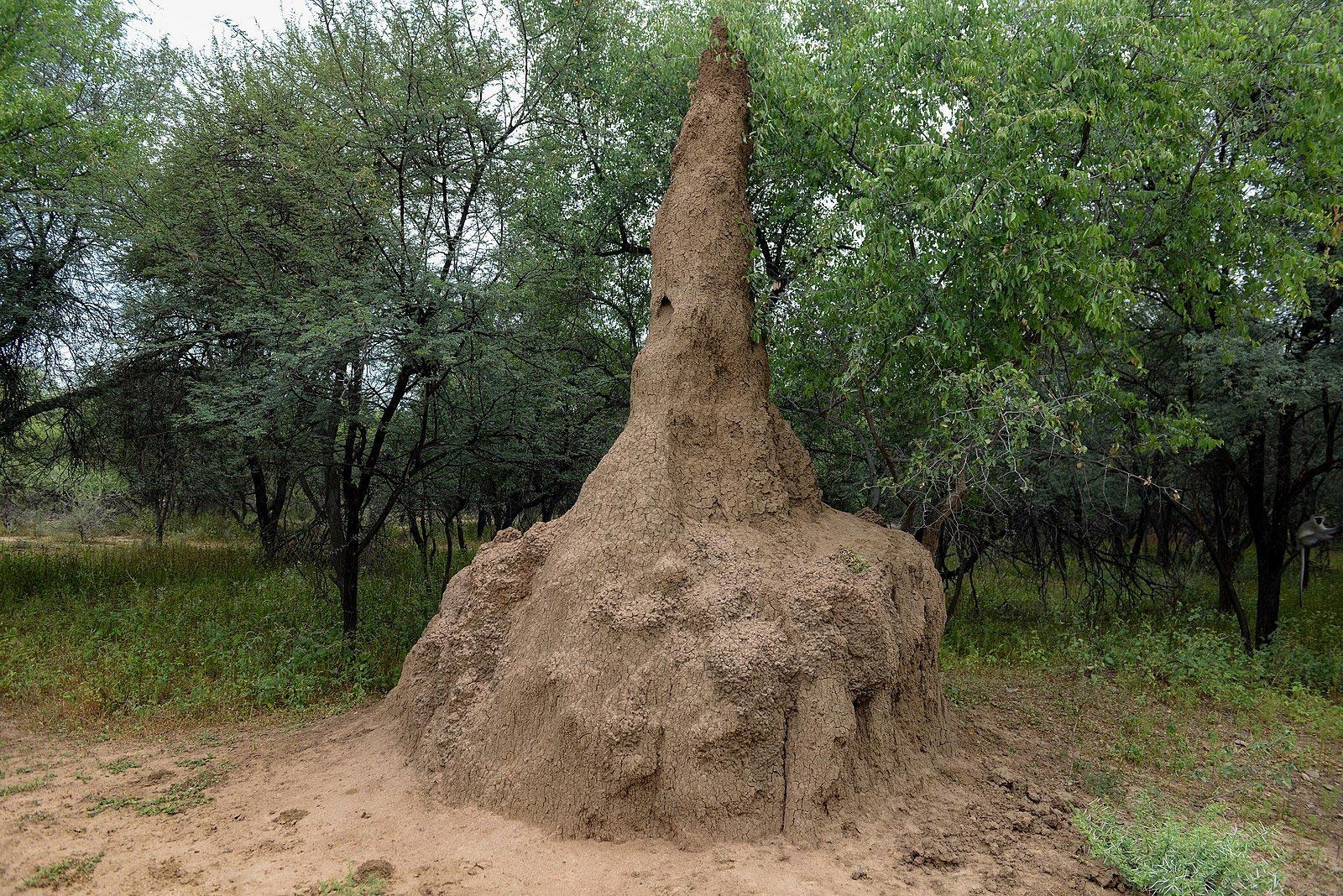
“We thought that by understanding how a termite contributes to the nest’s fabrication, we could define simple rules for designing architected materials with unique mechanical properties,” says Daraio. Architected materials are foam-like or composite solids that comprise the building blocks that are then organized into 3D structures, from the nano- to the micrometer scale. Up until this point, the field of architected materials has primarily focused on periodic architectures. These architectures contain a uniform geometry unit cell, like an octahedron or cube, and then those unit cells are repeated to form a lattice structure. However, focusing on ordered structures has limited the functionalities and use of architected materials.
“Periodic architectures are convenient for us engineers because we can make assumptions in the analysis of their properties. However, if we think about applications, they are not necessarily the optimal design choice,” says Daraio. Disordered structures, like that of a termite nest, are more prevalent in nature than periodic structures and often show superior functionalities, but, until now, engineers had not figured out a reliable way to design them.
Mimicking Termites’ Building Rules in Material Design

“The way we first approached the problem was by thinking of a termite’s limited number of resources,” says Daraio. When it builds its nest, a termite does not have a blueprint of the overall nest design; it can only make decisions based on local rules. For example, a termite may use grains of sand it finds near its nest and fit the grains together following procedures learned from other termites. A round sand grain may fit next to a half-moon shape for increased stability. Such basic rules of adjacency can be used to describe how to build a termite nest. “We created a numerical program for materials’ design with similar rules that define how two different material blocks can adhere to one another,” she says.
This algorithm, which Daraio and team call the “virtual growth program,” simulates the natural growth of biological structures, or the fabrication of termite nests. Instead of a grain of sand or a speck of dust, the virtual growth program uses unique materials’ geometries, or building blocks, as well as adjacency guidelines for how those building blocks can attach to each other. The virtual blocks used in this initial work include an L shape, an I shape, a T shape, and a + shape. In addition, the availability of each building block is given a defined limit, paralleling the limited resources a termite might encounter in nature. Using these constraints, the program builds out an architecture on a grid, and then those architectures can be translated into 2D or 3D physical models.
“Our goal is to generate disordered geometries with properties defined by the combinatory space of some essential shapes, like a straight line, a cross, or an ‘L’ shape. These geometries can then be 3D printed with a variety of different constitutive materials depending on applications’ requirements,” says Daraio.
Exploring Disordered Materials for Superior Performance
Mirroring the randomness of a termite nest, each geometry created by the virtual growth program is unique. Changing the availability of L-shaped building blocks, for example, results in a new set of structures. Daraio and her team experimented with the virtual inputs to generate more than 54,000 simulated architected samples. These samples could be clustered into groups with different mechanical characteristics that might determine a material’s stiffness, density, or how it deforms. By graphing the relationship between the building-block layout, the availability of resources, and the resulting mechanical features, the research team can analyze the underlying rules of disordered structures. This represents a completely new framework for materials analysis and engineering.
“We want to understand the fundamental rules of materials’ design to then create materials that have superior performances compared to the ones we currently use in engineering,” says Daraio. “For example, we envision the creation of materials that are more lightweight but also more resistant to fracture or better at absorbing mechanical impacts and vibrations.”
The virtual growth program explores the uncharted frontier of disordered materials by emulating the way a termite builds its nest rather than replicating the configuration of the nest itself. “This research aims at controlling disorder in materials to improve mechanical and other functional properties using design and analytical tools not exploited before,” says Daraio.
Reference: “Growth rules for irregular architected materials with programmable properties” by Ke Liu, Rachel Sun and Chiara Daraio, 25 August 2022, Science.
DOI: 10.1126/science.abn1459
In addition to Daraio, former Caltech postdoc Ke Liu and former undergraduate Rachel Sun (BS ’21) are co-authors. Sun worked on this project as a student in the 2020 Caltech Summer Undergraduate Research Fellowship (SURF) program. Funding was provided by the National Science Foundation, the Caltech Carver Mead New Adventures Fund, the Caltech SURF program, and Peking University College of Engineering.
Never miss a breakthrough: Join the SciTechDaily newsletter.
Follow us on Google and Google News.