
Close Menu
    Facebook X (Twitter) Instagram
    SciTechDaily
    • Biology
    • Chemistry
    • Earth
    • Health
    • Physics
    • Science
    • Space
    • Technology
    Facebook X (Twitter) Pinterest YouTube RSS
    SciTechDaily
    Home»Technology»Japan Could Host International Linear Collider
    Technology

    Japan Could Host International Linear Collider

    By SciTechDailyDecember 17, 20122 Comments3 Mins Read
    Facebook Twitter Pinterest Telegram LinkedIn WhatsApp Email Reddit
    Share
    Facebook Twitter LinkedIn Pinterest Telegram Email Reddit
    international-linear-collider-rendering
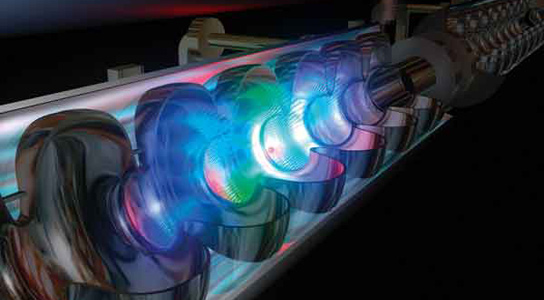
    Computer animation of International Linear Collider (ILC). Credit: Desy.de

    As most of the world is still dealing with the worst economic crisis in decades, Japan is currently being considered as the potential host for the International Linear Collider (ILC), a multi-billion-dollar machine that will smash atoms at higher and higher energy levels.

    Members of the ILC team will hand over the finalized design of the ILC to an independent committee of researchers. The blueprint calls for a 31-kilometer-long (19-mile-long) track of superconducting cavities that will be able to accelerate particles to energies of up to 500 gigaelectronvolts before colliding them. These collisions will be able to provide a glimpse of heavier particles, which would then quickly decay inside one of two detectors.

    The approach is similar to the LHC located at CERN in Geneva, Switzerland. The LHC’s view of the Higgs is obscured because the collider uses protons, composite particles made up of quarks, which produce a messy spray of debris. The ILC would use electrons and anti-electrons, which are fundamental particles and would give a cleaner Higgs signal.

    The ILC will cost between $7 and $8 billion to make, and the project has struggled to gain support from governments. Without international commitment, nothing is going to go forward. Japan has been hungry since it lost the bid to host the €13-billion prototype fusion reactor ITER in 2005. The quake and tsunami of last year led to a glut of reconstruction funding, some of which could go towards a scientific project like the ILC.

    Currently, scientists in Japan are conducting studies of two sites: one in the Tohoku region that was struck by the tsunami and one in Kyushu, in the south of Japan. The Japanese would bore deep into a mountainside to accommodate the collider. Several aspects of the design will need to be changed to fit this setup, but researchers believe both sites are excellent sites for an accelerator.

    A coalition of politicians from across Japan’s political parties has thrown their support behind the project, but the Japanese support for the collider isn’t assured. The country has never attempted such a large project, and it lacks the process for approving the large sums of money needed for the construction.

    If the ILC is approved in Japan, Europe will make a contribution, just as Japan contributed to the LHC. The USA may be more reluctant to participate due to current budgetary constraints.

    Never miss a breakthrough: Join the SciTechDaily newsletter.
    Follow us on Google and Google News.

    High Energy Physics International Linear Collider Particle Collider Particle Physics Popular
    Share. Facebook Twitter Pinterest LinkedIn Email Reddit

    Related Articles

    Could 3D Printers Create the Next Generation of Particle Accelerators?

    Devices to Process Ultra-High-Speed Wireless Data and Harvest Energy for Power Simultaneously

    More Powerful and Smaller Particle Accelerators Possible With “Game Changer” Laser

    New Tap-Proof Communication: Generating Quantum-Entangled Photons in a Spectral Range of Light Previously Inaccessible

    Stanford Researchers Miniaturize a Particle Accelerator to Fit on a Silicon Chip

    Hole-y Superconductor: Entirely New State of Matter Discovered

    New Technology Can Instantly Identify Airborne Chemicals – Down to Parts-Per-Billion

    Next Generation International Linear Collider Ready for Construction

    Higgs Boson Might Have Been Discovered by LHC High Energy Physicists

    2 Comments

    1. Cloudcom Servers on December 23, 2012 4:50 pm

      I wonder if Japan are hosting the collider, what about all tsunami attacks etc, is that safe and protected?

      Reply
    2. Jason Morgan on July 22, 2017 7:25 am

      I also wonder about the stability of a 31Km long linear accelerator in a major earthquake zone.

      Reply
    Leave A Reply Cancel Reply

    • Facebook
    • Twitter
    • Pinterest
    • YouTube

    Don't Miss a Discovery

    Subscribe for the Latest in Science & Tech!

    Trending News

    New “Nanozyme Hypothesis” Could Rewrite the Story of Life’s Origins

    Anatomy Isn’t Finished: The Human Body Still Holds Secrets

    “Pretty Close to Home”: The Hidden Earthquake Threat Beneath Seattle

    The Surprising Reason You Might Want To Sleep Without a Pillow

    Scientists Say This Natural Hormone Reverses Obesity by Targeting the Brain

    35-Million-Year-Old Mystery: Strange Arachnid Discovered Preserved in Amber

    Is AI Really Just a Tool? It Could Be Altering How You See Reality

    JWST Reveals a “Forbidden” Planet With a Baffling Composition

    Follow SciTechDaily
    • Facebook
    • Twitter
    • YouTube
    • Pinterest
    • Newsletter
    • RSS
    SciTech News
    • Biology News
    • Chemistry News
    • Earth News
    • Health News
    • Physics News
    • Science News
    • Space News
    • Technology News
    Recent Posts
    • Hidden Oceans of Magma Could Be Protecting Alien Life
    • After Decades of Searching, Astronomers Finally Track Down the Universe’s Missing Hydrogen
    • Scientists Capture Hidden Electron Patterns Inside Quantum Materials
    • New Study Challenges Alzheimer’s Theories: It’s Not Just About Plaques
    • Scientists Discover Way To Treat Lung Cancer and Its Deadly Side Effect Together
    Copyright © 1998 - 2026 SciTechDaily. All Rights Reserved.
    • Science News
    • About
    • Contact
    • Editorial Board
    • Privacy Policy
    • Terms of Use

    Type above and press Enter to search. Press Esc to cancel.