
Close Menu
    Facebook X (Twitter) Instagram
    SciTechDaily
    • Biology
    • Chemistry
    • Earth
    • Health
    • Physics
    • Science
    • Space
    • Technology
    Facebook X (Twitter) Pinterest YouTube RSS
    SciTechDaily
    Home»Chemistry»Japanese Scientists Unveil Game-Changing Material for Magnesium Batteries
    Chemistry

    Japanese Scientists Unveil Game-Changing Material for Magnesium Batteries

    By Tohoku UniversityApril 7, 2024No Comments3 Mins Read
    Facebook Twitter Pinterest Telegram LinkedIn WhatsApp Email Reddit
    Share
    Facebook Twitter LinkedIn Pinterest Telegram Email Reddit
    Battery Technology Illustration
    Researchers at Tohoku University have developed a new cathode material for rechargeable magnesium batteries, enabling efficient charging and discharging at low temperatures. This breakthrough, utilizing an enhanced rock-salt structure and a high-entropy strategy, overcomes previous challenges in magnesium diffusion and transport.

    Scientists at Tohoku University have achieved a significant breakthrough in battery technology by creating a new cathode material for rechargeable magnesium batteries (RMBs). This material facilitates efficient charging and discharging processes, even in cold environments. By utilizing an improved rock-salt structure, this pioneering material is set to revolutionize energy storage options, making them more cost-effective, safer, and higher in capacity.

    Details of the findings were published in the Journal of Materials Chemistry A on March 15, 2024.

    The study showcases a considerable improvement in magnesium (Mg) diffusion within a rock-salt structure, a critical advancement since the denseness of atoms in this configuration had previously impeded Mg migration. By introducing a strategic mixture of seven different metallic elements, the research team created a crystal structure abundant in stable cation vacancies, facilitating easier Mg insertion and extraction.

    This represents the first utilization of rocksalt oxide as a cathode material for RMBs. The high-entropy strategy employed by the researchers allowed the cation defects to activate the rocksalt oxide cathode.

    Overcoming RMB Limitations

    The development also addresses a key limitation of RMBs – the difficulty of Mg transport within solid materials. Until now, high temperatures were necessary to enhance Mg mobility in conventional cathode materials, such as those with a spinel structure. However, the material unveiled by Tohoku University researchers operates efficiently at just 90°C, demonstrating a significant reduction in the required operating temperature.
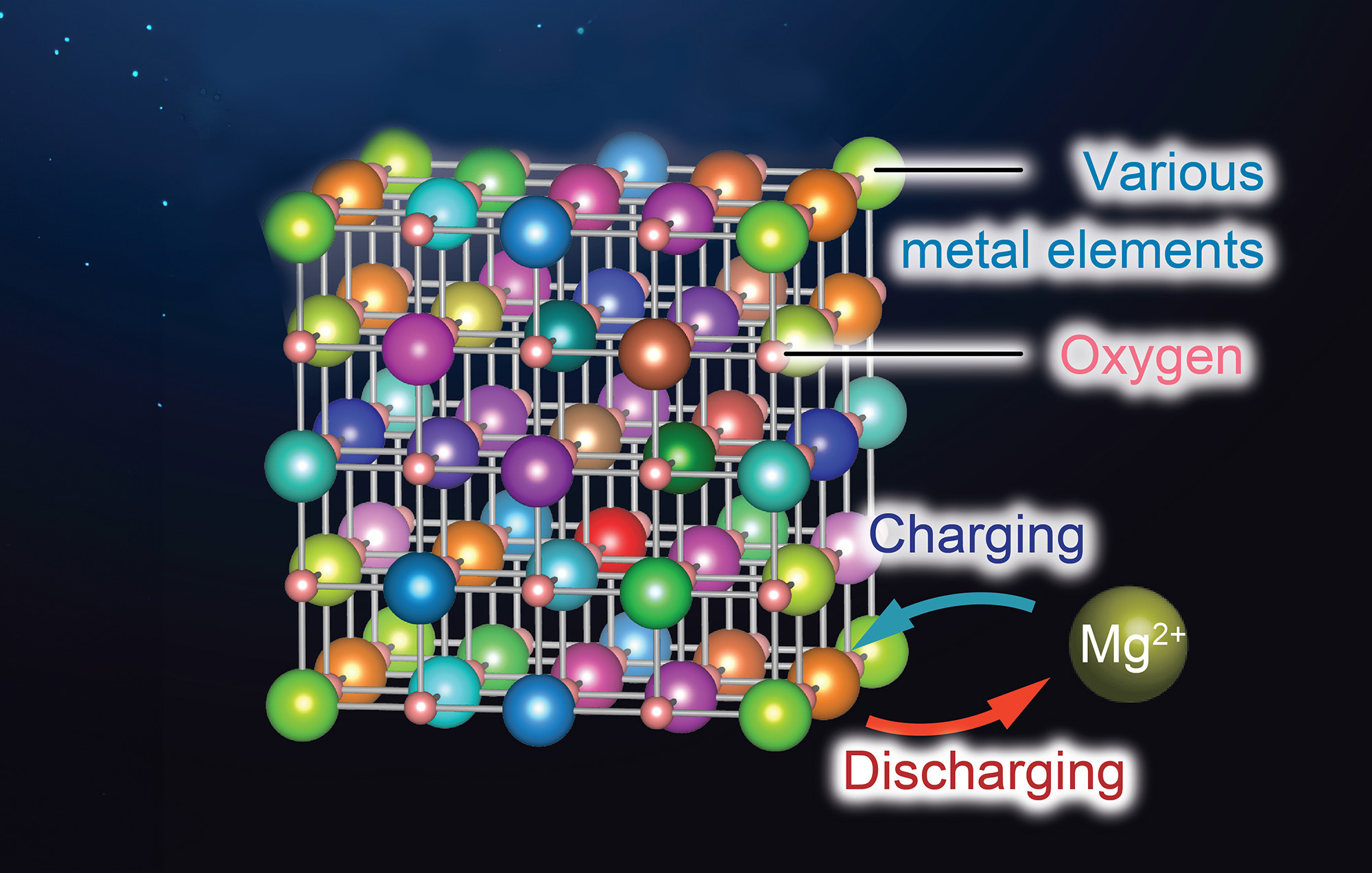
    Game Changing Material for Magnesium Batteries Graphic
    The present material contains many metal elements as cations thanks to the effect of the high configurational entropy. Credit: Tohoku University

    Tomoya Kawaguchi, a professor at Tohoku University’s Institute for Materials Research (IMR), notes the broader implications of the study. “Lithium is scarce and unevenly distributed, whereas magnesium is abundantly available, offering a more sustainable and cost-effective alternative for lithium-ion batteries. Magnesium batteries, featuring the newly developed cathode material, are poised to play a pivotal role in various applications, including grid storage, electric vehicles, and portable electronic devices, contributing to the global shift towards renewable energy and reduced carbon footprints.”

    Kawaguchi collaborated with Tetsu Ichitsubo, also a professor at IMR, who states, “By harnessing the intrinsic benefits of magnesium and overcoming previous material limitations, this research paves the way for the next generation of batteries, promising significant impacts on technology, the environment, and society.”

    Ultimately, the breakthrough is a major step forward in the quest for efficient, eco-friendly energy storage solutions.

    Reference: “Securing cation vacancies to enable reversible Mg insertion/extraction in rocksalt oxides” by Tomoya Kawaguchi, Masaya Yasuda, Natsumi Nemoto, Kohei Shimokawa, Hongyi Li, Norihiko L. Okamoto and Tetsu Ichitsubo, 15 March 2024, Journal of Materials Chemistry A.
    DOI: 10.1039/D3TA07942B

    Never miss a breakthrough: Join the SciTechDaily newsletter.
    Follow us on Google and Google News.

    Battery Technology Materials Science Tohoku University
    Share. Facebook Twitter Pinterest LinkedIn Email Reddit

    Related Articles

    New Li-Ion Conductor Discovered – The Novel Material Could Supercharge Electric Vehicle Batteries

    Selective Separation Could Help Alleviate Critical Shortage of Rare-Earth and Other Key Metals

    Solar Flow Battery: Single Device Generates, Stores and Redelivers Renewable Electricity From the Sun

    Researchers Use Salmon DNA to Develop Next-Generation High-Capacity Battery Material

    Organic Battery Breakthrough Makes Lithium-Ion Batteries More Environmentally Friendly

    New Solid Polymer-Based Electrolyte Helps Batteries Become Self-Healing, Recyclable

    Novel Carbon Coating Technology of Li-Rich Layered Oxide Cathode

    New Sodium-Conducting Material Significantly Outperforms All Others in Its Class

    Using X-Ray Imaging to Help Improve Lithium-Sulfur Battery Technology

    Leave A Reply Cancel Reply

    • Facebook
    • Twitter
    • Pinterest
    • YouTube

    Don't Miss a Discovery

    Subscribe for the Latest in Science & Tech!

    Trending News

    This Copper Drug Clears Alzheimer’s Brain Toxins and Boosts Memory

    Adults Over 65 Lost Massive Amounts of Weight With Ozempic

    How Flocking Birds “Defy” One of Physics’ Most Fundamental Laws

    Physicists Create a New Kind of Schrödinger’s Cat State From Exotic Quantum Building Blocks

    Your Diet Could Be Missing the Key Ingredient for Heart Protection

    Researchers Warn Widely Prescribed Blood Pressure Drugs Could Be Harming Diabetic Kidneys

    James Webb Spots Something Strange Between Day and Night on an Alien Planet

    How Ancient People Moved a 6-Ton Stone 700 Kilometers to Stonehenge

    Follow SciTechDaily
    • Facebook
    • Twitter
    • YouTube
    • Pinterest
    • Newsletter
    • RSS
    SciTech News
    • Biology News
    • Chemistry News
    • Earth News
    • Health News
    • Physics News
    • Science News
    • Space News
    • Technology News
    Recent Posts
    • Scientists Uncover Cause of Inflammatory Bowel Disease Solving Decades-Old Mystery
    • The Surprising Reason Swimming Could Be Better for Your Heart Than Running
    • Could Vitamin C Be the Secret to Keeping Your Brain Younger?
    • The Surprising Fix for Robot Traffic Jams
    • Near Absolute Zero, This Transistor Starts Acting Like a Brain Cell
    Copyright © 1998 - 2026 SciTechDaily. All Rights Reserved.
    • Science News
    • About
    • Contact
    • Editorial Board
    • Privacy Policy
    • Terms of Use

    Type above and press Enter to search. Press Esc to cancel.