
Close Menu
    Facebook X (Twitter) Instagram
    SciTechDaily
    • Biology
    • Chemistry
    • Earth
    • Health
    • Physics
    • Science
    • Space
    • Technology
    Facebook X (Twitter) Pinterest YouTube RSS
    SciTechDaily
    Home»Space»Keck Spectroscopy Confirmation of Large, Diffuse Galaxies in the Coma Cluster
    Space

    Keck Spectroscopy Confirmation of Large, Diffuse Galaxies in the Coma Cluster

    By Jim Shelton, Yale UniversityMay 21, 2015No Comments2 Mins Read
    Facebook Twitter Pinterest Telegram LinkedIn WhatsApp Email Reddit
    Share
    Facebook Twitter LinkedIn Pinterest Telegram Email Reddit
    Confirmation of the Existence of Large Diffuse Galaxies in the Coma Cluster
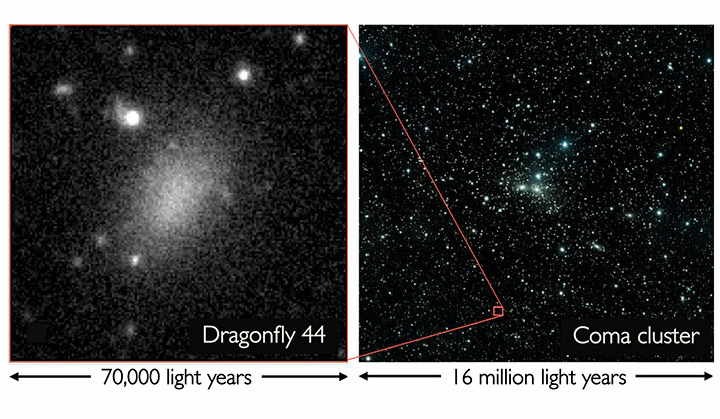
    A collection of unidentified blobs was discovered toward the Coma cluster of galaxies, using the Dragonfly Telephoto Array. One of these puzzling objects, Dragonfly 44, was studied in detail using the Keck Observatory and confirmed as an ultra-diffuse galaxy. Although it is composed of a billion stars, it is so far away that it appears as only a faint smudge. Credit: P. van Dokkum, R. Abraham, and J. Brodie

    In a newly published study, astronomers detail the discovery of large, diffuse galaxies in the Coma Cluster.

    A fluffy galaxy is hard to find, but that didn’t stop a Yale astronomer and an international research team from identifying the fluffiest galaxies in the universe.

    These “ultra diffuse” galaxies are located about 300 million light-years from Earth, in the Coma cluster of galaxies. What makes them fluffy? It is this: although they are as wide as our own Milky Way galaxy, they harbor only 1% as many stars.

    “If the Milky Way is a sea of stars, then these newly discovered galaxies are like wisps of clouds,” said Pieter van Dokkum, chair of the Department of Astronomy and lead author of a study published in the Astrophysical Journal Letters.

    “We are beginning to form some ideas about how they were born and it’s remarkable they have survived at all,” van Dokkum said. “They are found in a dense, violent region of space filled with dark matter and galaxies whizzing around, so we think they must be cloaked in their own invisible dark matter ‘shields’ that are protecting them from this intergalactic assault.”

    The research team included astronomers from San Jose State University, the University of Toronto, and the University of California-Santa Cruz. The team made its discovery by combining results from the Dragonfly Telephoto Array — which van Dokkum helped to invent — and the W.M. Keck Observatory’s 10-meter Keck I telescope.

    Reference: “Spectroscopic Confirmation of the Existence of Large, Diffuse Galaxies in the Coma Cluster” by Pieter van Dokkum, Aaron Romanowsky, Roberto Abraham, Jean Brodie, Charlie Conroy, Marla Geha, Allison Merritt, Alexa Villaume and Jielai Zhang, 1 May 2015, The Astrophysical Journal Letters.
    DOI: 10.1088/2041-8205/804/1/L26
    arXiv: 1504.03320


    Never miss a breakthrough: Join the SciTechDaily newsletter.
    Follow us on Google and Google News.

    Astronomy Astrophysics Cosmology
    Share. Facebook Twitter Pinterest LinkedIn Email Reddit

    Related Articles

    “Should Not Have Happened” – Titanic Galaxy Cluster Collision Defies Cosmology Theories

    On the Trail of a Mysterious Force in Space – Scientists Shed New Light on Dark Energy

    Space Explosions Just Got More Interesting: Challenging Conventional Understanding of Classical Novae

    Chaotic Triple Drama: Black Hole Billiards in the Centers of Galaxies

    Mysterious Cosmic Flashes Pinpointed to a Surprising Location in Space – “Closest Ever”

    Breaking Cosmology: Too Many Disk Galaxies – “A Significant Discrepancy Between Prediction and Reality”

    Unprecedented Number of Globular Clusters Discovered in Nearby Galaxy

    Part of the Universe’s Missing Matter Found Thanks to Very Large Telescope

    Twin Supernovae Open Up New Possibilities for Precision Cosmology

    Leave A Reply Cancel Reply

    • Facebook
    • Twitter
    • Pinterest
    • YouTube

    Don't Miss a Discovery

    Subscribe for the Latest in Science & Tech!

    Trending News

    A SpaceX Falcon 9 Rocket Hit the Moon and Blasted Open a 60-Foot Crater

    Study Reveals Your Organs May Be Aging at Very Different Speeds

    Scientists Finally Solve a 20-Year Mystery About Diamond Melting

    Ultra-Processed Foods Linked to 30% Higher Prostate Cancer Risk

    More Screen Time, Better Thinking? An 8-Year Study Finds a Surprising Link

    Cleaner Cars May Be Hiding a New Pollution Problem

    Common Plant Chemical Linked to Widespread Organ Damage in Aquatic Animals

    Dogs and Humans May Share a Surprising Biological Secret to Longevity

    Follow SciTechDaily
    • Facebook
    • Twitter
    • YouTube
    • Pinterest
    • Newsletter
    • RSS
    SciTech News
    • Biology News
    • Chemistry News
    • Earth News
    • Health News
    • Physics News
    • Science News
    • Space News
    • Technology News
    Recent Posts
    • A Relentless Storm Pattern Is Making Arctic Sea Ice Disappear Faster
    • Monkeys Just Challenged a Major Assumption About How Human Ancestors Climbed
    • A Billion Years Before the Grand Canyon, a Giant Cliff May Have Stretched Across America
    • Longer Breastfeeding Linked to Fewer ADHD Symptoms in Children
    • The Immune Systems of 110-Year-Olds Are Hiding a Remarkable Secret
    Copyright © 1998 - 2026 SciTechDaily. All Rights Reserved.
    • Science News
    • About
    • Contact
    • Editorial Board
    • Privacy Policy
    • Terms of Use

    Type above and press Enter to search. Press Esc to cancel.