
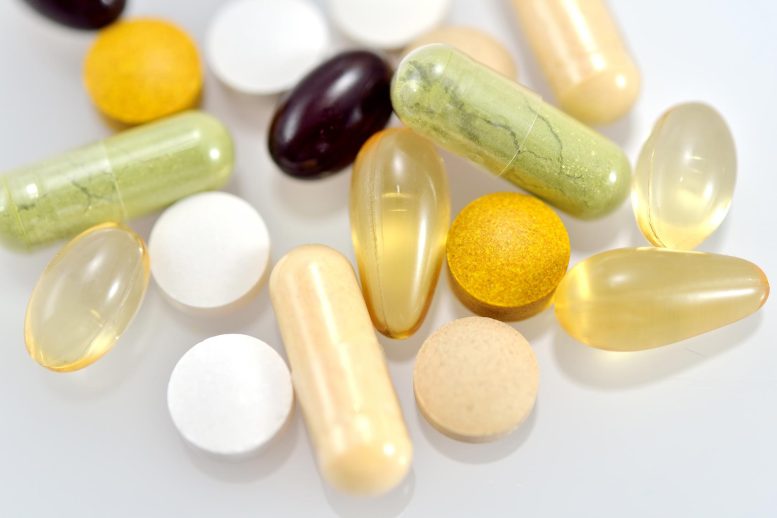
A meta-analysis of more than 884 studies finds omega-3, folic acid, and CoQ10 among the micronutrients that reduce cardiovascular risk.
Healthy diets are rich in antioxidants like amino acids, omega-3 fatty acids, and vitamin C, but exactly how beneficial these micronutrients are for cardiovascular health has long been controversial. Now a new meta-analysis published in the Journal of the American College of Cardiology provides some clarity.
Researchers systematically reviewed a total of 884 studies available to date on micronutrients taken as dietary supplements and analyzed their data. They identified several micronutrients that do reduce cardiovascular risk—as well as others that offer no benefit or even have a negative effect. More than 883,000 patients were involved in the combined studies.
“For the first time, we developed a comprehensive, evidence-based integrative map to characterize and quantify micronutrient supplements’ potential effects on cardiometabolic outcomes,” said Simin Liu, MD, MS, MPH, ScD, professor of epidemiology and medicine at Brown University and a principal investigator for the study. “Our study highlights the importance of micronutrient diversity and the balance of health benefits and risks.”
The findings could be used as the basis of future clinical trials to study specific combinations of micronutrients and their impact on cardiovascular health, he said.
Beneficial Micronutrients for Cardiovascular Health
Antioxidant supplementation has long been thought to play a role in heart health. That’s because these nutrients work to reduce oxidative stress, a known contributor to many cardiovascular diseases. Heart-healthy diets like the Mediterranean diet and the Dietary Approach to Stop Hypertension (DASH) feature foods that are naturally rich in antioxidants. However, results from studies of antioxidant supplements have been inconsistent—one reason why this approach hasn’t yet been widely adopted in preventative cardiology.
“Research on micronutrient supplementation has mainly focused on the health effects of a single or a few vitamins and minerals,” Liu said. “We decided to take a comprehensive and systematic approach to evaluate all the publicly available and accessible studies reporting all micronutrients, including phytochemicals and antioxidant supplements and their effects on cardiovascular risk factors as well as multiple cardiovascular diseases.”
The researchers looked at randomized, controlled intervention trials evaluating 27 different types of antioxidant supplements. They found strong evidence that several offered cardiovascular benefits. These included omega-3 fatty acid, which decreased mortality from cardiovascular disease; folic acid, which lowered stroke risk; and coenzyme Q10, an antioxidant sometimes marketed as CoQ10, which decreased all-cause mortality. Omega-6 fatty acid, L-citrulline, L-arginine, quercetin, melatonin, curcumin, Vitamin D, zinc, magnesium, alpha-lipoic acid (ALA), catechin, flavanol, and genistein also showed evidence of reducing cardiovascular risk.
Micronutrients with Neutral or Negative Effects
Not all supplements were beneficial. Vitamin C, Vitamin D, Vitamin E, and selenium showed no effect on long-term cardiovascular disease outcomes or type-2 diabetes risk. And beta carotene supplements increased all-cause mortality.
According to the researchers, the findings point to the need for more personalized, precision-based dietary interventions that involve specific combinations of beneficial supplements. Further study is needed, including large, high-quality interventional trials to investigate the long-term effects of certain micronutrients on health.
“Identifying the optimal mixture of micronutrients is important, as not all are beneficial, and some may even have harmful effects,” Liu said.
Reference: “Micronutrient Supplementation to Reduce Cardiovascular Risk” by Peng An PhD; Sitong Wan BSc; Yongting Luo PhD; Junjie Luo PhD; Xu Zhang MSc; Shuaishuai Zhou MSc; Teng Xu MSc; Jingjing He PhD; Jeffrey I. Mechanick MD; Wen-Chih Wu MD, MPH; Fazheng Ren PhD and Simin LiuMD, ScD, 5 December 2022, Journal of the American College of Cardiology.
DOI: 10.1016/j.jacc.2022.09.048
Never miss a breakthrough: Join the SciTechDaily newsletter.
Follow us on Google and Google News.
11 Comments
The ratio of omega 6 to omega 3 in the diet matters more than the absolute amounts of each. This article overlooked that. It’s a dangerous oversight if people think increasing omega 6 is sufficient for cardioprotection. https://pubmed.ncbi.nlm.nih.gov/12442909/
One paragraph says vitamen-D is beneficial followed by the next paragraph that says it isn’t. So which is it?
So why did my cardiologist tell me,”If you believe in CO Q10, I got a miracle facelift in a jar I’ll sell you’? Hard to know who or what to trust.
It has been less than a week since, on the same Google News lineup, we were reading of yet another study that indicated that supplements were of no practical value.
For that matter, we don’t know if the contents of the bottle contain what is on the label.
It would seem that nobody seems to be checking.
Who, then, do we believe? An unregulated industry?
Countless studies with widely varying results and professional opinions. As Joe commented on this forum earlier even the article made contradictory statements.
The longest living people don’t seem to be supplement takers.
JOE I saw that s*** too so which is it vitamin D good or not . I’m going with good 👍😊.
What was said about vitamin D is that it is beneficial (in other ways), but it was not found to be beneficial in this particular study against cardiovascular disease. There are studies that show how beneficial supplements like Omega-3 is.
We don’t know whom to believe. Was shopping a while ago. Heard this guy saying that Walmart is being sued, they had lead & something else in the 99 cent ingredients…he said that DISTILLED Water should flush everything out of our insides…don’t know whom to believe as of N-O-W…GUSH!!!
I’ve used CoQ10 for years but initially not for heart health. I used it for healthy gums and it worked. Years later I had to have heart stints and the Chief of Surgery said that taking CoQ10 likely saved my life. I was a “heart attack waiting to happen” but my very strong heart did not fail. The surgeon believed CoQ10 strengthened my heart and helped prevent any failure.
Coincidentally…there seems to be a coalition between dental and gum disease and cardiovascular disease. Apparently the plaques that build up around gum and tooth can break off and enter the blood stream and build up in the arteries, contributing,however,not solely responsible for the need for cardiovascular intervention like stents. I believe that the micronutrients,micronutrients,minerals, all play a role in human health. How much or how little per individual person is and likely will always be suspect.as the article reads,it’s an accumulative study, of many other scientific studies. And also sites the need for further development of individual specific testing and analysis to help determine who needs what specific beneficial supplementation. Variety of foods is key to good nutrition. Supplements may help particular conditions, not necessarily to address every conceived ailment due to the “I got it syndrome”.
Niacin is one of the best supplements for artery health and cholesterol regulation. I think fasting will be the best way to help with hypertension and cholesterol.