
Federal funding brings together experts to chart a viable path to realizing fusion energy as a clean power source.
The University of Rochester’s Laboratory for Laser Energetics (LLE) has received a four-year, $10 million award from the US Department of Energy’s (DOE) Office of Fusion Energy Science (FES) to lead a national research hub dedicated to advancing inertial fusion energy (IFE) science and technology.
The LLE-led inertial fusion energy hub—named IFE-COLoR, which stands for Inertial Fusion Energy-Consortium on LPI (laser-plasma interaction) Research—is one of only three such hubs in the nation selected by the DOE through competitive peer review. The award is part of a recent DOE initiative to stimulate IFE research and development by building on the momentum of scientists’ breakthrough in achieving ignition, or a fusion reaction that creates a net energy gain, last year.
“For more than 50 years, the Laboratory for Laser Energetics has played a pivotal role in framing and solving key challenges in inertial confinement fusion and high-intensity laser science and technology,” says Stephen Dewhurst, the vice president for research at Rochester. “As the world’s foremost academic center in these fields, LLE is well-suited to lead this new hub and advance fusion energy to help build a future powered by abundant and clean fusion energy.”
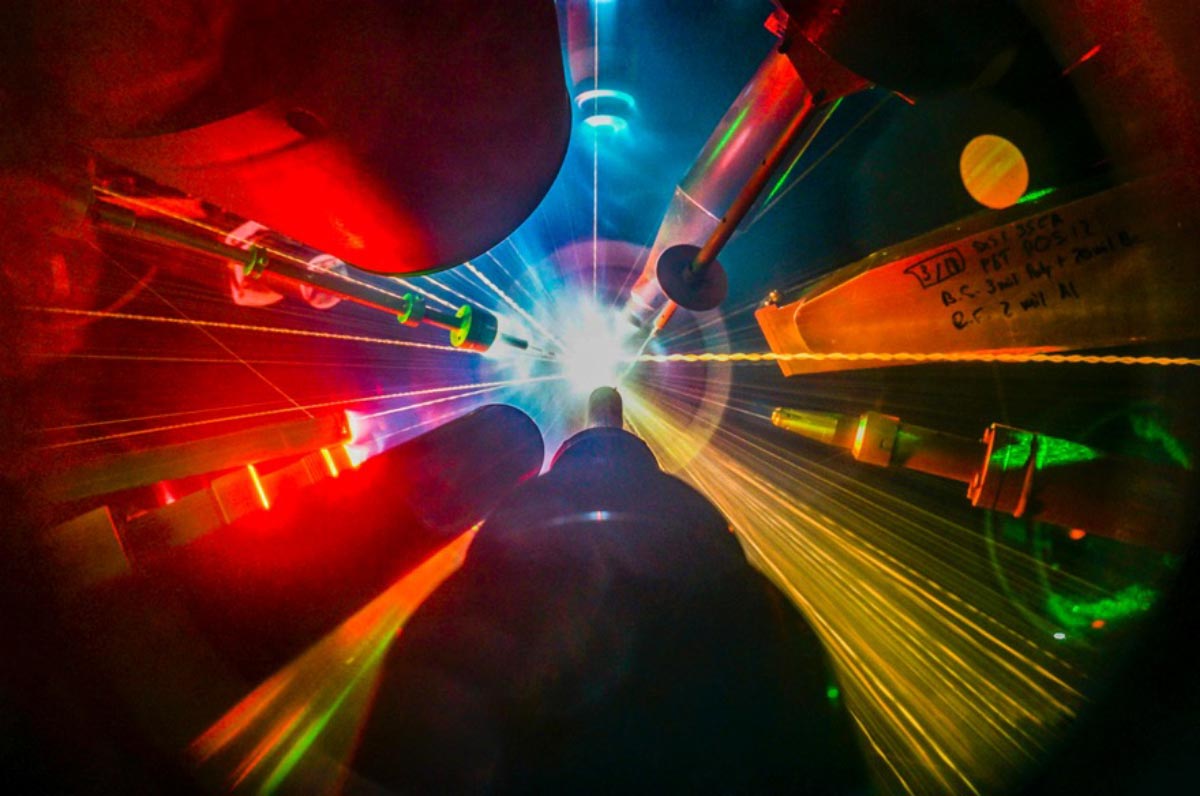
Housed at Rochester, the IFE-COLoR hub brings together experts from LLE, the University of California–Los Angeles, the University of Nebraska–Lincoln, and the private sector, including Ergodic and Xcimer Energy Corporation. The hub’s coordinated efforts and expertise will focus on determining the scientific and technological underpinnings for a broad-bandwidth, direct-drive IFE laser system—one that could pave the way to building the world’s first fusion power plant.
Mitigating Laser-Plasma Instabilities
“This is an exciting opportunity that brings together an outstanding team that is pioneering the next generation of broadband lasers and laser-plasma science to mitigate laser-plasma instabilities—a step change for inertial fusion energy,” says Dustin Froula, the IFE-COLoR principal investigator and the division director of plasma and ultrafast laser science and engineering at LLE.
Fusion energy has the potential to provide an abundant, affordable, and clean energy supply. Yet harnessing fusion, which fuels the sun and other stars, in a reproducible efficient way remains a scientific and technical challenge.
One of the specific challenges for developing an IFE system is efficiently coupling energy from the laser driver onto the fusion target. The IFE-COLoR hub aims to directly address the main obstacle to achieving efficient laser coupling: laser-plasma instabilities at IFE conditions. These laser-plasma instabilities have plagued inertial confinement fusion drivers since the 1960s. The IFE-COLoR team’s approach builds on recent advancements in broadband laser technologies developed for short-pulse lasers to deliver a novel broadband long-pulse laser that is predicted to mitigate laser-plasma instabilities. Doing so successfully will enable more than 90 percent of the laser energy to be coupled with the implosion, creating a practical and economic laser-driven IFE system.
To demonstrate the science of this new approach, the IFE-COLoR hub will couple state-of-the-art laser technologies developed by LLE into the new Fourth Generation Laser for Ultrabroadband eXperiments (FLUX) with advanced laser-plasma instability modeling and experiments guided by experimentally tested hydrodynamic simulations.
“From the initial experiments, scientists have wanted to use lasers with lots of colors (i.e., a large bandwidth) to mitigate laser-plasma instabilities,” says Froula. “It has taken more than fifty years to develop the technologies and science that will enable experiments to demonstrate the laser-plasma science that will underpin a future direct-drive inertial fusion energy system.”
The Future Inertial Fusion Energy Ecosystem
For laser-driven IFE to become a reality, a dedicated workforce will need to be educated, trained, and supported over the next decade. The LLE is positioned to steward this future inertial fusion energy ecosystem, at Rochester and beyond.
LLE operates the Omega Laser Facility, the largest laser in the world at an academic institution, under a recently renewed cooperative agreement with the National Nuclear Security Administration. It is the only facility focused on direct-drive inertial confinement fusion, with more than five decades of advancing frontier science and technology while fostering generations of workforce. As a result, LLE has the framework for integrated research, operational excellence, and advanced workforce and educational opportunities. The scientific innovations associated with the hub will advance inertial fusion energy while providing mission-critical workforce development for the nation.
Education outreach is another critical aspect of the new hub’s mission, according to Froula. Building on LLE’s current array of education programs for students, IFE-COLoR will support a new annual, 10-week-long IFE Summer Undergraduate Research Program at LLE for 15 undergraduate students from across the country.
Government officials have expressed their support for the inertial fusion energy hub at Rochester:
US Senator Charles Schumer: “The University of Rochester’s Lab for Laser Energetics, fueled by its 400 Rochester workers, has long been on the cutting edge of energy, science and technology. Just last year scientists at the Lawrence Livermore National Laboratory, supported by Rochester’s LLE, produced a nuclear fusion reaction with a net energy gain—a major milestone in the fight against climate change and creating cheap, clean power. That’s why I’ve always fought to secure funding for the lab and its innovative scientists and students as they work to advance the future of clean energy. As one of only three such hubs in the nation, this funding from the US Department of Energy guarantees that Rochester’s LLE will lead the way toward a future no longer reliant on fossil fuels and ensures they can continue their vital work for years to come.”
US Senator Kirsten Gillibrand: “Congratulations to the University of Rochester for this prestigious award from the DOE. This investment from DOE and siting this national hub in New York recognizes the University’s leadership and the innovative research occurring at the Laboratory for Laser Energetics. With continued support and development, LLE can lead and build on important discoveries for fusion energy, and potential clean energy applications.”
Congressman Joe Morelle: “Congratulations to the University of Rochester on receiving this funding award to support inertial fusion energy research. By making federal investments in research and development, we are unlocking the next generation of clean, safe, and carbon-free energy. I’m incredibly grateful to Secretary Granholm and the Department of Energy for recognizing the University’s leading-edge capability in this emerging field and commend their decision to invest in our community’s scientific excellence.”
Empire State Development President, CEO, and Commissioner Hope Knight: “Congratulations to the University of Rochester’s Laboratory for Laser Energetics for securing this important federal funding, which reflects the U of R’s global reputation as a leader in forward-thinking discoveries. Coupled with Governor Hochul’s continued commitment to cutting-edge R&D investment and New York State’s laser-focused energy efforts, this support will lead to next-generation industry applications that spur economic growth.”
NYSERDA President and CEO Doreen M. Harris: “NYSERDA congratulates the University of Rochester and its Laboratory for Laser Energetics for, once again, demonstrating national leadership in advancing fusion energy and being chosen to lead this dynamic and promising IFE-COLoR hub. It is strong leadership, combined with expertise and determination, that has already lead to many successes for the LLE and I am excited to see the many more that will come as a result of this innovative collaboration.”
About the University’s Laser Lab
LLE was established at the University in 1970 and is the largest US Department of Energy university-based research program in the nation. LLE is principally supported by the National Nuclear Security Administration as an integral part of its Stockpile Stewardship Program. This new award from DOE FES builds on LLE’s expertise, as well as previous support from DOE FES, including LaserNetUS, and ARPA-E to advance science and technology relevant to fusion energy. The LLE also has received support from the New York State Energy Research and Development Authority (NYSERDA) and, currently, from Empire State Development.
As a center for the investigation of the interaction of intense radiation with matter, LLE is a unique national resource for research and education in science and technology. Current research includes exploring fusion as a future energy source, developing new laser and materials technologies, and better understanding high-energy-density phenomena. In addition to its vital roles in various areas of scientific research and its support of the local high-tech economy, LLE plays an important role in educating the next generation of scientists and engineers.
Never miss a breakthrough: Join the SciTechDaily newsletter.
Follow us on Google and Google News.
3 Comments
According to topological vortex gravitational field theory, the force of the sun’s spin is the main factor driving its evolution. Topological vortices are nodes of communication between humans and nature. Radioactive elements are topological nodes with high activity in the microscopic world. Constructing a reasonable topological structure with radioactive elements as nodes is more likely to be the direction of future energy for humanity society.
Wishing you all success.
Fusion power is viable source from what elements or stars?
Scientific research guided by correct theories will give you answers.
Science cannot be achieved overnight. It’s even less likely to sit back and enjoy the benefits.
Wishing you success.