
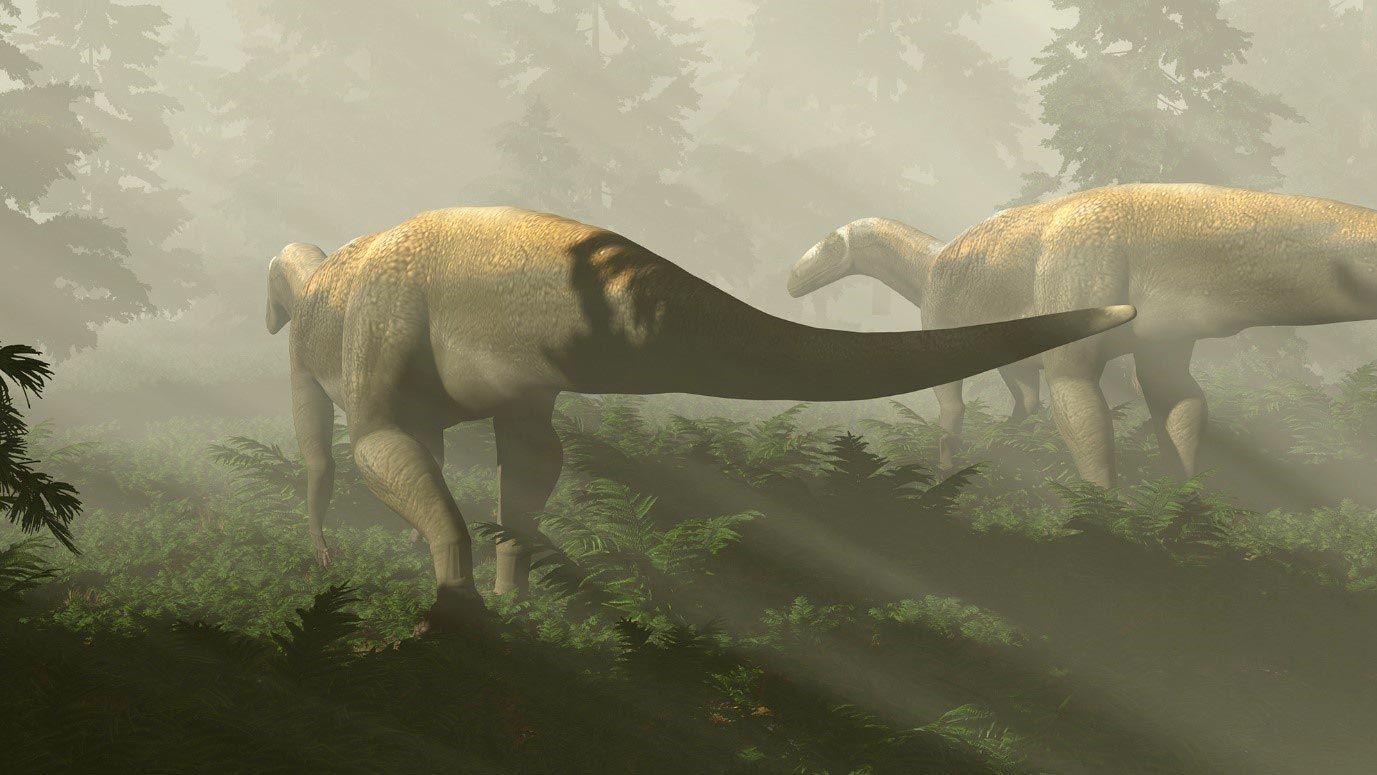
“Raptor-like” dinosaur discovered in an Australian mine, actually uncovered as a timid vegetarian.
50-year-old findings of the Triassic period’s “largest meat-eating dinosaur” reanalyzed as the long-necked herbivore Prosauropod.
Fossil footprints found in an Australian coal mine around 50 years ago have long been thought to be that of a large ‘raptor-like’ predatory dinosaur, but scientists have in fact discovered they were instead left by a timid long-necked herbivore.
University of Queensland paleontologist Dr. Anthony Romilio recently led an international team to re-analyze the footprints, dated to the latter part of the Triassic Period, around 220 million years ago.
“For years it’s been believed that these tracks were made by a massive theropod predator that was part of the dinosaur family Eubrontes, with legs over two meters (6.6 feet) tall,” Dr. Romilio said.
“This idea caused a sensation decades ago because no other meat-eating dinosaur in the world approached that size during the Triassic period.”
However, findings made by a team of international researchers, published today in the peer-reviewed journal Historical Biology, in fact, show the tracks were instead made by a dinosaur known as a Prosauropod – a vegetarian dinosaur that was smaller, with legs about 1.4 meters (4.6 feet) tall and a body length of six meters (20 feet).
Reassessing Old Evidence With New Technology
The research team suspected there was something not quite right with the original size estimates and there was a good reason for their doubts.
“Unfortunately, most earlier researchers could not directly access the footprint specimen for their study, instead relying on old drawings and photographs that lacked detail,” Dr. Romilio said.
The dinosaur fossils were discovered more than half a century ago around 200 meters (660 feet) deep underground at an Ipswich coal mine, just west of Brisbane.
“It must have been quite a sight for the first miners in the 1960s to see big bird-like footprints jutting down from the ceiling,” Dr. Romilio said.
Why the Tracks Appear Upside-Down
Hendrik Klein, co-author and fossil expert from Saurierwelt Paläontologisches Museum in Germany, said the footprints – referred to as ‘Evazoum’, scientifically, the footprint type made by prosauropod dinosaurs – were made on the water-sodden layers of ancient plant debris with the tracks later in-filled by silt and sand.
“This explains why today they occur in an upside-down position right above our heads,” Mr. Klein said.
“After millions of years, the plant material turned into coal which was extracted by the miners to reveal a ceiling of siltstone and sandstone, complete with the natural casts of dinosaur footprints.”
The mine has long since closed, but fortunately, in 1964, geologists and the Queensland Museum mapped the trackway and made plaster casts, now used in current research.
“We made a virtual 3D model of the dinosaur footprint that was emailed to team members across the world to study,” Mr. Klein said.
Virtual 3D Models Reveal a Plant-Eating Dinosaur
“The more we looked at the footprint and toe impression shapes and proportions, the less they resembled tracks made by predatory dinosaurs – this monster dinosaur was definitely a much friendlier plant-eater.
“This is still a significant discovery even if it isn’t a scary Triassic carnivore.
“This is the earliest evidence we have for this type of dinosaur in Australia, marking a 50-million-year gap before the first quadrupedal sauropod fossils known.”
The dinosaur footprint is on display at the Queensland Museum, Brisbane.
The 3D model of the dinosaur footprint can be viewed from MorphoSource.
Reference: “Saurischian dinosaur tracks from the Upper Triassic of southern Queensland: possible evidence for Australia’s earliest sauropodomorph trackmaker” by Anthony Romilio, Hendrik Klein, Andréas Jannel and Steven W. Salisbury, 16 October 2021, Historical Biology.
DOI: 10.1080/08912963.2021.1984447
Never miss a breakthrough: Join the SciTechDaily newsletter.
Follow us on Google and Google News.