
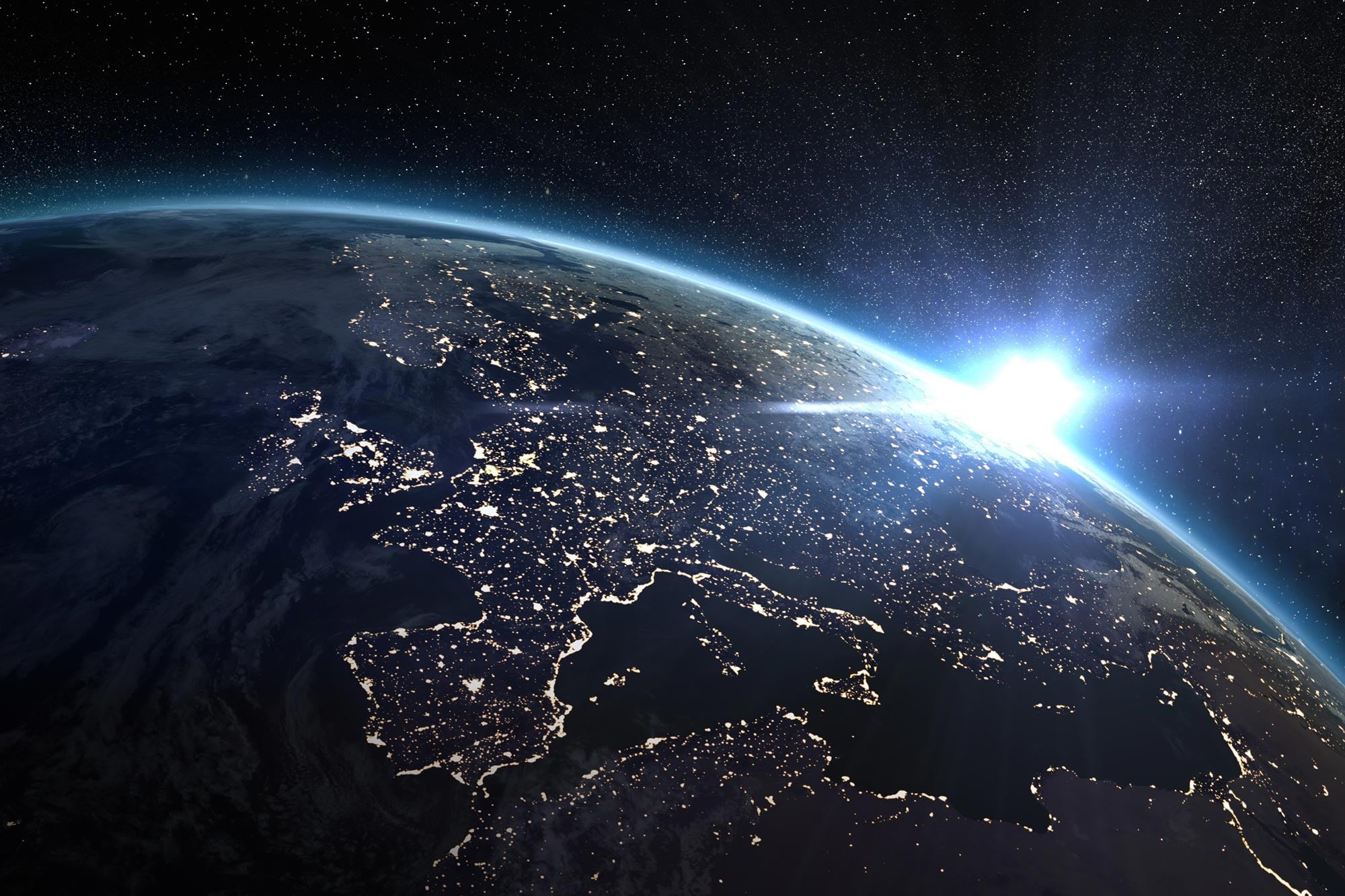
Satellite observations reveal that global nighttime lighting is steadily rising, though the trend varies widely by region, with some areas brightening rapidly while others dim.
An analysis of data from the VIIRS Day/Night Band satellite instrument, covering 2014 through 2022, shows that artificial lighting at night is increasing worldwide by about 2 percent each year.
“Although there has been a total increase of 16 percent worldwide, that does not mean that lighting is increasing everywhere,” explained Christopher Kyba. “In areas where lighting increased, we found global emissions rose by 34 percent. This was offset by an 18 percent decrease in emissions from other areas.”
The study reveals that changes in nighttime lighting vary widely by location and are more dynamic than previously thought. China and India grew significantly brighter during this period due to urban expansion, while many industrialized countries saw declines in measured emissions, often linked to a shift toward LED lighting and policies aimed at reducing light pollution.
Ukraine experienced a sharp drop in lighting following the Russian invasion. France also saw a notable decrease (down 33 percent), as many cities turn off streetlights after midnight to conserve energy and limit light pollution.
“In Germany, light emissions remained almost constant overall despite local variations,” Kyba reports. “While light emissions rose by 8.9 percent in brightening German regions, they fell by 9.2 percent in dimming areas.”
Across Europe, satellite measurements show an overall 4 percent decline in nighttime light. However, this modest drop may not match what people perceive, since the satellite’s sensitivity differs from human vision.
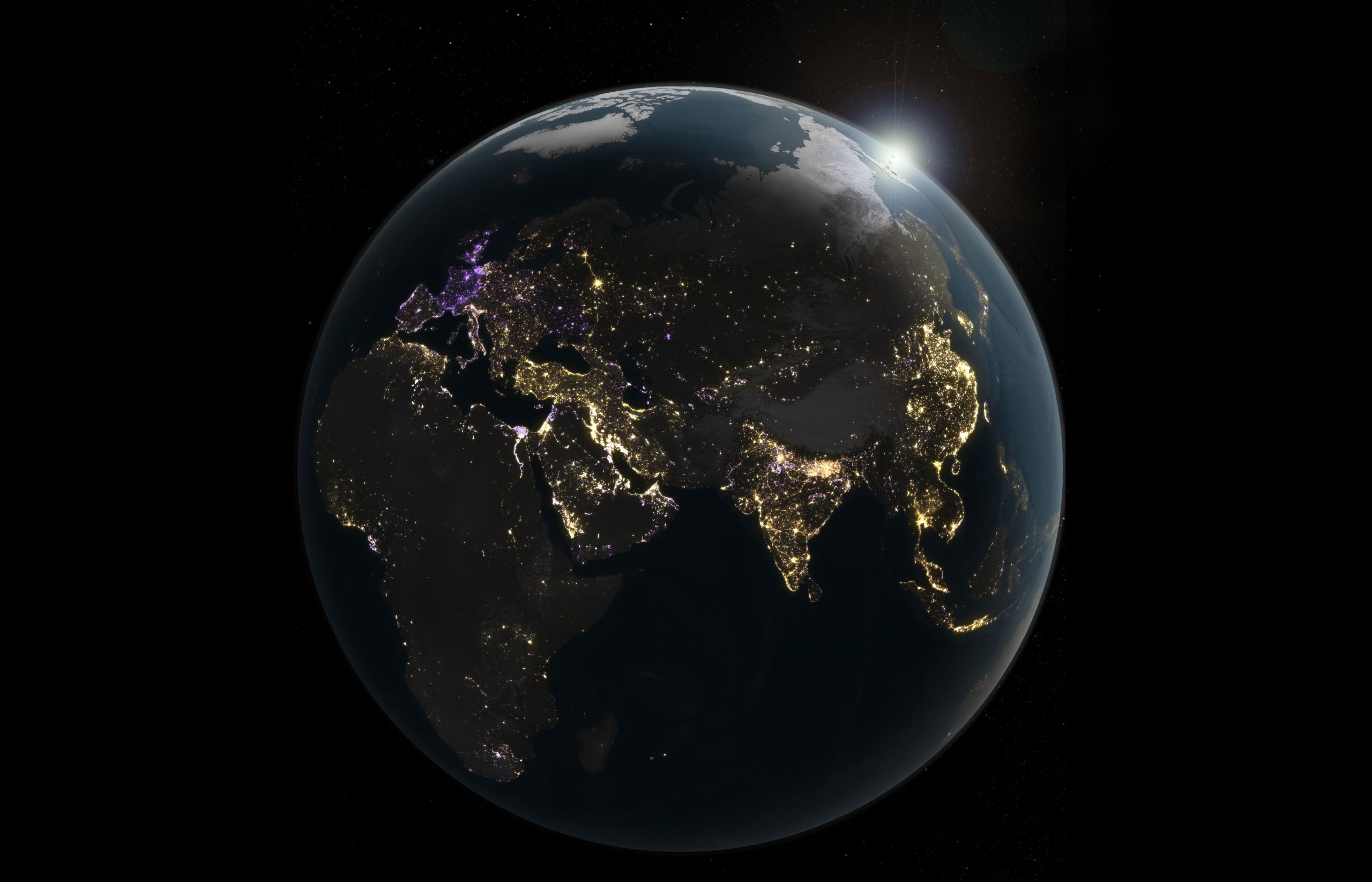
First global analysis at full resolution
These results were made possible by examining data collected each night. Earlier studies relied on monthly or yearly averages, which made it harder to capture subtle changes due to limitations in the instruments.
“Until now, no global analysis had been conducted using the full-resolution nighttime data,” Kyba emphasizes.
The researchers also applied an algorithm that accounts for the satellite’s viewing angle. Residential areas tend to appear brighter when seen from an angle rather than from directly overhead, while the opposite is often true in dense urban centers. This new method corrects for those differences for the first time.
The Satellite
The study used data from the Visible Infrared Imaging Radiometer Suite (VIIRS) Day/Night Band (DNB) instrument on the Suomi NPP, NOAA-20, and NOAA-21 satellites, operated by NOAA and NASA.
These satellites collect data after midnight, usually between 1:00 a.m. and 4:00 a.m. local time, and scan nearly the entire Earth each night, from 70° North to 60° South. Each pixel represents an area of about 0.5 square kilometers (about 0.19 square miles). The analysis focused only on artificial lighting, excluding natural sources such as wildfires and auroras.
A new satellite for Europe
“Artificial light is a major consumer of electricity at night, and light pollution harms ecosystems,” says Christopher Kyba. “It is therefore important to understand how both of these are changing.”
Kyba is leading a proposal for a next-generation satellite to monitor nighttime lighting as part of the European Space Agency’s “Earth Explorer 13” mission. This instrument would detect much fainter light than current systems and provide higher resolution data, helping reduce uncertainty about what is changing and where.
“While the U.S. and China each have multiple satellites that observe nighttime light, there is currently no European satellite designed for this purpose,” says Kyba.
Reference: “Satellite imagery reveals increasing volatility in human night-time activity” by Tian Li, Zhuosen Wang, Christopher C. M. Kyba, Miguel O. Román, Karen C. Seto, Yun Yang, Shi Qiu, Theres Kuester, Michail Fragkias, Xiang Chen, Thomas H. Meyer, Chadwick D. Rittenhouse, Xiaonan Tai, Mari Cullerton, Falu Hong, Ashley Grinstead, Kexin Song, Ji Won Suh, Xiucheng Yang, Virginia L. Kalb, Chengbin Deng and Zhe Zhu, 8 April 2026, Nature.
DOI: 10.1038/s41586-026-10260-w
Never miss a breakthrough: Join the SciTechDaily newsletter.
Follow us on Google and Google News.