
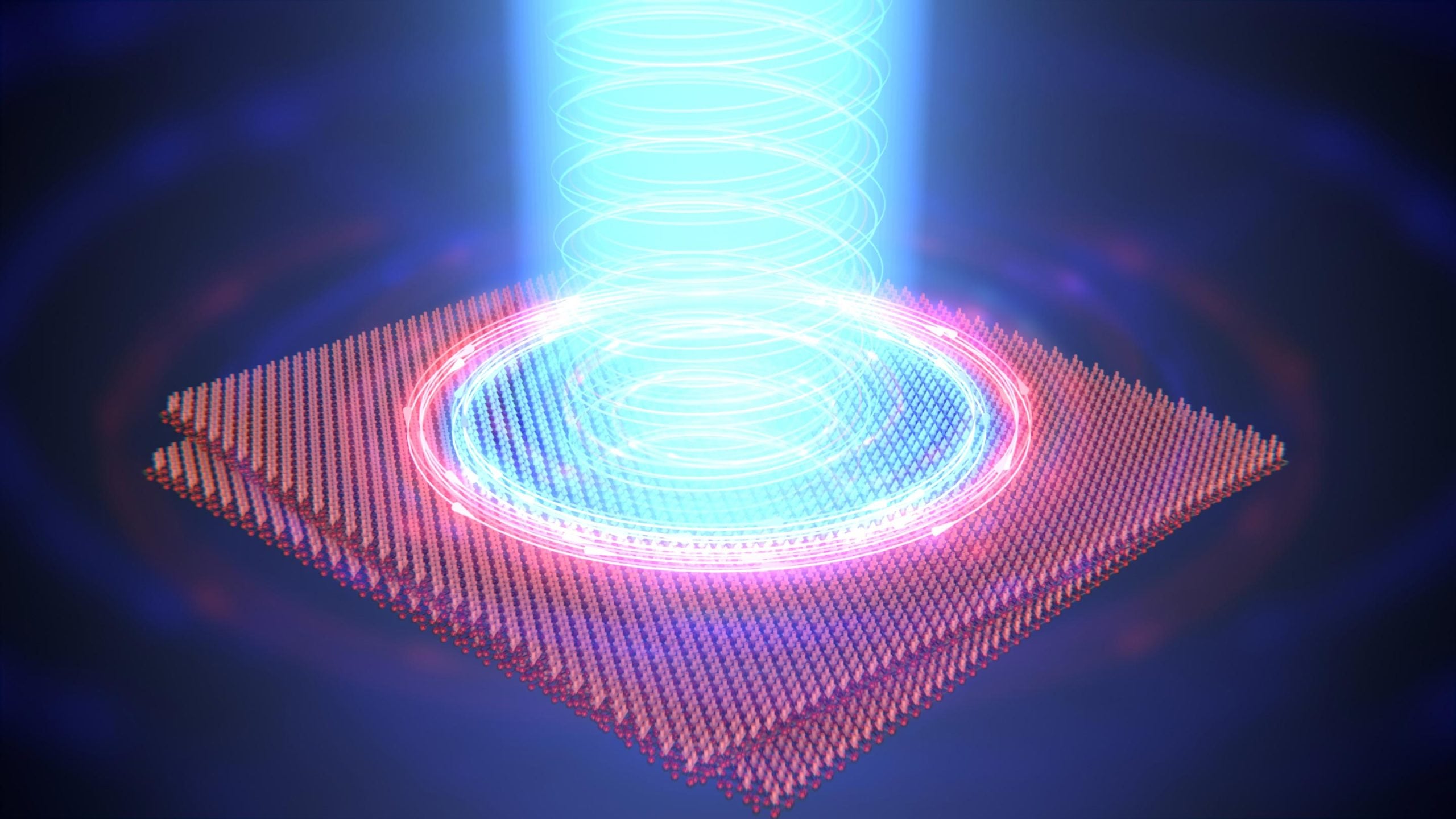
Scientists have demonstrated that light alone can reversibly control magnetism in a topological material.
Researchers at the University of Basel and ETH Zurich have found a way to flip the magnetic polarity of an unusual ferromagnet using a laser beam. If the approach can be refined and scaled, it points toward electronic components that could be reconfigured with light instead of being permanently fixed.
A ferromagnet acts like it has a built-in internal agreement. Inside the material, enormous numbers of electrons behave like tiny bar magnets because of their spins. When those spins line up, their individual magnetic fields add together, producing the familiar strength that makes a compass needle settle in a direction or lets a refrigerator magnet cling to a door.
That orderly alignment is not automatic, because heat constantly shakes the system. Ferromagnetism appears only when the interactions that encourage alignment win out over thermal motion, which happens below a critical temperature (often called the Curie temperature).
The usual way to reverse magnetism
Most methods for switching a ferromagnet’s polarity rely on heating. By raising the material above its critical temperature, the organized alignment breaks down and the spins can rearrange. When the system cools, the spins can “freeze” into a new collective direction, leaving the magnet reversed.
In the new work, the team led by Prof. Dr. Tomasz Smoleński at the University of Basel and Prof. Dr. Ataç Imamoğlu at ETH Zurich achieved that reorientation using light alone, without heating, and reported the results in Nature.
Interactions and topology
The experiment relied on a carefully engineered structure: two wafer thin layers of the organic semiconductor molybdenum ditelluride, stacked with a slight twist between them. Twisted layered materials are known for producing unusual electronic behavior because the small mismatch between layers can reshape how electrons move and interact.
This is where topology comes in. Topological states are often explained through simple shapes: a ball (no hole) versus a doughnut (one hole). A key idea is that you cannot smoothly deform one into the other, so these states are distinct and robust once established.
In the experiments co supervised by Smoleński and Imamoğlu, the researchers could tune the electrons between topological insulating states and conducting metallic states. In both cases, electron interactions pushed the spins to align in parallel, which turned the system into a ferromagnet.
“What’s exciting about our work is that we combine the three big topics in modern condensed matter physics in a single experiment: strong interactions between the electrons, topology and dynamical control,” Imamoğlu says. To achieve this, the researchers used a special material consisting of two wafer-thin layers of the organic semiconductor molybdenum ditelluride, which are slightly twisted with respect to each other.
“Our main result is that we can use a laser pulse to change the collective orientation of the spins,” says Olivier Huber, a PhD student at ETH, who carried out the experiments together with his colleague Kilian Kuhlbrodt and Tomasz Smoleński. A few years ago, this had already been done for single electrons, but now the “switching” or change of polarity of the entire ferromagnet was achieved. “This switching was permanent and, moreover, the topology influences the switching dynamics,” says Smoleński.
In other words, the result is not just that light can trigger a flip. The way the flip unfolds is tied to whether the electrons are in a topological insulating state or a metallic conducting one, linking magnetism and topology in a single controllable platform.
Dynamical control of the ferromagnet
In this way, the laser pulse can also be used to draw new boundary lines, inside of which the topological ferromagnetic state is located. This can be done repeatedly, so that a dynamical control of the topological and ferromagnetic properties is possible. To show that the tiny ferromagnet, which is only a few micrometers in size, had actually changed its polarity, the researchers measured the reflection of a second, much weaker laser beam. This reflection revealed the orientation of the electron spins.
“In the future, we will be able to use our method to optically write arbitrary and adaptable topological circuits on a chip,” says Smoleński. This approach could then be used to create tiny interferometers, with which extremely small electromagnetic fields can be measured.
Reference: “Optical control over topological Chern number in moiré materials” by O. Huber, K. Kuhlbrodt, E. Anderson, W. Li, K. Watanabe, T. Taniguchi, M. Kroner, X. Xu, A. Imamoğlu and T. Smoleński, 28 January 2026, Nature.
DOI: 10.1038/s41586-025-09851-w
Never miss a breakthrough: Join the SciTechDaily newsletter.
Follow us on Google and Google News.
1 Comment
Scientists have demonstrated that light alone can reversibly control magnetism in a topological material.
VERY GOOD!
Based on topological vortex theory (TVT), laser manipulation can solve many problems, including simulating nuclear fusion and optimizing certain functions of particle accelerators.