
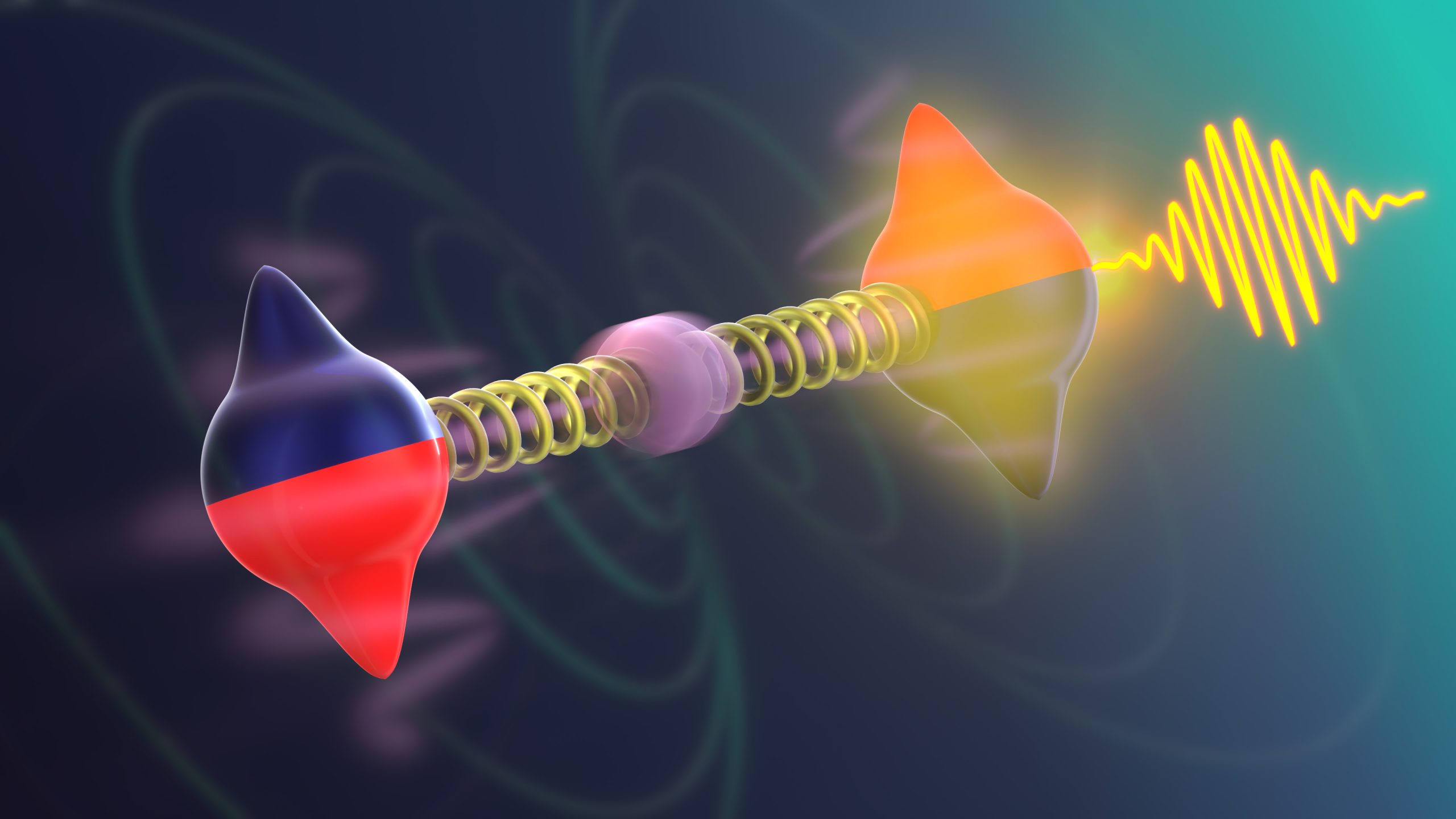
The team has discovered a Magnon-phonon Fermi resonance in an antiferromagnet.
A significant challenge in modern data processing technology is the slow and energy-intensive nature of data storage. It’s projected that data storage centers will soon account for nearly 10 percent of global energy consumption. This rise is partly driven by the inherent limitations of the materials currently used, such as ferromagnets. As a result, there is a growing pursuit of faster, more energy-efficient alternatives.
One of the most encouraging pathways are antiferromagnets – materials that not only promise more robust and 1.000 times faster read and write operations but also are more abundant than their ferromagnetic counterparts. Understanding and control of these quantum materials is key to advancing future technologies. An international research team now reports on a major step forward in this endeavor, as the scientists report in the journal Nature Communications.
Interaction between spins and the crystal lattice of a material is essential in spintronic applications, as they use spin – the electron´s magnetic moment – to write information in magnetic bits. In ferromagnetic materials, these spins interact strongly, creating a ripple effect known as a spin wave, which can travel through the material. Spin waves are exciting because they can carry information without moving electrons, unlike the electric currents in today’s computer chips, which means less heat is produced. And just as light can be thought of as quantized particles called photons, spin waves have their own quasiparticles called magnons. On the other hand, when atoms in a material´s lattice vibrate uniformly, this motion is described by quasiparticles called phonons.
The team’s research focused on the antiferromagnetic material cobalt difluoride (CoF2) where magnons and phonons coexist. In this material, neighboring spins are aligned antiparallel, allowing for spin dynamics a thousand times faster than in conventional ferromagnetic materials. This advancement could lead to faster and more energy-efficient data bit writing. Scientists excite these spin dynamics by coupling them with light pulses at terahertz frequencies.
In addition, the so-called Fermi resonance, first described almost a century ago in carbon dioxide, occurs at the atomic and molecular level when two vibrational modes caused by the absorption of thermal energy interact and one is twice the frequency of the other. The principle of Fermi resonance has so far been extended to magnonic or phononic systems. In this work however, scientists achieve for the first time a strong coupling between the spin and the crystal lattice which constitutes a mutual energy transfer between these subsystems of an antiferromagnetically ordered material.
Magnons and phonon in sync
In this project, experimental and theoretical condensed matter scientists from the Institute for Molecules and Materials (IMM) of Radboud University, the Helmholtz-Zentrum Dresden-Rossendorf (HZDR), University of Cologne, and the Ioffe Institute, revealed a novel energy transfer channel between magnons and phonons in an antiferromagnet under the condition of Fermi resonance.
This may enable future control of such antiferromagnetic systems for faster and more energy-efficient data storage. Using the intense and spectrally bright accelerator-based superradiant THz source at HZDR’s ELBE Center for High-Power Radiation Sources, the researchers selectively excited the antiferromagnetic spin resonance and tuned its center frequency by high external magnetic field up to several Tesla. This configuration allowed them to tune the spin resonance frequencies to half the lattice vibration frequency fulfilling the Fermi resonance condition.
The researchers found a new regime of coupled magnon-phonon dynamics that allows energy exchange between these two subsystems at the Fermi resonance. By tuning the frequencies of the magnons, the researchers can control this process and in particular enhance the magnon-phonon coupling. This new regime was observed as a broadening of the phonon spectra and an asymmetric redistribution of the phonon spectral weight. Ultimately, their results suggest a hybridized two-magnon-one-phonon state. Their work could prove important in the fields of magnonics and phononics where coherent energy control plays a central role.
Innovative functionalities in future data storage
The research results offer a pathway to manipulate spin-lattice coupling on demand. Firstly, this allows for a considerable increase in operational frequency from the conventional GHz rate offered by ferromagnetic materials up to the THz scale in antiferromagnetic materials. Secondly, this might significantly enhance the efficiency of magnetic writing, which, in turn, will reduce the minimal amount of energy required for bit writing operations, thereby considerably lowering total energy consumption.
Therefore, the results propose an innovative way to control the dynamics of antiferromagnets, leading to conceptually new data storage technologies based on such materials. In future studies, the research team aims to explore if the condition of Fermi resonance can be expanded to control other novel quantum materials, potentially leading to advancing material science and technology.
Reference: “Magnon-phonon Fermi resonance in antiferromagnetic CoF2” by Thomas W. J. Metzger, Kirill A. Grishunin, Chris Reinhoffer, Roman M. Dubrovin, Atiqa Arshad, Igor Ilyakov, Thales V. A. G. de Oliveira, Alexey Ponomaryov, Jan-Christoph Deinert, Sergey Kovalev, Roman V. Pisarev, Mikhail I. Katsnelson, Boris A. Ivanov, Paul H. M. van Loosdrecht, Alexey V. Kimel and Evgeny A. Mashkovich, 28 June 2024, Nature Communications.
DOI: 10.1038/s41467-024-49716-w
Never miss a breakthrough: Join the SciTechDaily newsletter.
Follow us on Google and Google News.
1 Comment
Spin waves are exciting because they can carry information without moving electrons, unlike the electric currents in today’s computer chips, which means less heat is produced.
VERY GOOD.
The universe does not write algebra, formulas, or fractions. The universe is a superposition, deflection, and entanglement of geometric shapes, is a synchronous effect of countless topological vortices and their fractal structures. Topological vortex researches help to deepen scientific knowledge and improve scientific methods ( https://scitechdaily.com/microscope-spacecrafts-most-precise-test-of-key-component-of-the-theory-of-general-relativity/#comment-858570 ).