
Close Menu
    Facebook X (Twitter) Instagram
    SciTechDaily
    • Biology
    • Chemistry
    • Earth
    • Health
    • Physics
    • Science
    • Space
    • Technology
    Facebook X (Twitter) Pinterest YouTube RSS
    SciTechDaily
    Home»Biology»“Laser View” Into the Avocado: New Method Exposes Cellular Secrets
    Biology

    “Laser View” Into the Avocado: New Method Exposes Cellular Secrets

    By University of GöttingenAugust 6, 2024No Comments3 Mins Read
    Facebook Twitter Pinterest Telegram LinkedIn WhatsApp Email Reddit
    Share
    Facebook Twitter LinkedIn Pinterest Telegram Email Reddit
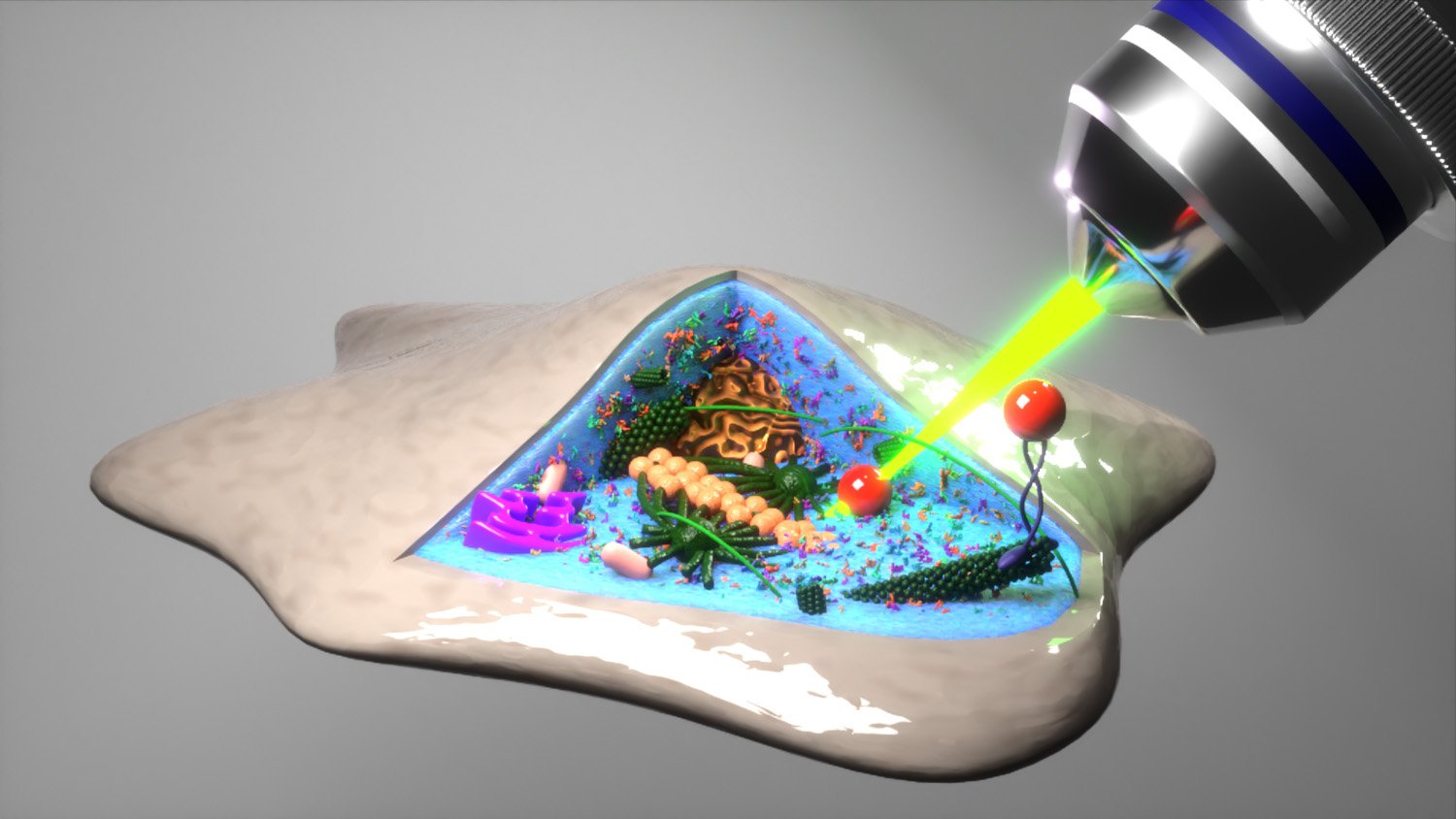
    View Into the Cell Using an Optical Laser Trap
    A view into the cell using an optical laser trap: it localizes microscopic particles in order to draw conclusions about their random trembling movement. A new approach developed by the Göttingen researchers makes it possible to deduce from these movements how hard, soft or liquid the inside of the cell is. Credit: Till Moritz Münker

    A research team at the University of Göttingen has developed a method for recognizing cell properties.

    Checking whether an avocado is hard or soft by looking at it? This would require recognizing how the plant cells behave behind the skin. The same applies to all other cells on our planet: Despite more than 100 years of intensive research, many of their properties remain hidden inside the cell. Researchers at the University of Göttingen describe in their recent publication in Nature Materials a new approach that can determine the particularly difficult-to-detect mechanical properties of the cell interior by taking a closer look.

    Cells are the basic units of all life and their precise understanding is a key factor in the progress made in medicine and biology. Nevertheless, research on them is still challenging because many methods destroy the cell during analysis. Researchers at the University of Göttingen now pursued a new idea: they used the random fluctuating movement that all microscopic particles perform. To do this, they first simulated the expected fluctuations and then checked the predictions using optical laser traps that can precisely control microparticles.

    Using this approach, the research team was able to analyze the movement of microscopic particles – with precision in the nanometer range and a time resolution of around 50 microseconds. In addition, the analysis also takes into account the history, i.e. past movements. It turned out that many objects always want to return to a certain place after having moved away randomly. The researchers used this tendency to return to a previous position to define a new quantification, the so-called mean back relaxation (MBR).

    Introducing Mean Back Relaxation (MBR)

    This new variable now serves as a kind of fingerprint: it contains information about the causes of the observed movements. This makes it possible for the first time to distinguish active processes from purely temperature-dependent processes (Brownian motion). “With MBR, we can obtain more information from the object movements than is possible with the usual approaches,” explains Professor Matthias Krüger from the Institute of Theoretical Physics at the University of Göttingen.

    In order to make statements about living cells, the researchers applied the method to the inside of living cells. “As our knowledge of the inside of cells is still limited, it was initially unclear whether the MBR could also be used here. When I saw the resulting curves, I could hardly believe my eyes, because the inside of cells could be described very precisely using the approaches we had originally worked out for much simpler situations,” marvels Professor Timo Betz from the Third Institute of Physics, head of the experiments.

    “The results show that the combination of a close look and new, intelligent analysis methods can provide insights into whether the inside of cells is soft, hard or liquid,” says first author of the study, Till Münker from the Third Institute of Physics. The work was co-funded by the European Union as part of an ERC Consolidator Grant.

    Reference: “Accessing activity and viscoelastic properties of artificial and living systems from passive measurement” by Till M. Muenker, Gabriel Knotz, Matthias Krüger and Timo Betz, 31 July 2024, Nature Materials.
    DOI: 10.1038/s41563-024-01957-2

    Never miss a breakthrough: Join the SciTechDaily newsletter.
    Follow us on Google and Google News.

    Biophysics Imaging Microscopy University of Göttingen
    Share. Facebook Twitter Pinterest LinkedIn Email Reddit

    Related Articles

    Researchers Unravel Long-Standing Mystery of Collagen’s Instability

    New Research Shatters Old Beliefs About Gold Nanoparticles and Cancer

    New Color-Changing Invention Enables “Time Travel” Within Cells

    DNA Repair at Light Speed: Unraveling the Mystery With TARDIS

    Researchers Develop High-Speed Super-Resolution Microscope With a Large Field of View

    Scientists Unveil Unprecedented “Live” View Into the Brain’s Complexity

    “Hightech” Materials From Nature – Researchers Discover Surprising Properties of the Cytoskeleton

    Molecular Movie Reveals How To Get Chloride Ions Into the Cell

    Laser Transformation of Crystal Structures in Super Slow Motion

    Leave A Reply Cancel Reply

    • Facebook
    • Twitter
    • Pinterest
    • YouTube

    Don't Miss a Discovery

    Subscribe for the Latest in Science & Tech!

    Trending News

    Even Occasional Binge Drinking May Triple Liver Damage Risk

    Liftoff! NASA’s Artemis II Launch Sends Astronauts Around the Moon for First Time in 50 Years

    Scientists Discover New Way To Eliminate “Zombie Cells” Driving Aging

    This New Quantum Theory Could Change Everything We Know About the Big Bang

    This One Vitamin May Help Protect Your Brain From Dementia Years Later

    Stopping Weight-Loss Drugs Like Ozempic Can Quickly Erase Heart Benefits

    A 500-Million-Year-Old Surprise Is Forcing Scientists to Rethink Spider Evolution

    Coffee and Blood Pressure: What You Need To Know Before Your Next Cup

    Follow SciTechDaily
    • Facebook
    • Twitter
    • YouTube
    • Pinterest
    • Newsletter
    • RSS
    SciTech News
    • Biology News
    • Chemistry News
    • Earth News
    • Health News
    • Physics News
    • Science News
    • Space News
    • Technology News
    Recent Posts
    • NASA Artemis II Skips Burn As Astronaut Captures Stunning View of Earth
    • NASA’s Artemis II: Humans Just Left Earth Orbit for the First Time Since 1972
    • What Causes Chronic Pain? Scientists Identify Key Culprit in the Brain
    • Semaglutide Shows Surprising Mental Health Benefits in Massive 100,000-Person Study
    • This Little-Known Japanese Fruit Could Help Stop Lung Cancer Before It Starts
    Copyright © 1998 - 2026 SciTechDaily. All Rights Reserved.
    • Science News
    • About
    • Contact
    • Editorial Board
    • Privacy Policy
    • Terms of Use

    Type above and press Enter to search. Press Esc to cancel.