

A simple method developed at KAUST uses laser beams to create graphene electrodes that have better performance than those produced through older methods.
Electrodes consisting of graphene, an atypical form of carbon, may transform the way electroactive substances are detected and measured in numerous fields ranging from food safety and clinical diagnosis to environmental monitoring1,2,3.
Graphene comprises multiple ultrathin and highly ordered sheets of interconnected honeycomb-shaped rings of carbon atoms. This multilayered architecture provides the material with exceptional electronic properties, especially electrical conductivity and electrocatalytic activity, as well as physical features that are useful for making electrochemical sensors.
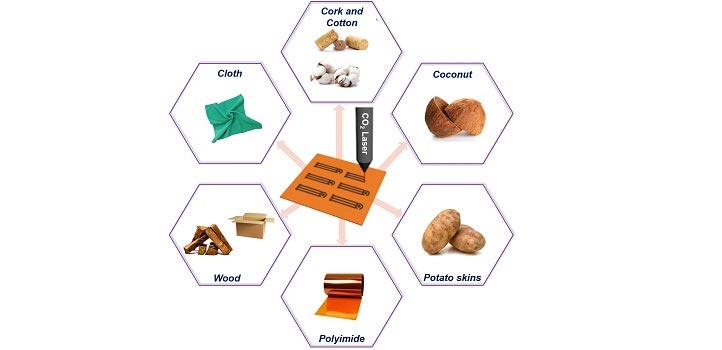
Typically, graphene electrodes are produced by peeling off individual sheets from graphite or depositing a reactive gaseous mixture of precursors onto a substrate. However, these approaches involve time-consuming, multistep synthesis and isolation processes; plus, they struggle to control stacking and oxidation of the sheets.
To improve on technically challenging and expensive approaches, researchers from Khaled Salama’s lab, in collaboration with others, developed a simple and scalable method that converts polymer or carbon precursor films into graphene electrodes using a laser beam. This mask-free method produces uniform, three-dimensional multilayered electrodes that combine high porosity and surface area, necessary for next-generation electrochemical sensor and biosensor platforms.
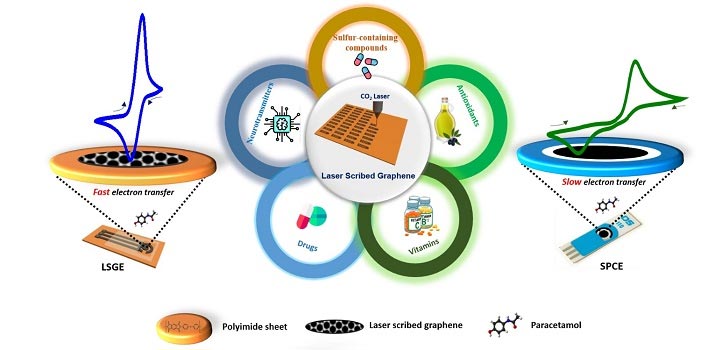
Salama’s team and collaborators from the Hassan II University of Casablanca, Morocco, incorporated laser-derived graphene (LDG) electrodes in sensing platforms for major sources of antioxidants called phenolic compounds and related electroactive biomolecules².
All tested compounds showed higher electrocatalytic activity on the graphene-based platforms than on conventional systems using carbon electrodes.
“The graphene-based platforms showed excellent performance for detecting paracetamol, a common drug,” says Abdellatif Ait Lahcen, a postdoc from Salama’s Lab. They also distinguished paracetamol in a commercially available tablet that combines the drug with the antioxidant ascorbic acid, which often produces interferences in typical electrochemical analyses.
An evaluation of the electrochemical behavior of a set of hormones and neurotransmitters called catecholamines also provided insight into the mechanisms of oxidation–reduction reactions of these compounds.
There are many electrode modification approaches that can boost sensor performance. Biological receptors, such as enzymes, nucleic acids and antibodies, provide target-specific sensors, but they require complex surface immobilization techniques.
Potential alternatives are emerging for these natural receptors. Synthetic polymers known as molecularly imprinted polymers (MIPs) are durable and easy to prepare. KAUST researchers plan to optimize the fabrication of the sensors and expand their applications to other biomolecules and disease biomarkers. “We are developing MIP-modified biomimetic sensors for the early detection of breast cancer biomarkers,” Ait Lahcen says.
The researchers modified LDG electrodes with MIPs to fabricate a cheap sensor for the detection of bisphenol A (BPA) in water and plastic samples³. The modification involved synthesizing polypyrrole under applied voltage in the presence of BPA molecules, which acted as templates and left imprints in the polymer when removed. The sensor displayed higher sensitivity and selectivity toward BPA than similar substances, such as estradiol, epinephrine and bisphenol F.
“Combining LDG electrodes with MIPs will lead to new highly sensitive and selective electrochemical sensors,” says Tutku Beduk, a Ph.D. student from Salama’s lab.
Salama believes that these MIP-based sensors will help ensure that water remains clean, pure and toxin-free.
References:
“Electrochemical sensors and biosensors using laser-derived graphene: A comprehensive review” by Abdellatif Ait Lahcen, Sakandar Rauf, Tutku Beduk, Ceren Durmus, Abdulrahman Aljedaibi, Suna Timur, Husam N. Alshareef, Aziz Amine, Otto S. Wolfbeis and Khaled N. Salama, 27 August 2020, Biosensors and Bioelectronics.
DOI: 10.1016/j.bios.2020.112565
“Laser scribed graphene: A novel platform for highly sensitive detection of electroactive biomolecules” by Abdelghani Ghanam, Abdellatif Ait Lahcen, Tutku Beduk, Husam N. Alshareef, Aziz Amine and Khaled Nabil Salama, 19 August 2020, Biosensors and Bioelectronics.
DOI: 10.1016/j.bios.2020.112509
“One-step electrosynthesized molecularly imprinted polymer on laser scribed graphene bisphenol a sensor” by Tutku Beduk, Abdellatif Ait Lahcen, Nouran Tashkandi and Khaled Nabil Salama, 11 April 2020, Sensors and Actuators B: Chemical.
DOI: 10.1016/j.snb.2020.128026
Never miss a breakthrough: Join the SciTechDaily newsletter.
Follow us on Google and Google News.