
Close Menu
    Facebook X (Twitter) Instagram
    SciTechDaily
    • Biology
    • Chemistry
    • Earth
    • Health
    • Physics
    • Science
    • Space
    • Technology
    Facebook X (Twitter) Pinterest YouTube RSS
    SciTechDaily
    Home»Earth»Lava Unleashed: Iceland’s Fiery Spectacle on the Reykjanes Peninsula
    Earth

    Lava Unleashed: Iceland’s Fiery Spectacle on the Reykjanes Peninsula

    By Lindsey Doermann, NASA Earth ObservatoryApril 9, 2024No Comments3 Mins Read
    Facebook Twitter Pinterest Telegram LinkedIn WhatsApp Email Reddit
    Share
    Facebook Twitter LinkedIn Pinterest Telegram Email Reddit
    Lava Flows Iceland March 2024 Annotated
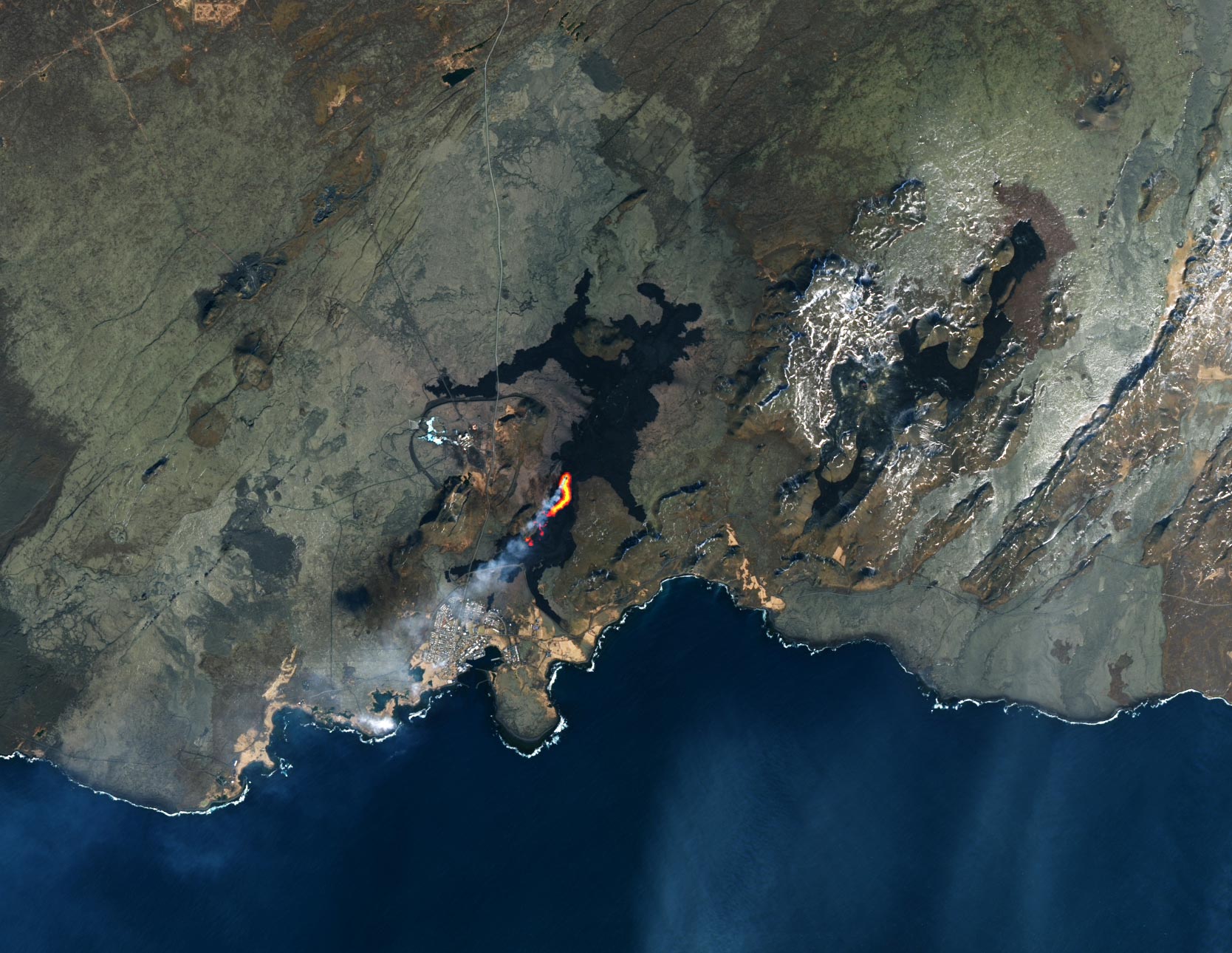
    Satellite image of the ongoing eruption on Iceland’s Reykjanes peninsula captured on March 30, 2024, by the Operational Land Imager on Landsat 8.

    The latest fissure eruption on Iceland’s Reykjanes peninsula was the largest of four recent bouts of activity near the town of Grindavík.

    Lava poured from a volcanic fissure near the town of Grindavík, Iceland, in spring 2024. The eruption, which began on March 16 and remained active over two weeks later, was the largest in a string of four volcanic events on the Reykjanes peninsula starting in December 2023.

    Landsat 8’s OLI (Operational Land Imager) captured this image of the ongoing eruption on March 30, 2024. The natural color scene is overlaid with an infrared signal to help distinguish the lava’s heat signature. The active part of the fissure and the origin of a volcanic plume are apparent. While the eruption was still active at this time, additional satellite and ground observations indicated it was likely waning.

    The eruption began at 8:23 p.m. local time on March 16, the Icelandic Met Office (IMO) reported. A fissure nearly 3 kilometers (2 miles) long quickly opened in a similar location to the February 2024 eruption. Hundreds of people at the Blue Lagoon, as well as a small number in Grindavík, were evacuated within about 30 minutes of the eruption starting.

    In the days that followed, lava flowed toward infrastructure such as water pipes and roads, the town of Grindavík, and the ocean. Human-constructed barriers of earth and rock diverted lava away from town, although a flow extended across one road. Officials were initially concerned that lava would reach the coast and cool rapidly upon contacting water. This could have posed additional hazards such as the production of hydrogen chloride gas, but the flow stopped short.
    Reykjanes Peninsula Changes 2023 2024
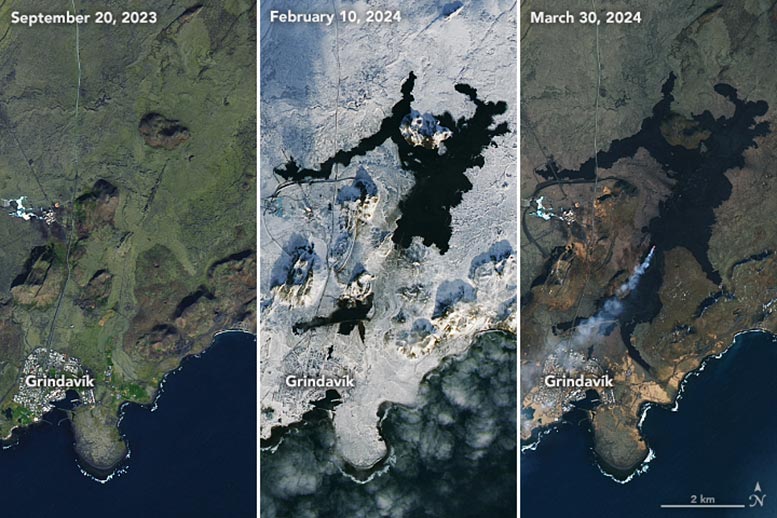
    Landsat image comparison from September 20, 2023, February 10, 2024, and March 30, 2024, shows the recent changes on the Reykjanes peninsula.

    This Landsat image comparison shows the recent changes on the Reykjanes peninsula. In September 2023 (left), the area was quiet volcanically. By February 10, 2024 (center), three separate fissure eruptions had occurred. The footprint of new basaltic rock grew in March 2024 (right) as new lava spanned nearly 6 square kilometers (2.3 square miles), according to the IMO.

    Like the eruptions that preceded it, the spring 2024 event was effusive, not explosive. Effusive eruptions tend to emit minimal ash, and their plumes typically contain water vapor, sulfur dioxide, carbon dioxide, and small amounts of other volcanic gases.

    This eruption did not disrupt air travel, but sulfur dioxide (SO2) emissions were hazardous locally at times. Workers evacuated the power plant north of Grindavík on March 18 due to gas pollution, the Icelandic National Broadcasting Service reported. The SO2 emissions from this eruption were forecast to drift across the United Kingdom and northern Europe, according to models based on satellite observations, but at an altitude too high to affect surface air quality.

    Unlike the other recent eruptions in this region, the springtime event stretched out over weeks rather than a couple of days. The reason for the relatively prolonged eruption may be that magma now has an easier path to the surface, experts suggested in news reports. Others think that magma is no longer accumulating in the shallow magma chamber beneath the area and that this eruption could be the last in the longer cycle.

    NASA Earth Observatory images by Lauren Dauphin, using Landsat data from the U.S. Geological Survey.

    Never miss a breakthrough: Join the SciTechDaily newsletter.
    Follow us on Google and Google News.

    NASA NASA Earth Observatory Popular Volcano
    Share. Facebook Twitter Pinterest LinkedIn Email Reddit

    Related Articles

    Massive Tonga Volcano Plume Reached the Mesosphere – 36 Miles Into the Atmosphere

    Island Obliterated: Dramatic Changes at Hunga Tonga-Hunga Ha’apai

    Hunga Tonga Island Obliterated – NASA Satellites Capture Massive Blast

    A Wolf Awakens in the Galápagos Islands at Night

    Mount Michael, Volcano Track or Plume? 1,000-Meter-Tall Active Stratovolcano Puts On a Show

    Volcanic Eruption Continues at La Palma – Effects Being Felt From Above and Below

    “Smoking Mountain” – An Outburst From Popocatépetl Volcano in Mexico

    Young Volcanic Island Nishinoshima Belches Ash and Lava As It Grows in the Pacific

    Unusual “Volcano Track” Clouds Investigated

    Leave A Reply Cancel Reply

    • Facebook
    • Twitter
    • Pinterest
    • YouTube

    Don't Miss a Discovery

    Subscribe for the Latest in Science & Tech!

    Trending News

    The Universe Is Expanding Too Fast and Scientists Can’t Explain Why

    “Like Liquid Metal”: Scientists Create Strange Shape-Shifting Material

    Early Warning Signals of Esophageal Cancer May Be Hiding in Plain Sight

    Common Blood Pressure Drug Shows Surprising Power Against Deadly Antibiotic-Resistant Superbug

    Scientists Uncover Dangerous Connection Between Serotonin and Heart Valve Disease

    Scientists Discover a “Protector” Protein That Could Help Reverse Hair Loss

    Bone-Strengthening Discovery Could Reverse Osteoporosis

    Scientists Uncover Hidden Trigger Behind Stem Cell Aging

    Follow SciTechDaily
    • Facebook
    • Twitter
    • YouTube
    • Pinterest
    • Newsletter
    • RSS
    SciTech News
    • Biology News
    • Chemistry News
    • Earth News
    • Health News
    • Physics News
    • Science News
    • Space News
    • Technology News
    Recent Posts
    • Scientists Overcome Major Quantum Bottleneck, Potentially Transforming Teleportation and Computing
    • Quantum Physics’ Strangest Problem May Hold the Key to Time Itself
    • Scientists Create “Liquid Gears” That Spin Without Touching
    • The Simple Habit That Could Help Prevent Cancer
    • Forgotten Medicinal Plant Shows Promise in Fighting Dangerous Superbugs
    Copyright © 1998 - 2026 SciTechDaily. All Rights Reserved.
    • Science News
    • About
    • Contact
    • Editorial Board
    • Privacy Policy
    • Terms of Use

    Type above and press Enter to search. Press Esc to cancel.