
Close Menu
    Facebook X (Twitter) Instagram
    SciTechDaily
    • Biology
    • Chemistry
    • Earth
    • Health
    • Physics
    • Science
    • Space
    • Technology
    Facebook X (Twitter) Pinterest YouTube RSS
    SciTechDaily
    Home»Physics»Life’s Building Blocks May Not Have Originated on This Planet
    Physics

    Life’s Building Blocks May Not Have Originated on This Planet

    By Hokkaido UniversitySeptember 28, 2019No Comments4 Mins Read
    Facebook Twitter Pinterest Telegram LinkedIn WhatsApp Email Reddit
    Share
    Facebook Twitter LinkedIn Pinterest Telegram Email Reddit
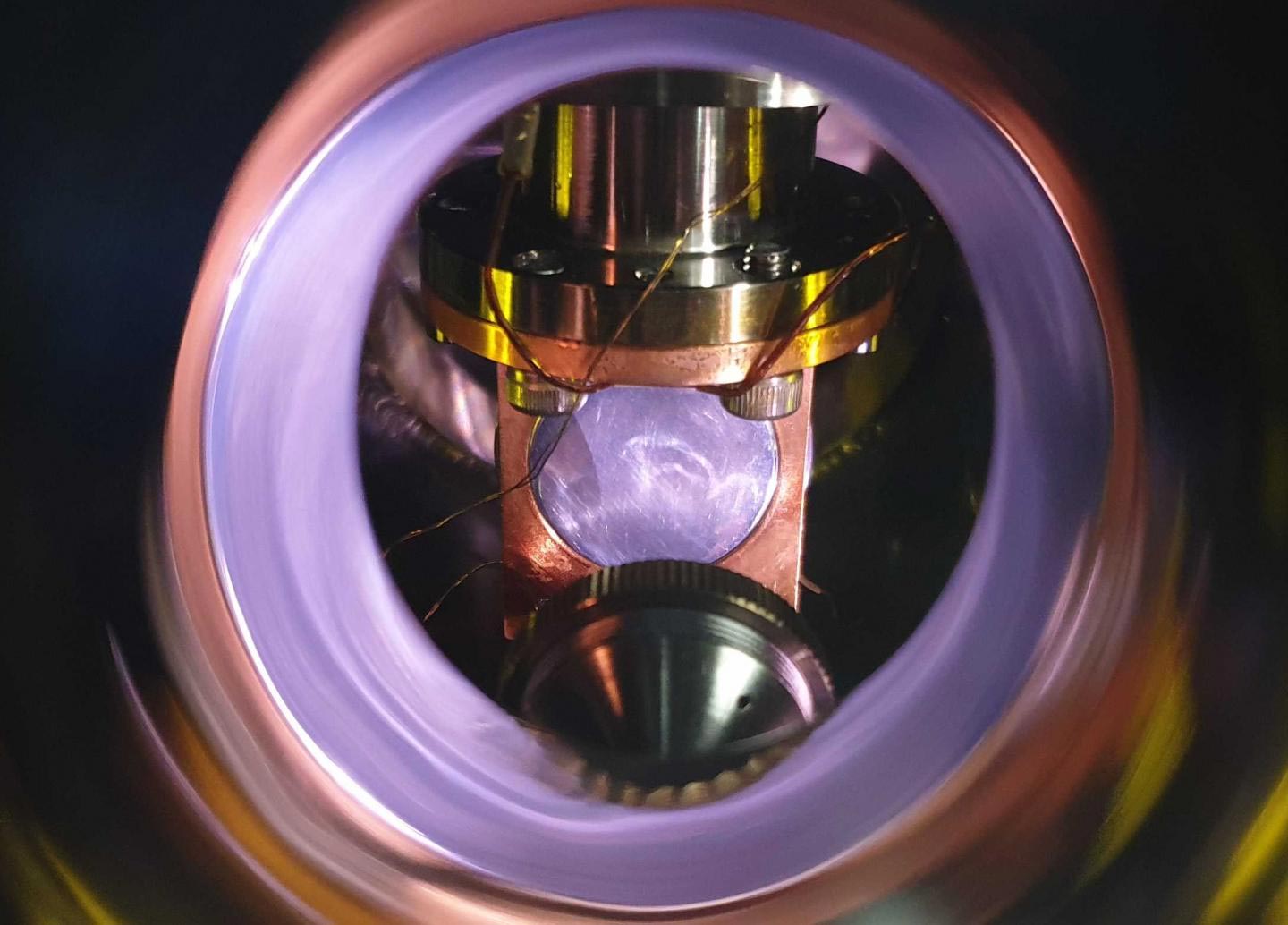
    Ultra-High Vacuum Reaction Chamber
    An inside look of an ultra-high vacuum reaction chamber that simulates chemical reactions in an interstellar cloud environment. Credit: Hokkaido University

    An experiment shows that one of the basic units of life­­­ — nucleobases — could have originated within giant gas clouds interspersed between the stars.

    Essential building blocks of DNA – compounds called nucleobases – have been detected for the first time in a simulated environment mimicking gaseous clouds that are found interspersed between stars. The finding, published in the journal Nature Communications, brings us closer to understanding the origins of life on Earth.

    “This result could be key to unraveling fundamental questions for humankind, such as what organic compounds existed during the formation of the solar system and how they contributed to the birth of life on Earth,” says Yasuhiro Oba of Hokkaido University’s Institute of Low Temperature Science.

    Scientists have already detected some of the basic organic molecules necessary for the beginnings of life in comets, asteroids, and interstellar molecular clouds: giant gaseous clouds dispersed between stars. It is thought that these molecules could have reached Earth through meteorite impacts some four billion years ago, providing key ingredients for the chemical cocktail that gave rise to life. Learning how these molecules formed is vital to understanding the origins of life.

    “This result could be key to unraveling fundamental questions for humankind, such as what organic compounds existed during the formation of the solar system and how they contributed to the birth of life on Earth.” — Yasuhiro Oba

    The basic structural unit of DNA and RNA is called a nucleotide and is composed of a nucleobase, a sugar, and a phosphate group. Previous studies mimicking the expected conditions in interstellar molecular clouds have detected the presence of sugar and phosphate, but not of nucleobases.
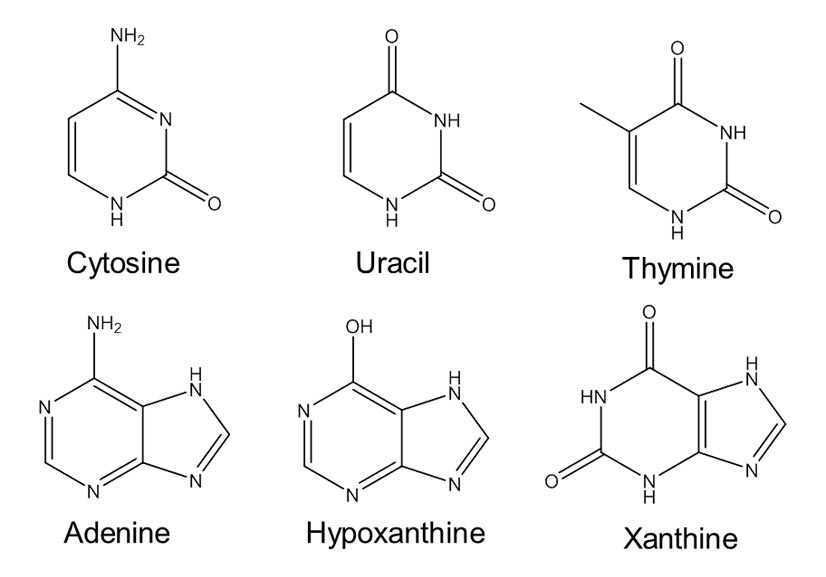
    The Nucleobases Detected in a Simulated Interstellar Cloud Environment
    The fundamental nucleobases detected in a simulated interstellar cloud environment. Credit: Hokkaido University

    Now, Yasuhiro Oba and colleagues at Hokkaido University, Kyushu University, and the Japan Agency for Marine-Earth Science and Technology (JAMSTEC) have used advanced analytical methods to detect the fundamental nucleobases in a simulated interstellar cloud environment.

    The team conducted their experiments in an ultra-high vacuum reaction chamber. A gaseous mixture of water, carbon monoxide, ammonia, and methanol was continuously supplied onto a cosmic-dust analog at a temperature of -263° Celsius (-441° Fahrenheit). Two deuterium discharge lamps attached to the chamber supplied vacuum ultraviolet light to induce chemical reactions. The process led to the formation of an icy film on the dust analog inside the chamber. 
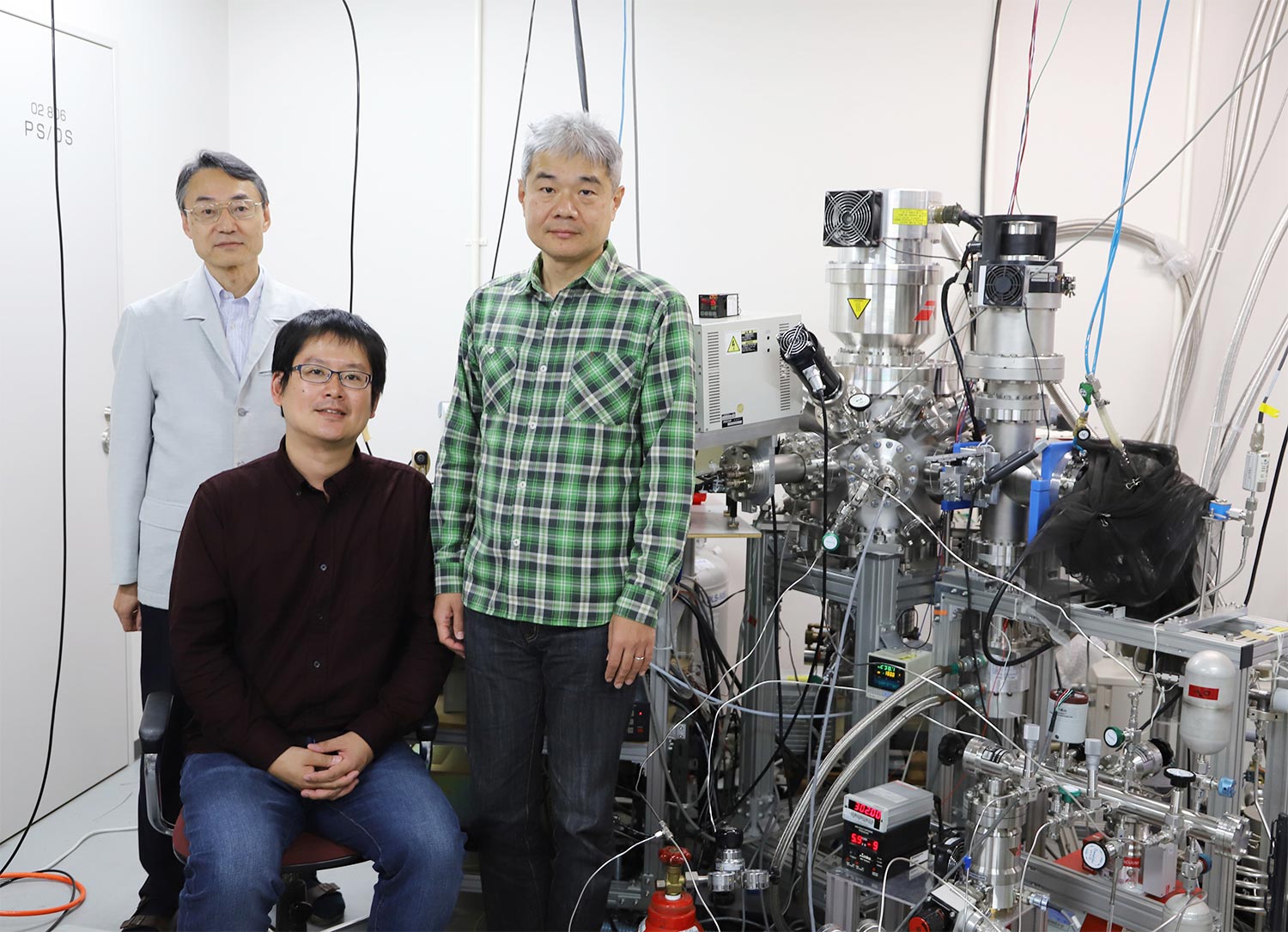
    Akira Kouchi, Yasuhiro Oba and Naoki Watanabe
    Akira Kouchi (left), Yasuhiro Oba (center), and Naoki Watanabe (right) of the research team at Hokkaido University’s Institute of Low Temperature Science. Credit: Hokkaido University

    The team used a high-resolution mass spectrometer and a high-performance liquid chromatograph to analyze the product that formed on the substrate after warming it to room temperature. Recent advances in these technological tools allowed them to detect the presence of the nucleobases cytosine, uracil, thymine, adenine, xanthine, and hypoxanthine. They also detected amino acids, which are the building blocks of proteins, and several kinds of dipeptide, or a dimer of amino acid, in the same product.

    The team suspects that past experiments simulating interstellar molecular cloud environments would have produced nucleobases, but that the analytical tools used were not sensitive enough to detect them in complex mixtures.

    “Our findings suggest that the processes we reproduced could lead to the formation of the molecular precursors of life,” says Yasuhiro Oba. “The results could improve our understanding of the early stages of chemical evolution in space.”

    Reference: “Nucleobase synthesis in interstellar ices” by Yasuhiro Oba, Yoshinori Takano, Hiroshi Naraoka, Naoki Watanabe and Akira Kouchi, 27 September 2019, Nature Communications.
    DOI: 10.1038/s41467-019-12404-1

    Never miss a breakthrough: Join the SciTechDaily newsletter.
    Follow us on Google and Google News.

    Astrophysics Biochemistry Evolution Hokkaido University
    Share. Facebook Twitter Pinterest LinkedIn Email Reddit

    Related Articles

    Lightning Strikes – Perhaps 1,000,000,000,000,000,000 of Them – May Have Sparked Life on Earth

    How Did Life Begin? New Study Reveals Life in the Universe Could Be Common

    Numerical Calculations Give Insight into the Relativistic Properties of Turbulence

    Physicists Look at the Conditions Necessary for Carbon-Based Life in the Universe

    A Look Inside the Darkside-50 Experiment

    Mathematical Model May Explain What Dark Matter Consists Of

    Black Holes Have Properties That Resemble the Dynamics of Solids and Liquids

    The Bolshoi Simulation: Boxing the Universe

    Ultracold Neutrons Could Escape to Another Braneworld

    Leave A Reply Cancel Reply

    • Facebook
    • Twitter
    • Pinterest
    • YouTube

    Don't Miss a Discovery

    Subscribe for the Latest in Science & Tech!

    Trending News

    Your Blood Pressure Reading Could Be Wrong Because of One Simple Mistake

    Astronomers Stunned by Ancient Galaxy With No Spin

    Physicists May Be on the Verge of Discovering “New Physics” at CERN

    Scientists Solve 320-Million-Year Mystery of Reptile Skin Armor

    Scientists Say This Daily Walking Habit May Be the Secret to Keeping Weight Off After Dieting

    New Therapy Rewires the Brain To Restore Joy in Depression Patients

    Giant Squid Detected off Western Australia in Stunning Deep-Sea Discovery

    Popular Sugar-Free Sweetener Linked to Liver Disease, Study Warns

    Follow SciTechDaily
    • Facebook
    • Twitter
    • YouTube
    • Pinterest
    • Newsletter
    • RSS
    SciTech News
    • Biology News
    • Chemistry News
    • Earth News
    • Health News
    • Physics News
    • Science News
    • Space News
    • Technology News
    Recent Posts
    • One of the World’s Most Popular Weedkillers May Be Fueling Deadly Superbugs
    • Scientists Create Laser “Whirlpools” That Spin Tiny Cells Without Touching Them
    • Scientists Discover “Hidden” Materials That Could Transform Clean Energy and Batteries
    • Scientists Just Measured an Energy Pulse Smaller Than a Trillionth of a Billionth of a Joule
    • 540-Million-Year-Old Fossils Reveal a Huge Surprise About Early Life on Earth
    Copyright © 1998 - 2026 SciTechDaily. All Rights Reserved.
    • Science News
    • About
    • Contact
    • Editorial Board
    • Privacy Policy
    • Terms of Use

    Type above and press Enter to search. Press Esc to cancel.