
Researchers see long-term perspective for lithium extraction at geothermal plants.
Geothermal wells existing in the Upper Rhine Valley would allow for the reliable extraction of lithium for several decades without these sources running dry. This is the result of recent data analyses made by researchers of Karlsruhe Institute of Technology (KIT). The results are reported in Energies.
Geothermal Lithium Extraction in Upper Rhine Valley
On the way towards climate neutrality, Europe will need large amounts of lithium for battery storage systems. So far, however, its share in the worldwide lithium extraction volume has only been one percent. For this reason, researchers of KIT study ways to extract lithium from geothermal sources.
“In theory, geothermal power plants in the Upper Rhine Valley and Northern German Basin might cover between 2 and 12 percent of Germany’s annual lithium demand,” says Valentin Goldberg from KIT’s Institute of Applied Geosciences (AGW).
With his team, he calculated this potential based on an extensive data analysis. However, it has not been clear for how long extraction will be possible. Another study of the researchers now offers an optimistic perspective. “According to our findings, lithium extraction will be possible for many years at low environmental cost,” Goldberg says.
“The model developed for our study describes lithium extraction in the Upper Rhine Valley. But parameters are chosen such that they can also be transferred to other joint systems.”
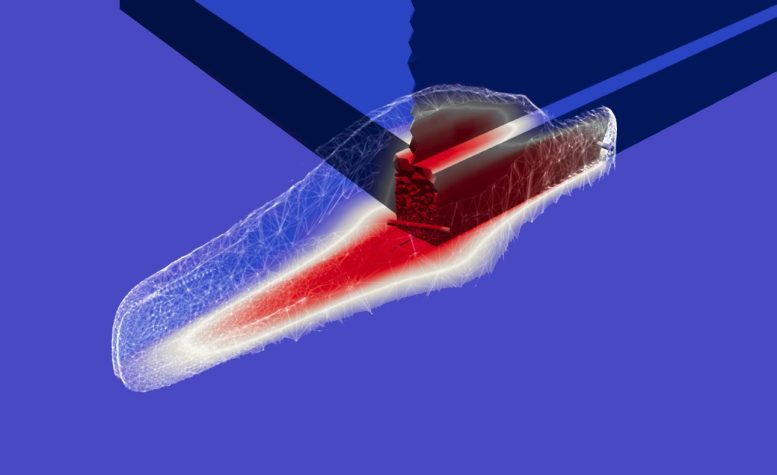
Spreading of lithium-depleted thermal water around the injection borehole along the fault zone after 30 years. Credit: Valentin Goldberg and Fabian Nitschke
Modeling of Geothermal Lithium Production
Extraction of lithium from thermal waters is no conventional type of mining. That is why no conventional methods could be applied for analysis.
“The lithium dissolved in water exists in a widely branched network of joints and cavities in the rock. However, it can only be accessed at certain points via individual wells,” says Dr. Fabian Nitschke, AGW, who was also involved in this study. “The reservoir dimension, hence, depends on the amount of water that can be accessed hydraulically via wells.”
To calculate the lithium production potential, researchers had to consider the potential water extraction volume, its lithium concentration, and lithium extraction per unit time.
“We use a dynamic transport model adapted to underground conditions in the Upper Rhine Valley. It couples thermal, hydraulic, and chemical processes. Similar models are known from petroleum and gas industry, but have not yet been applied to lithium,” Nitschke points out.
When using geothermal energy, the extracted water is pumped back into the ground via a second borehole. Researchers wanted to find out whether lithium concentration of the deep water decreases with time. The results show that lithium concentration in the extraction borehole decreases by 30 to 50 percent in the first third of the investigation period of 30 years, as the deep water is diluted by the returned water. Then, lithium concentration remains constant.
“This can be attributed to the open joint system that continuously supplies fresh deep water from other directions,” Nitschke says. Modeling suggests that continuous lithium extraction will be possible for decades: “Actually, extraction of this unconventional resource shows the classical cyclic behavior. Yields of hydrocarbon extraction or ore mining are also highest in the beginning and then start to decrease gradually.”
Sensible Investment in a Sustainable Future
Thomas Kohl from AGW, who directs the corresponding research activities as Professor for Geothermal Energy and Reservoir Technology, considers the research results another argument in favor of a wide use of geothermal energy.
“We already knew that geothermal sources can supply baseload-capable, renewable energy for decades. Our study now reveals that a single power plant in the Upper Rhine Valley could additionally cover up to 3 percent of the annual German lithium consumption.” Kohl’s group is now working on solutions for practical implementation.
Recently, it published a study in Desalination on the preliminary treatment of thermal water for resource extraction. “The next step now is to transfer this technology to the industrial scale,” Kohl says.
References:
“Challenges and Opportunities for Lithium Extraction from Geothermal Systems in Germany—Part 3: The Return of the Extraction Brine” by Valentin Goldberg, Ali Dashti, Robert Egert, Binil Benny, Thomas Kohl and Fabian Nitschke, 9 August 2023, Energies.
DOI: 10.3390/en16165899
“Development of a continuous silica treatment strategy for metal extraction processes in operating geothermal plants” by Valentin Goldberg, Daniel Winter, Fabian Nitschke, Sebastian Held, Florian Groß, Daniel Pfeiffle, Jörg Uhde, Diego Morata, Joachim Koschikowski and Thomas Kohl, 15 June 2023, Desalination.
DOI: 10.1016/j.desal.2023.116775
Never miss a breakthrough: Join the SciTechDaily newsletter.
Follow us on Google and Google News.