
Close Menu
    Facebook X (Twitter) Instagram
    SciTechDaily
    • Biology
    • Chemistry
    • Earth
    • Health
    • Physics
    • Science
    • Space
    • Technology
    Facebook X (Twitter) Pinterest YouTube RSS
    SciTechDaily
    Home»Space»Hubble Space Telescope Team Recovers the Cosmic Origins Spectrograph Instrument
    Space

    Hubble Space Telescope Team Recovers the Cosmic Origins Spectrograph Instrument

    By NASADecember 1, 20211 Comment3 Mins Read
    Facebook Twitter Pinterest Telegram LinkedIn WhatsApp Email Reddit
    Share
    Facebook Twitter LinkedIn Pinterest Telegram Email Reddit
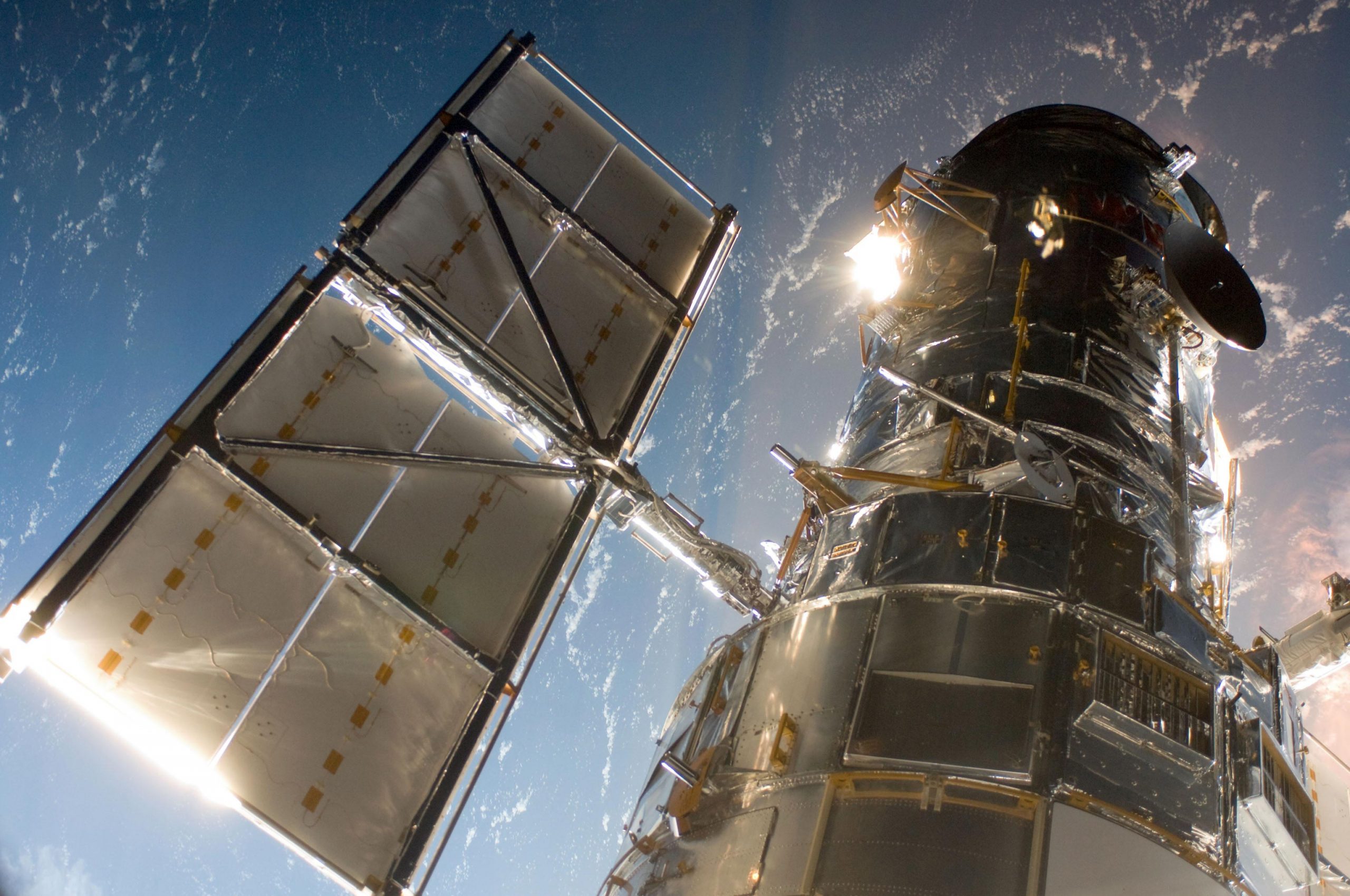
    Hubble Space Telescope in Orbit
    The Hubble Space Telescope was launched by the space shuttle Discovery on April 24, 1990. Avoiding distortions of the atmosphere, Hubble has an unobstructed view peering to planets, stars, and galaxies, some more than 13.4 billion light-years away. Credit: NASA

    The Hubble Space Telescope team recovered the Cosmic Origins Spectrograph instrument on Sunday, November 28, moving the telescope further toward full science operations. Three of Hubble’s four active instruments are now collecting science data once again.

    The team also continued work on developing and testing changes to instrument software that would allow them to conduct science operations even if they encounter several lost synchronization messages in the future. Those changes would first be installed on the Cosmic Origins Spectrograph once they’re completed and tested within a few weeks. Hubble’s other instruments would also receive similar changes. The team has not detected further synchronization message issues since monitoring began November 1.
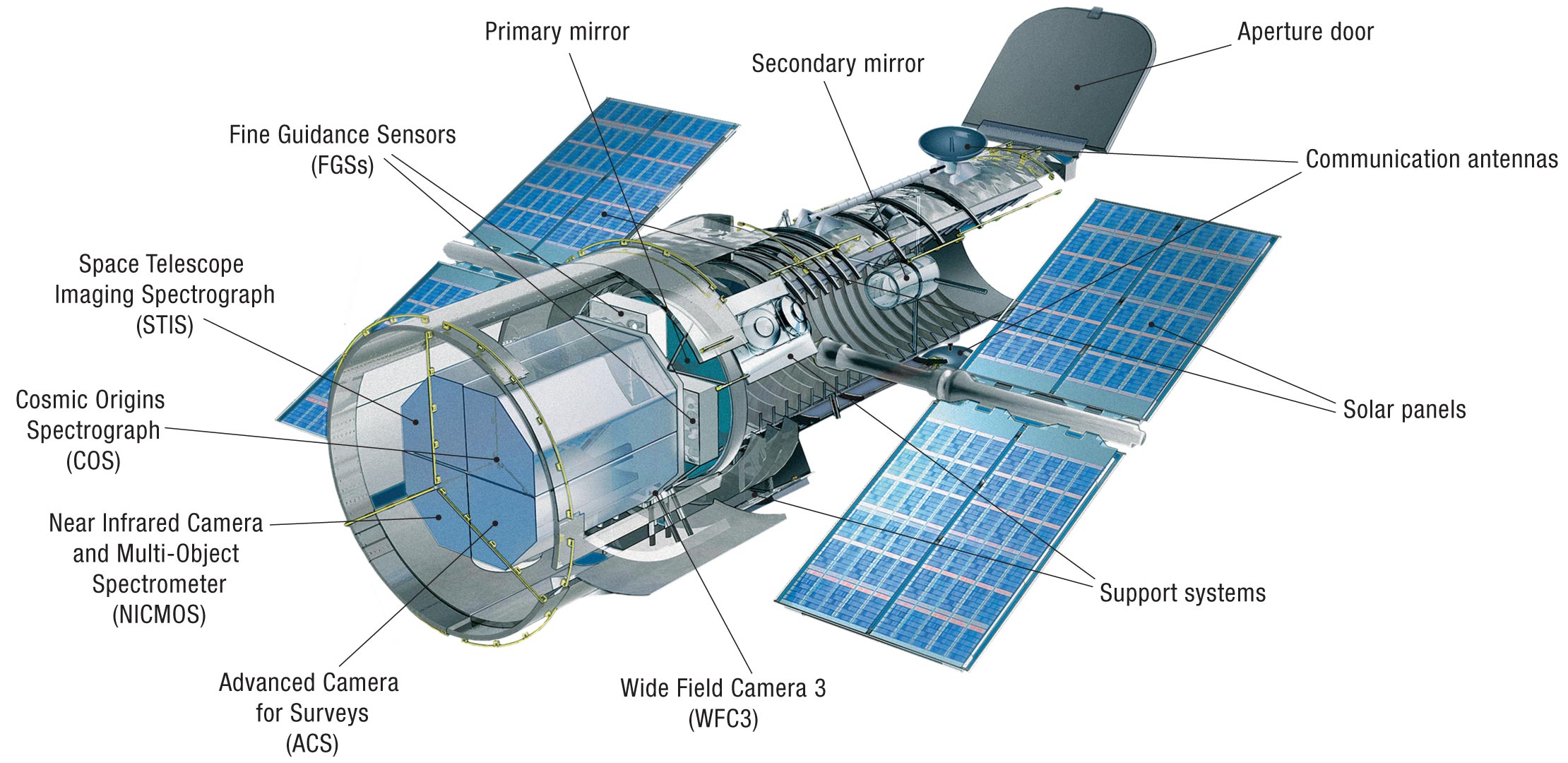
    Hubble’s Instruments Including Control and Support Systems
    This is a cutaway diagram of the Hubble Space Telescope, with components labeled. The forward shell houses the telescope’s optical assembly. In the middle of the telescope are the reaction wheels and the bays that house the observatory’s control electronics. The aft shroud houses the scientific instruments, gyroscopes, and star trackers. The instruments are located in containers that make them easy to remove and replace. Credit: NASA’s Goddard Space Flight Center, ESA

    Cosmic Origins Spectrograph (COS)

    COS focuses exclusively on ultraviolet (UV) light and is the most sensitive ultraviolet spectrograph ever, increasing Hubble’s sensitivity at least 10 times in the UV spectrum and up to 70 times when looking at extremely faint objects. It is best at observing points of light, like stars and quasars.

    The Cosmic Origins Spectrograph (COS), installed during SM4 in 2009, has expanded Hubble’s spectroscopic capabilities. The instrument provides unique capabilities that are taking the telescope into exciting new discovery space.
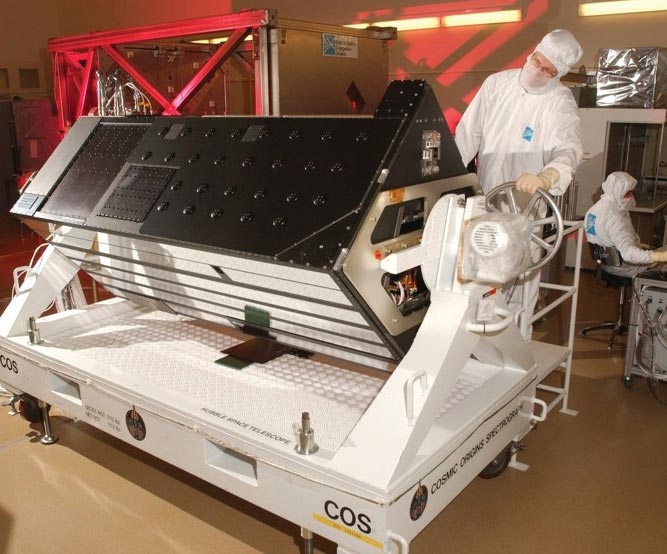
    Hubble's Cosmic Origins Spectrograph (COS) Instrument
    Hubble’s Cosmic Origins Spectrograph (COS) instrument. Credit: NASA

    COS studies the large-scale structure of the universe and how galaxies, stars, and planets formed and evolved, and it can help to determine how elements needed for life, such as carbon and iron, first formed.

    As a spectrograph, COS doesn’t make images but instead performs spectroscopy, the science of breaking up light into its individual components. Any object that absorbs or emits light can be studied with a spectrograph to determine its characteristics such as temperature, density, chemical composition, and velocity.

    A primary science objective for COS is to measure the structure and composition of the ordinary matter that is concentrated in what is known as the ‘cosmic web’: long, narrow filaments of galaxies and intergalactic gas separated by huge voids. The cosmic web is shaped by the gravity of the mysterious, underlying cold dark matter, while ordinary matter serves as a luminous tracery of the filaments. COS will use scores of faint distant quasars as ‘cosmic flashlights,’ whose beams of light have passed through the cosmic web. Absorption of this light by material in the web will reveal the characteristic spectral fingerprints of that material. This will allow Hubble observers to deduce its composition and its specific location in space.

    Observations like this, covering vast distances across space and back in time, will provide information on both the large-scale structure of the universe and the progressive changes in chemical composition of matter, as the universe has grown older.

    Never miss a breakthrough: Join the SciTechDaily newsletter.
    Follow us on Google and Google News.

    Hubble Space Telescope NASA
    Share. Facebook Twitter Pinterest LinkedIn Email Reddit

    Related Articles

    Webb and Hubble Unite: A Breathtaking 3D Journey Through the Pillars of Creation

    Stellar Fireworks: Hubble Revisits a Strange Star’s 40-Year Nova Mystery

    Gyroscope Failures Force NASA to Change How It Points Hubble Space Telescope

    The Physics of Failure: Analyzing Hubble’s Gyroscope Malfunction

    Cosmic Geode: Hubble Captures the Birth of a Sun-like Star

    Final Upgrade: Hubble Celebrates the 15th Anniversary of Servicing Mission 4

    Supermassive Spectacle: Hubble Captures a Galaxy With a Voracious Black Hole

    NASA Triumph: Science Restored on Hubble Space Telescope After Gyro Glitch

    Hubble Celebrates 34th Anniversary With a Spectacular View of the Little Dumbbell Nebula

    1 Comment

    1. Robert the Bob on December 4, 2021 10:55 pm

      The dates are all 2021 as if all these information blocks are from this year yet they seem like old news summarized

      Reply
    Leave A Reply Cancel Reply

    • Facebook
    • Twitter
    • Pinterest
    • YouTube

    Don't Miss a Discovery

    Subscribe for the Latest in Science & Tech!

    Trending News

    Scientists Discover How Coffee Impacts Memory, Mood, and Gut Health

    Why Did the Neanderthals Disappear? Scientists Reveal Humans Had a Hidden Advantage

    Physicists Propose Strange Experiment Where Time Goes Quantum

    Magnesium Magic: New Drug Melts Fat Even on a High-Fat, High-Sugar Diet

    Weight-Loss Drugs Like Ozempic May Come With an Unexpected Cost

    Mezcal “Worm” in a Bottle Mystery: DNA Testing Reveals a Surprise

    New Research Reveals That Your Morning Coffee Activates an Ancient Longevity Switch

    This Is What Makes You Irresistible to Mosquitoes

    Follow SciTechDaily
    • Facebook
    • Twitter
    • YouTube
    • Pinterest
    • Newsletter
    • RSS
    SciTech News
    • Biology News
    • Chemistry News
    • Earth News
    • Health News
    • Physics News
    • Science News
    • Space News
    • Technology News
    Recent Posts
    • Harvard Scientists Reveal Secret Structure Behind How You Smell
    • Scientists Just Discovered the Hidden Trick That Keeps Your Cells Alive
    • This Simple Movement Could Be Secretly Cleaning Your Brain
    • Male Birth Control Breakthrough: Scientists Find Way To Turn Sperm Production Off and Back On
    • A Common Vitamin Could Hold the Key to Treating Fatty Liver Disease
    Copyright © 1998 - 2026 SciTechDaily. All Rights Reserved.
    • Science News
    • About
    • Contact
    • Editorial Board
    • Privacy Policy
    • Terms of Use

    Type above and press Enter to search. Press Esc to cancel.