
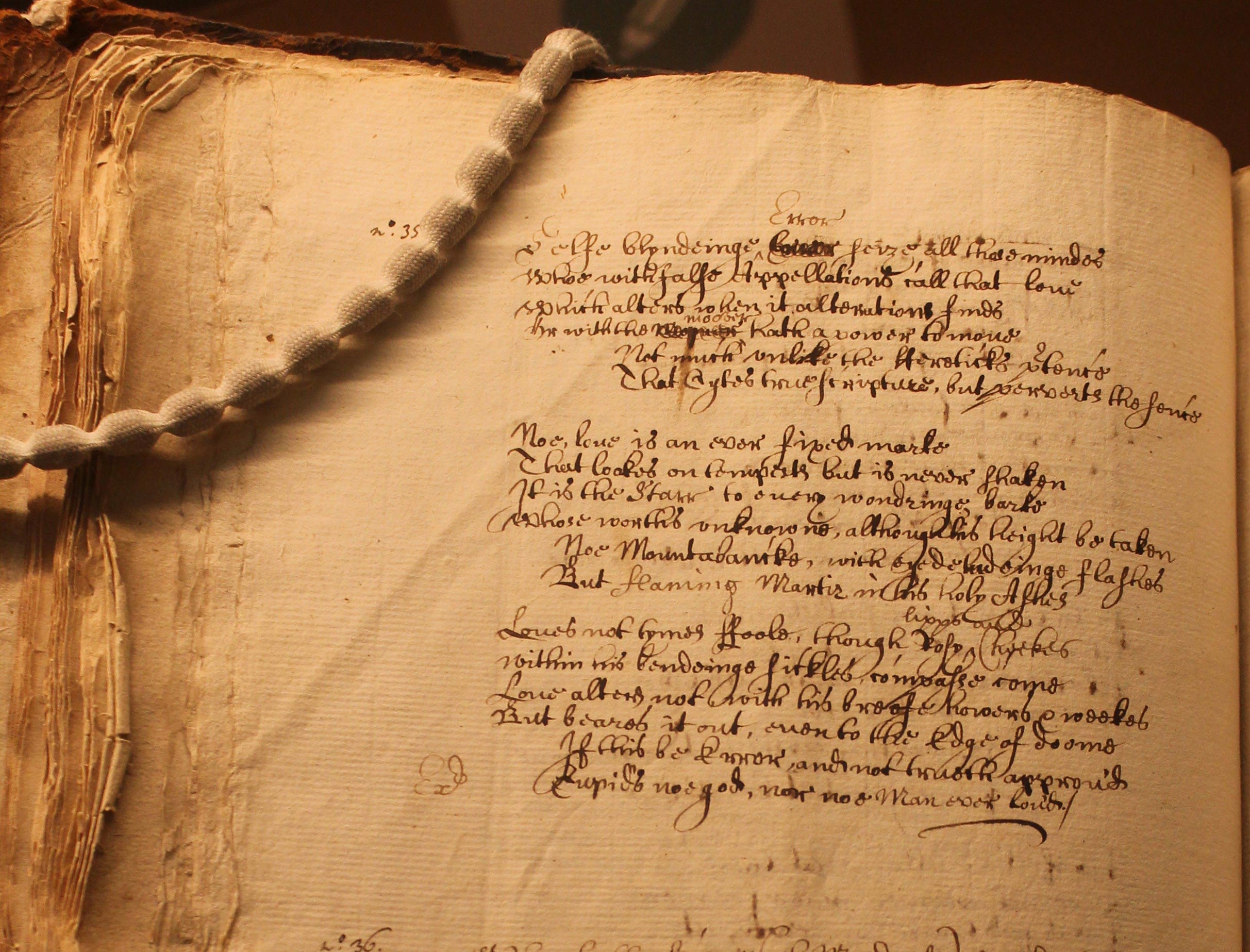
A rare manuscript version of Shakespeare’s Sonnet 116, discovered by Dr. Leah Veronese, reveals how the poem was politically repurposed and set to music during the English Civil War.
Dr Leah Veronese of Oxford University’s English Faculty has discovered a rare manuscript copy of Shakespeare’s Sonnet 116, hidden within a 17th-century poetry miscellany. The manuscript was found among the papers of Elias Ashmole (1617–1692), a noted royalist and founder of the Ashmolean Museum. This is only the second known manuscript copy of the sonnet ever identified.
Dr Veronese made the discovery during her DPhil research in Oxford’s Bodleian Library. The sonnet appears in a “miscellany”—a handwritten collection of literary works by various authors, a common form of sharing poetry in the early modern period. The manuscript also includes several poems written by Ashmole himself.
Misidentified and Overlooked
Dr Veronese explained: “As I was leafing through the manuscript, the poem struck me as an odd version of Sonnet 116. When I looked in the catalogue (originally compiled in the nineteenth century) the poem was described, not inaccurately, as “on constancy in love” – but it doesn’t mention Shakespeare. I think the combination of the additional first line ‘Self-blinding error seize those minds’ and absence of Shakespeare from the original catalogue description may be the reason why this poem has passed un-noticed as a copy of Sonnet 116 all these years.”
What makes this version particularly fascinating is how the poem has been adapted. The sonnet sits among politically charged works, for example, banned Christmas carols and satirical poems on the tumultuous events of the early 1640s. In this copy, the sonnet has been adapted as a song set to music by the composer Henry Lawes. This copy only includes the text, but the music itself can be found in a book of songs in New York Public Library. The song-setting includes seven additional lines, and changes to the Shakespeare’s original opening and final couplet. The opening is changed from:
Let me not to the marriage of true minds
Admit impediments; love is not love
Which alters when it alteration finds
…to:
Self blinding error seize all those minds
Who with false appellations call that love
Which alters when it alterations finds
Layers of Meaning: Love and Loyalty
A likely practical reason for these added lines is to create more verses to be sung. However, in the context of the English Civil War, the additional lines could also be read as an appeal towards religious and political loyalty.
Although the additional lines are quite ambiguous in meaning, they read more politically when read in the collection of a Royalist, surrounded by Royalist poetry. The added lines potentially transform the sonnet from a meditation on romantic love into a powerful political statement. It is worth noting that the public performance of songs was outlawed during the Republican regime. Many musicians, like Henry Lawes himself, survived by secret private performances in the home. Not only does this text provide us with a new example of how Shakespeare was being read during the civil war, but also how his texts were being politically repurposed to suit the issues of the day.
Professor Emma Smith, Professor of Shakespeare Studies at the University of Oxford, said: “This exciting discovery shows that centuries of searching for evidence about Shakespeare and his early reception hasn’t exhausted the archives. ‘Let me not to the marriage of true minds’ is now one of Shakespeare’s most famous sonnets, but it doesn’t seem to have been very popular in his own time. Whereas other sonnets were widely circulated and quoted, only one previous reference to this one was known. And what Dr Veronese shows in her investigation of this new version is that the sonnet being understood in the context of Royalist politics – a long way from its role in modern weddings!”
Dr Veronese’s discovery sheds new light on how Shakespeare’s words resonated, and were reshaped, during one of the most tumultuous periods in English history.
Reference: “A New Copy of Shakespeare’s Sonnet 116: A Cavalier Cover Version” by Leah S Veronese, 3 February 2025, The Review of English Studies.
DOI: 10.1093/res/hgaf002
Never miss a breakthrough: Join the SciTechDaily newsletter.
Follow us on Google and Google News.