
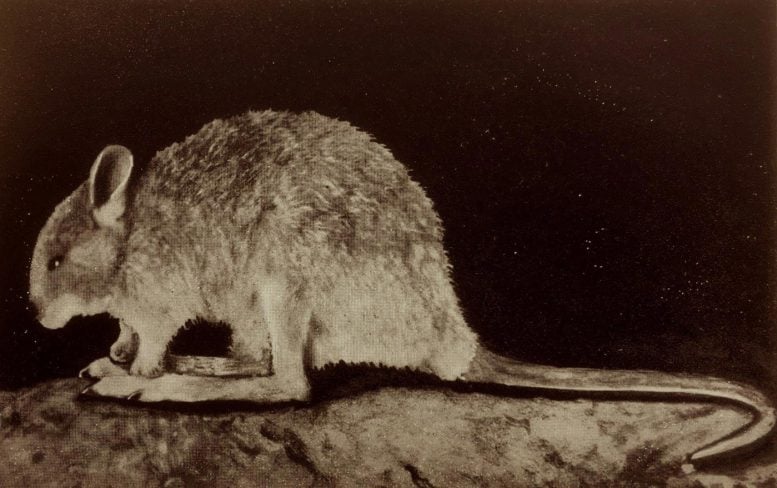
New research on the feeding habits of the desert rat-kangaroo could help locate the possibly extinct species, with unconfirmed sightings suggesting it may still exist.
A fascinating native Australian rat-kangaroo, once believed to be extinct, may still be surviving in the harsh and remote Sturt Stony Desert. Researchers from Flinders University have uncovered new insights into its feeding habits that could aid in locating the elusive species.
By analyzing the biting capabilities of various small animal skulls, experts in marsupial evolution and ecology have identified the likely diet of the desert rat-kangaroo (Caloprymnus campestris). This research helps pinpoint the most promising areas for monitoring and potentially rediscovering the species.
“Rat-kangaroos, like bettongs and potoroos, are an ideal group of animals for testing skull biomechanics because they each have different shaped skulls and specialize in very different food groups,” says Dr. Rex Mitchell, lead author of a new article published in the Journal of Experimental Biology.

“We were surprised to find the heftier skull of the desert rat-kangaroo isn’t necessarily adapted for biting into harder foods. When we included the animal’s smaller size into the analysis, the robust features of the desert rat-kangaroo’s skull were only found to be effective enough to handle eating a softer range of foods.”
Sightings and Conservation Challenges
The latest research could help efforts to ‘rediscover’ the desert rat-kangaroo – known as ‘ngudlukanta’ to the traditional custodians of that Country, the Wangkangurru Yarluyandi people – particularly after unsubstantiated reports of a distinctively small, short-faced, hopping animal in the vicinity of their home range in the Lake Eyre Basin in remote far north-east South Australia into adjacent Queensland.
Predation by foxes and cats and competition with rabbits, overstocking with cattle and sheep, and poor fire management have pushed it to extinction. The small desert-dwelling potoroid marsupial is now known from only a handful of museum specimens that were gathered in inaccessible areas of South Australia.

The small marsupial was declared extinct in 1994 after the last specimen was collected in 1930, but monitoring for the rare animal continues.

Senior author of the new study, Flinders University Associate Professor Vera Weisbecker, says: “It is plausible that a small, nocturnal species could be evading detection in the vast inland desert. In fact, this species was previously a resurrected ‘Lazarus’ species after its rediscovery in the 1930s.”
“So regardless of whether or not the species persists in the Sturt Stony Desert or elsewhere, the story of the desert rat-kangaroo serves as an ongoing reminder that extinction declarations might not always be the end of the story,” she says.
New Insights Could Refine Search Efforts
This new-found evidence of its feeding habits could help to focus search efforts on specific regions where these plants grow.
The desert rat-kangaroo was known to eat mostly leaves of plants, but its short round face led previous researchers to suggest that it could eat harder foods as well if needed, such as seeds and twigs.
“Finetuning the search through understanding the animals’ diet better might just resurrect the little desert survivor once more,” adds Dr. Mitchell.
Using computer models of historic skeleton specimens, the new study uses a method called Finite Element Analysis (FEA) to test the skull’s ability to handle the forces that happen during biting.
The skull of the desert rat-kangaroo was compared with the skulls of short-faced specialists of harder foods like the burrowing bettong, or boodie, and the specialists of softer fungi like the long-nosed potoroo.
The researchers say these kinds of studies give valuable insights into the relationship between skull shape and biting ability, with applications to animal behavior, conservation, ecology, evolution, and paleontology.
Reference: “Testing hypotheses of skull function with comparative finite element analysis: three methods reveal contrasting results” by D. Rex Mitchell, Stephen Wroe, Meg Martin and Vera Weisbecker, 25 February 2025, Journal of Experimental Biology.
DOI: 10.1242/jeb.249747
The lead authors were funded by Australian Research Council Centre of Excellence for Australian Biodiversity and Heritage (CE170100015) and an ARC Future Fellowship (FT180100634) to VW.
The authors acknowledge the assistance of Microscopy Australia and the Australian National Fabrication Facility (ANFF) under the National Collaborative Research Infrastructure Strategy, at the South Australian Regional Facility, Flinders Microscopy and Microanalysis, Flinders University. Also David Stemmer of the SA Museum. This research was conducted on the traditional lands of the Kaurna people.
Never miss a breakthrough: Join the SciTechDaily newsletter.
Follow us on Google and Google News.