
Iron Age cargoes from Dor reveal how ancient Mediterranean trade evolved alongside shifting empires and political power.
New findings from researchers at the University of California San Diego and the University of Haifa are changing how scholars understand ancient seaborne trade in the eastern Mediterranean. Recently published in Antiquity, the study reports the first documented discovery of Iron Age ship cargoes recovered from within a former port city in Israel, offering rare and direct evidence of maritime trade during a period that has largely been reconstructed from land-based archaeology.
The international research effort was led by UC San Diego’s Thomas E. Levy, co-director of the UC San Diego Qualcomm Institute Center for Cyber-Archaeology and Sustainability, a distinguished professor in the Division of Graduate Education and Postdoctoral Affairs and the inaugural holder of the Norma Kershaw Chair in the Archaeology of Ancient Israel and Neighboring Lands in the Department of Anthropology, together with Assaf Yasur-Landau, founder of the University of Haifa’s Laboratory for Coastal Archaeology and Underwater Survey.
Their work reveals shifting patterns of trade, political influence, and regional connectivity between the 11th and 6th centuries BCE.
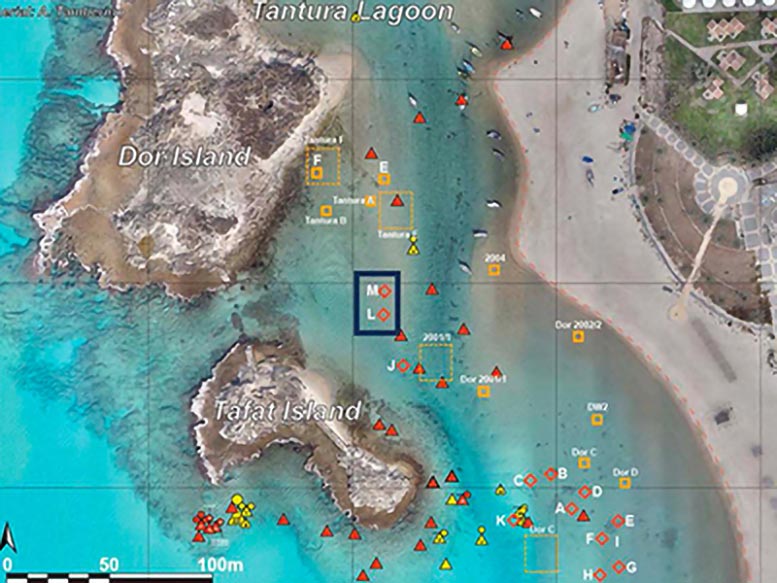
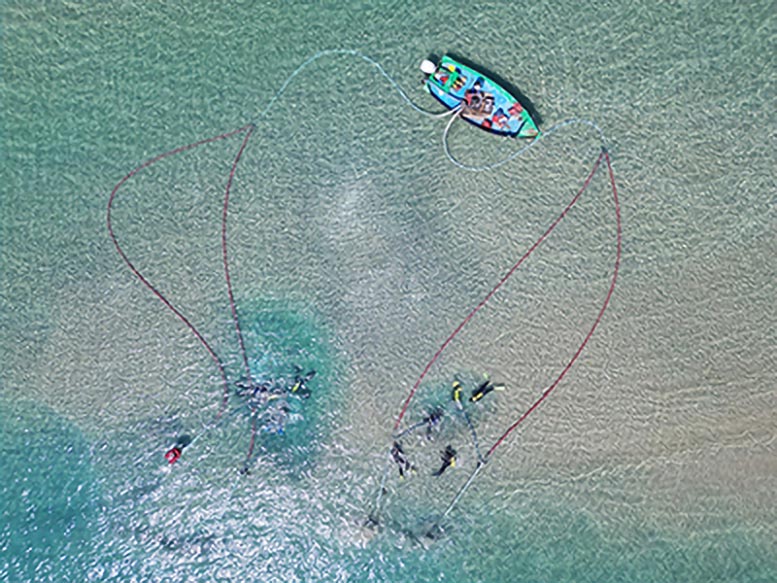
During their investigation, the team identified three separate submerged cargo assemblages in the Dor Lagoon—also known as Tantura Lagoon—along Israel’s Carmel Coast. In antiquity, this sheltered inlet served the port city of Dor, a key maritime hub positioned between Egyptian, Phoenician, and later Assyrian and Babylonian trade networks.
These discoveries rank among the very few known Iron Age ship cargoes anywhere in the Mediterranean and are the first directly associated with a documented Iron Age port city in the southern Levant.
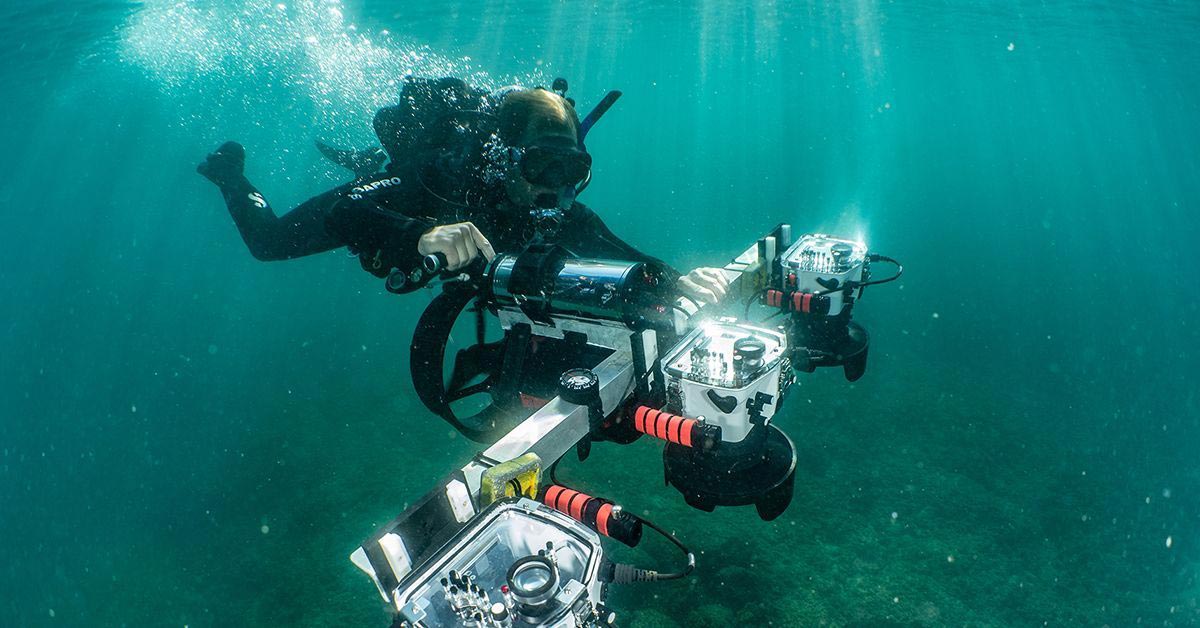
The research forms part of a long-standing marine and cyber-archaeology collaboration between UC San Diego’s Center for Cyber-Archaeology and Sustainability and the University of Haifa’s School of Archaeology and Maritime Cultures. By combining advanced tools such as 3D modeling, multispectral imaging, and digital mapping with conventional archaeological excavation, the team is able to investigate submerged cultural heritage in ways not previously possible.
Ancient cargoes tell a story of trade, power and decline
Together, the three cargoes represent different phases of the Iron Age and reflect broader changes in political power, economic organization, and regional trade across the eastern Mediterranean.
Dor M, the oldest cargo, dates to the 11th century BCE and includes a cluster of storage jars and an anchor inscribed with Cypro-Minoan writing.
“Scripts on the anchor and storage jars found in Dor M suggest connections to Cyprus and Egypt,” the authors note, “and the typology of the storage jars provides a link to the Phoenician coast.” Together, the findings at Dor M align with the Egyptian Report of Wenamun, a literary text from around 1,000 BCE that describes maritime journeys to Dor and beyond during this period.
Dor L1 includes Phoenician-style jars and thin-walled bowls that date from the late 9th to early 8th century BCE. Unlike Dor M, this cargo lacks evidence of trade with Egypt and Cyprus. The authors point out that although this does align with land-based findings that show a decline in Dor’s connectivity and imports under Israelite control, the cargo provides “unequivocal evidence for the continuation of maritime activity” during that time period.
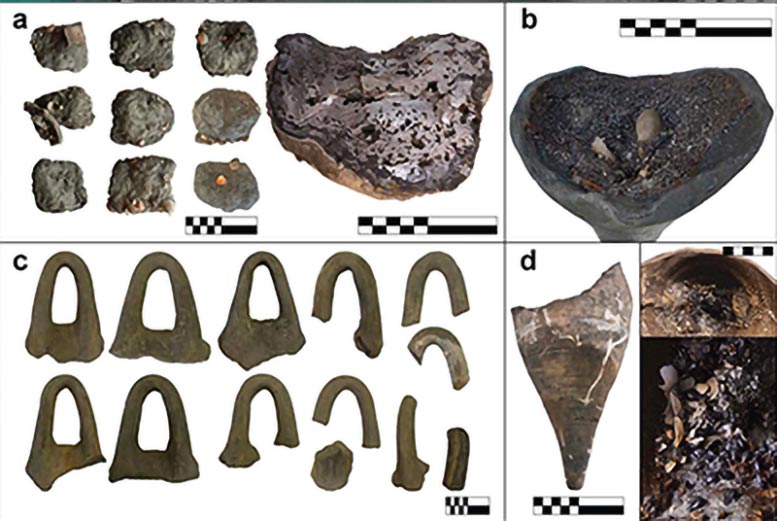
Dor L2 is the most intact and recent of the three; it dates to the late 7th or early 6th century BCE and is the most complete cargo. It includes Cypriot-style basket-handle amphorae and, remarkably, iron blooms (porous masses of metallic iron and slag that are an intermediate product of an iron ore smelting method). “Iron Age anchors with both wood and lead components are rare but attested in the archaeological record,” the authors explain, highlighting that such blooms “point to early industrial-scale metal trade” at this time.
Based on radiocarbon dating and residue analysis, the cargo is likely from the days when Dor was a thriving maritime hub operating under the imperial control of the Babylonian or Assyrian empires. The finding aligns well with other Iron Age shipwrecks found along the Anatolian coast that suggest “an expanded interaction zone” after Dor “returned to Phoenician hands.”
The team also recovered botanical remains like date pits. In one instance, “a basket-handle amphora base containing grape seeds… provides a date range similar to the L2 anchor,” helping to confirm the cargo’s dating.
A new lens on ancient connectivity
While the excavations to date have only uncovered the uppermost layers of the site’s sandbar, the findings already point to Dor as a dynamic maritime center whose fortunes rose and fell with geopolitical tides. The lagoon itself and its harbor are protected by three islets to the west. Discoveries of quays, stone anchors, and artificial jetty-like structures called “moles” have seen Dor emerge as a vital node in the Iron Age Mediterranean trade web.
Still, these findings are only the beginning. To date, the study has “excavated only up to 25% of the sandbar in which the cargoes are located, and excavations are ongoing.” Many more artifacts remain buried, including possible sections of a ship’s hull in Dor L2.
The work builds on nearly a decade of collaboration between UC San Diego and the University of Haifa, supported in part by the Qualcomm Institute’s emphasis on cyber-archaeology and the use of advanced digital tools to preserve and analyze submerged cultural heritage. By integrating cyber-archaeology methods with underwater excavation, the team was able to reconstruct ancient shipping activity with an unprecedented level of detail, down to the grape seeds, date pits, and anchor inscriptions.
The research is not only a significant academic discovery but also a working model for cross-border, cross-disciplinary archaeological research.
Reference: “Iron Age ship cargoes from the harbour of Dor (Israel)” by Assaf Yasur-Landau, Marko Runjajić, Evgeny Shegol, Remi Rosen, Karsyn Johnson, Deborah Cvikel, Shirly Ben-Dor Evian, David E. Friesem, Tzilla Eshel, Gunnar Lehmann, Cassandra Donnely, Artemis Georgiou, Harel Shochat, Meir Edrey, Dafna Langgut and Thomas E. Levy, 26 May 2025, Antiquity.
DOI: 10.15184/aqy.2025.71
This research was funded by a grant from the Malcolm H. Wiener Foundation, for the study of the Bronze Age in the Coast of the Carmel, and the Koret Foundation (grant no. 19-0295).
Never miss a breakthrough: Join the SciTechDaily newsletter.
Follow us on Google and Google News.