

Removing the Oxytocin Receptor Does Not Interfere with Monogamy or Giving Birth
Turning a decades-old dogma on its head, new research from scientists at University of California, San Francisco and Stanford Medicine shows that the receptor for oxytocin, a hormone considered essential to forming social bonds, may not play the critical role that scientists have assigned to it for the past 30 years.
In the study, published on January 27, 2023, in the journal Neuron, the team found that prairie voles bred without receptors for oxytocin and showed the same monogamous mating, attachment, and parenting behaviors as regular voles. In addition, females without oxytocin receptors gave birth and produced milk, though in smaller quantities, than ordinary female voles.
The results indicate that the biology underlying pair bonding and parenting isn’t purely dictated by the receptors for oxytocin, sometimes referred to as the “love hormone.”
“While oxytocin has been considered ‘Love Potion #9,’ it seems that potions 1 through 8 might be sufficient,” said psychiatrist Devanand Manoli, MD, PhD, a senior author of the paper and member of the UCSF Weill Institute for Neurosciences. “This study tells us that oxytocin is likely just one part of a much more complex genetic program.”
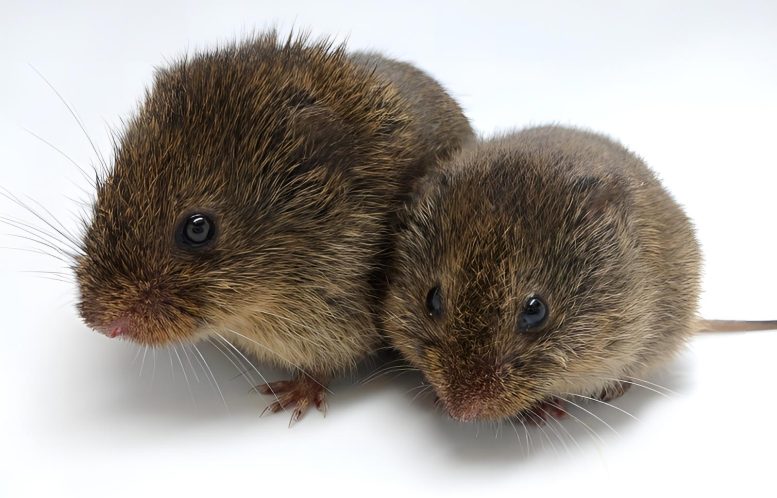
CRISPR Voles Pack a Surprise
Because prairie voles are one of the few mammalian species known to form lifelong monogamous relationships, researchers study them to better understand the biology of social bonding.
Studies in the 1990s using drugs that prevent oxytocin from binding to its receptor found that voles were unable to pair bond, giving rise to the idea that the hormone is essential to forming such attachments.
The current project emerged from shared interests between Manoli and co-senior author and neurobiologist Nirao Shah, MD, PhD, then at UCSF and now at Stanford Medicine. Shah had been interested in the biology of oxytocin and social attachment in prairie voles since teaching about the oxytocin studies decades earlier. Manoli, who wanted to investigate the neurobiology of social bonding, joined Shah’s lab in 2007 as a postdoctoral scholar.
For this study, 15 years in the making, the two applied new genetic technologies to confirm if oxytocin binding to its receptor was indeed the factor behind pair bonding. They used CRISPR to generate prairie voles that lack functional oxytocin receptors. Then, they tested the mutant voles to see whether they could form enduring partnerships with other voles.
To the researchers’ surprise, the mutant voles formed pair bonds just as readily as normal voles.
“The patterns were indistinguishable,” said Manoli. “The major behavioral traits that were thought to be dependent on oxytocin – sexual partners huddling together and rejecting other potential partners as well as parenting by mothers and fathers – appear to be completely intact in the absence of its receptor.”
Labor and Lactation
Even more surprising for Manoli and Shah than the pair bonding was the fact that a significant percentage of the female voles were able to give birth and provide milk for their pups.
Oxytocin is likely to have a role in both birth and lactation, but one that is more nuanced than previously thought, Manoli said. Female voles without receptors proved perfectly capable of giving birth, on the same timeframe and in the same way as the regular animals, even though labor has been thought to rely on oxytocin.
The results help to clear up some of the mystery surrounding the hormone’s role in childbirth: Oxytocin is commonly used to induce labor but blocking its activity in mothers who experience premature labor isn’t better than other approaches for halting contractions.
When it came to producing milk and feeding pups, however, the researchers were taken aback. Oxytocin binding to its receptor has been considered essential for milk ejection and parental care for many decades, but half of the mutant females were able to nurse and wean their pups successfully, indicating that oxytocin signaling plays a role, but it is less vital than previously thought.
“This overturns conventional wisdom about lactation and oxytocin that’s existed for a much longer time than the pair bonding association,” said Shah. “It’s a standard in medical textbooks that the milk letdown reflex is mediated by the hormone, and here we are saying, ‘Wait a second, there’s more to it than that.’”
Hope for Social Connection
Manoli and Shah focused on understanding the neurobiology and molecular mechanisms of pair bonding because it is thought to hold the key to unlocking better treatments for psychiatric conditions, such as autism and schizophrenia, that interfere with a person’s ability to form or maintain social bonds.
Over the past decade, much hope was pinned on clinical trials using oxytocin to address those conditions. But those results were mixed, and none has illuminated a clear path to improvement.
The researchers said their study strongly suggests that the current model – a single pathway or molecule being responsible for social attachment –is oversimplified. This conclusion makes sense from an evolutionary perspective, they said, given the importance of attachment to the perpetuation of many social species.
“These behaviors are too important to survival to hinge on this single point of potential failure,” said Manoli. “There are likely other pathways or other genetic wiring to allow for that behavior. Oxytocin receptor signaling could be one part of that program, but it’s not the be-all end-all.”
The discovery points the researchers down new paths to improving the lives of people struggling to find social connection.
“If we can find the key pathway that mediates attachment and bonding behavior,” Shah said, “We’ll have an eminently druggable target for alleviating symptoms in autism, schizophrenia, many other psychiatric disorders.”
For more on this research, see Were We Wrong About the “Love Hormone” Oxytocin?
Reference: “Oxytocin receptor is not required for social attachment in prairie voles” by Kristen M. Berendzen, Ruchira Sharma, Maricruz Alvarado Mandujano, Yichao Wei, Forrest D. Rogers, Trenton C. Simmons, Adele M.H. Seelke, Jessica M. Bond, Rose Larios, Nastacia L. Goodwin, Michael Sherman, Srinivas Parthasarthy, Isidero Espineda, Joseph R. Knoedler, Annaliese Beery, Karen L. Bales, Nirao M. Shah and Devanand S. Manoli, 27 January 2023, Neuron.
DOI: 10.1016/j.neuron.2022.12.011
Additional authors include: Ruchira Sharma, Rose Larios, Nastacia Goodwin, Michael Sherman and Isidero Espineda of UCSF, Maricruz Alvarado Mandujano, YiChao Wei, Srinivas Parthasarthy and Joseph Knoedler of Stanford, and Forrest Rogers, Trenton Simmons, Adele Seelke, Jessica Bond, and Karen Bales of UC Davis, and Annaliese Beery of UC Berkeley.
This work was supported by NIH grants R01MH123513, R01MH108319, DP1MH099900 and R25MH060482, NSF grant, 1556974, and philanthropy. For details, see the study.
Never miss a breakthrough: Join the SciTechDaily newsletter.
Follow us on Google and Google News.