
Credit: ESA
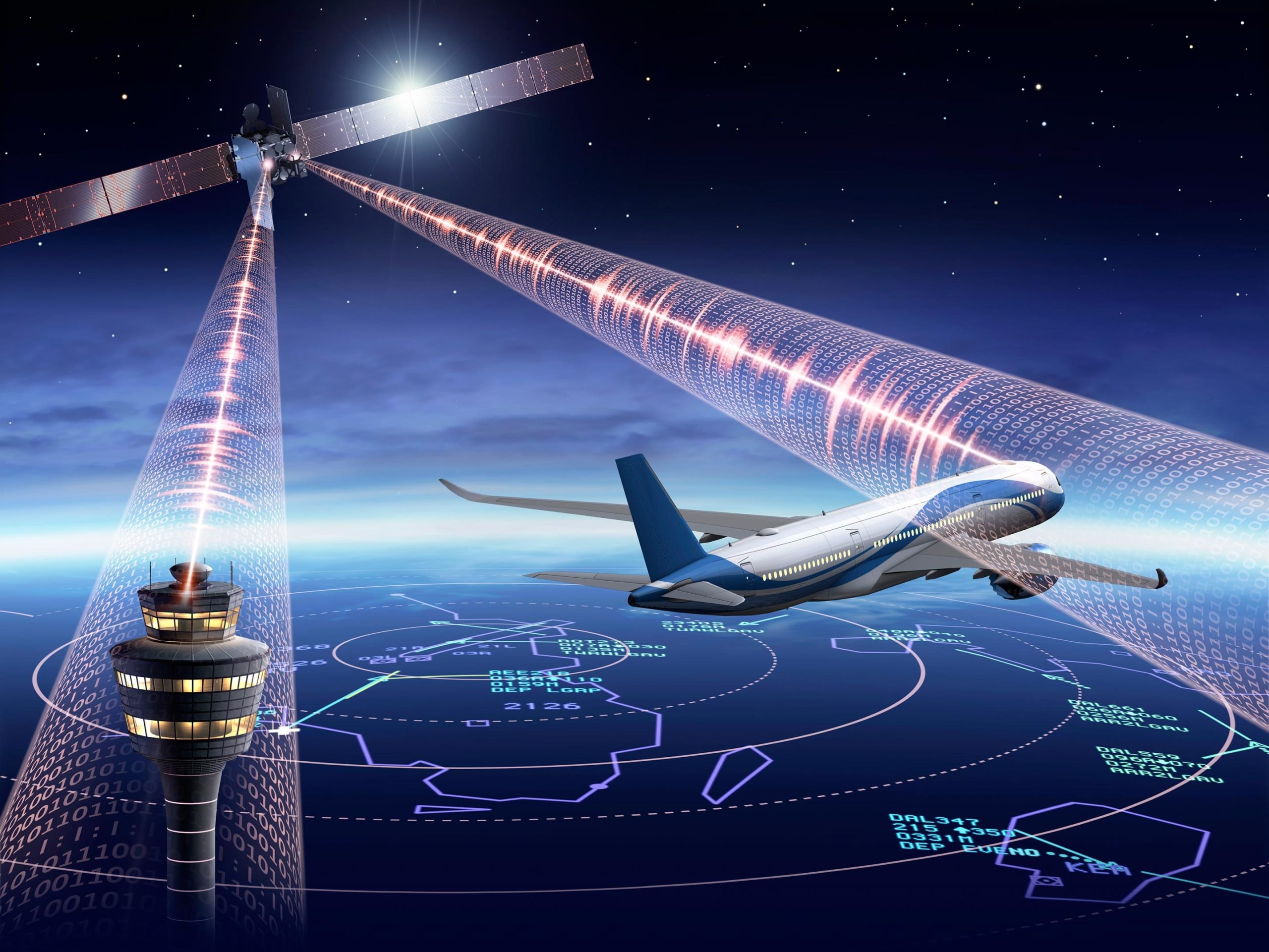
Iris, a new ESA–Inmarsat satellite system, will optimize European flight paths to cut fuel use and emissions.
Air passengers will soon be able to cut their carbon footprint when traveling on flights that are routed using satellites.
An agreement signed today between satellite company Inmarsat and the European Satellite Services Provider, which represents air traffic controllers from seven European countries, will enable final tests of the space-based system to be conducted and evaluated. It is expected to be introduced across Europe by 2023.
ESA has worked with Inmarsat to develop a space-enabled digital alternative to traditional air traffic control that enables pilots to take more efficient trajectories, saving fuel and cutting carbon emissions.
How Iris Works
The system – called Iris – uses satellites to exchange data with aircraft, supplementing the terrestrial communications system with digital position reports, clearances, and runway conditions, sent via telecommunications satellites between cockpits and air traffic control centers.
Flight plans can be continually updated during the flight to maintain an optimal trajectory towards the destination, minimizing the fuel burned and the carbon dioxide emitted.
Iris was first tested on planes flying over Europe in 2018 and debuted in the US on a new Boeing 737-9 operated by Alaska Airlines earlier this year.

Today’s agreement is between Inmarsat and the European Satellite Services Provider, a company founded by seven air navigation service providers from France, Germany, Italy, Portugal, Spain, Switzerland, and the UK to operate and provide services for a satellite-based navigation system managed by the European Commission called the European Geostationary Navigation Overlay Service.
It aims to manage final testing and certification – which includes certification from the European Aviation Safety Agency ahead of commercial rollout across Europe. The agreement was signed today at the World Air Traffic Management Congress in Madrid.
Part of the Single European Sky Initiative
Iris will implement its improvements under the European Commission’s single European sky air traffic management research program, which promises to boost efficiency, capacity, and performance of air traffic management worldwide.
John Broughton, Senior Vice President of Aircraft Operations and Safety Services at Inmarsat, said: “There is monumental support within the aviation industry for modernizing air traffic management. The benefits for airlines and passengers are vast, from faster and more efficient flight routes with fewer delays, to improvements in environment efficiencies, including less fuel usage and carbon dioxide emissions.”
Charlotte Neyret, Chief Executive Officer of the European Satellite Services Provider, said: “The Iris program is a game-changer for the aviation industry, providing the most advanced new technology to complement datalink communications and meet the challenge of digital, greener and sustainable air travel. The ESSP has been working on this important program with Inmarsat and ESA for several years and we are proud to now expand our involvement. We will provide the full range of ESSP’s expertise in implementing and operating mission-critical services to ensure that Iris will offer the highest quality of service to all aviation stakeholders.”
Elodie Viau, Director of Telecommunications and Integrated Applications at ESA, said: “ESA is proud to work with Inmarsat and the European Satellite Services Provider to digitalize air space and reduce the environmental impact of flying, while simultaneously improving the efficiency of the aviation industry. The digitalization of our skies will lead to a greener environment, a better passenger experience, and a more competitive European economy.”
Never miss a breakthrough: Join the SciTechDaily newsletter.
Follow us on Google and Google News.
1 Comment
I thought that the ‘woke’ solution to the flying carbon footprint was to put wings on VERY large batteries. Nobody is saying much about the range though. If an electric car has a driving range of about 5 hours, an airplane might need 2 or 3 spares for trips to Australia, China, or South Africa from the US. It is a bit awkward to swap out batteries in the middle of the ocean, so the extra battery capacity will have to be carried on board, leaving less room for passengers and luggage. Maybe we can invent something with a lot higher energy density. If we are successful, I suggest we name it “jet fuel.”