
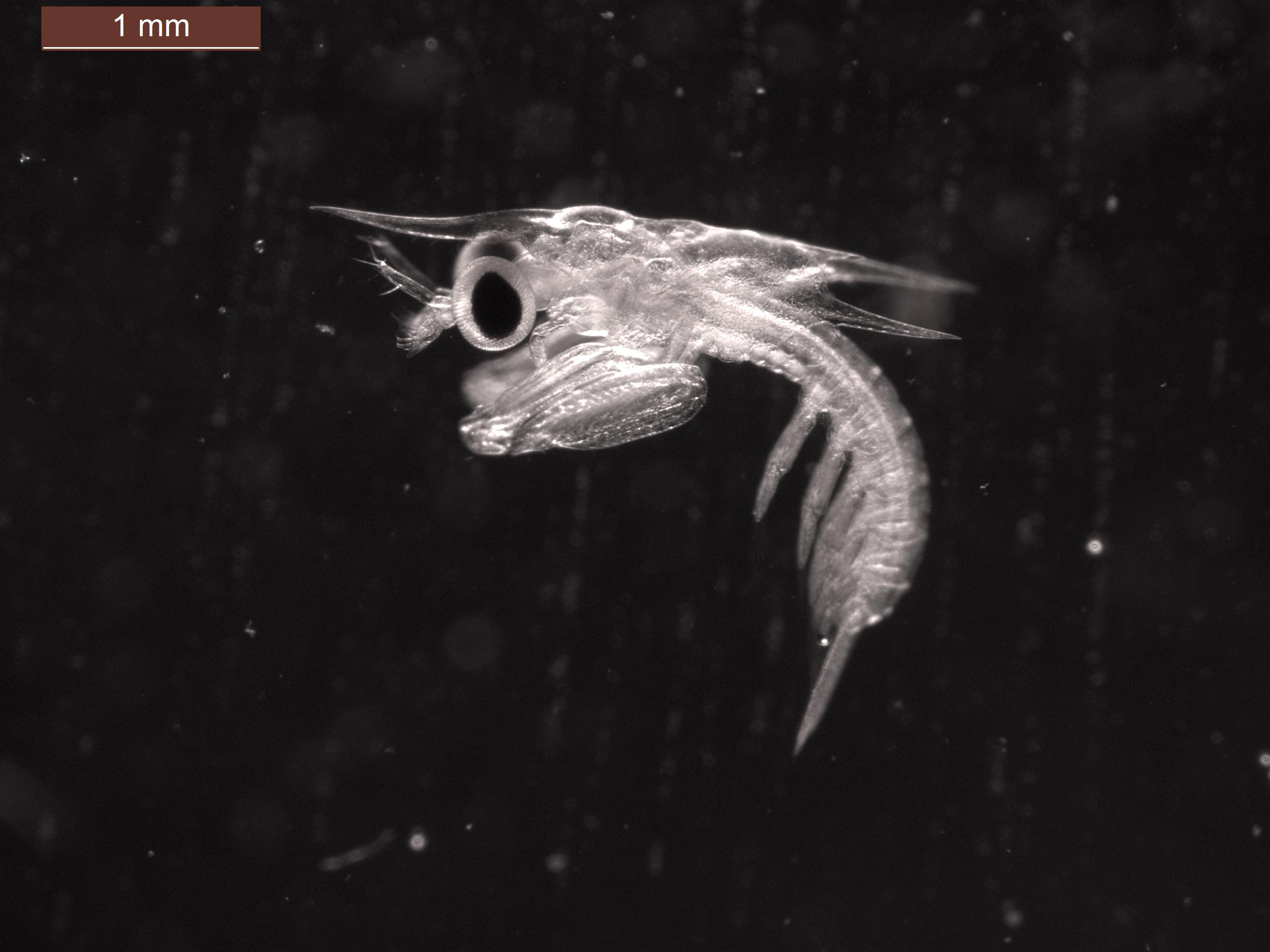
Mantis shrimp larvae start smashing prey just days after hatching, with adult-like, spring-loaded appendages that unleash ultra-fast, high-acceleration strikes.
Adult mantis shrimp pack an explosive punch that can split water, but no crustacean emerges fully formed. Minute larvae can undergo six or seven transformations before emerging as fully developed adults, and limbs and maneuvers develop over time. So, when do mantis shrimp larvae acquire the ability to pulverize their dinner and how powerful are the punches that these mini crustaceans pack?
“We knew that larval mantis shrimp have these beautiful appendages; Megan Porter and Eve Robinson at the University of Hawaii had captured normal videos of a couple of strikes a few years ago,” says Jacob Harrison from Duke University, USA. So, he packed up Sheila Patek’s high-speed camera and high-resolution lens and traveled to Hawai’i to investigate the developing crustacean’s maneuvers.
The team publish their discovery that minute mantis shrimp larvae can begin unleashing their ballistic blows as little as 9-days after hatching in Journal of Experimental Biology and show that the limbs reach blistering accelerations of 22 million deg/s2, moving at ~0.385mm/s, which is 5-10 times faster than the larval snacks they dine on
“The larvae can be incredibly tricky to collect,” says Harrison, recalling how he and Porter lured the microscopic creatures into their nets at night with lights. The problem was that the crustaceans came along with a Noah’s ark of other larval critters. “It can be incredibly challenging to sift through a bucket teeming with larval crabs, shrimp, fish, and worms to find the mantis shrimp,” laughs Harrison.
He then needed a technique for securing the Gonodactylaceus falcatus larvae in place for the camera. “I had to superglue a 4 mm-sized larva onto a toothpick, place it on a custom-designed rig, and orient the individual within view of the camera lens before I could even start collecting data. It took about a year to troubleshoot the right way to set up the camera before we knew that we could capture these videos,” Harrison recalls.
Capturing the Mechanics of a Microscopic Punch
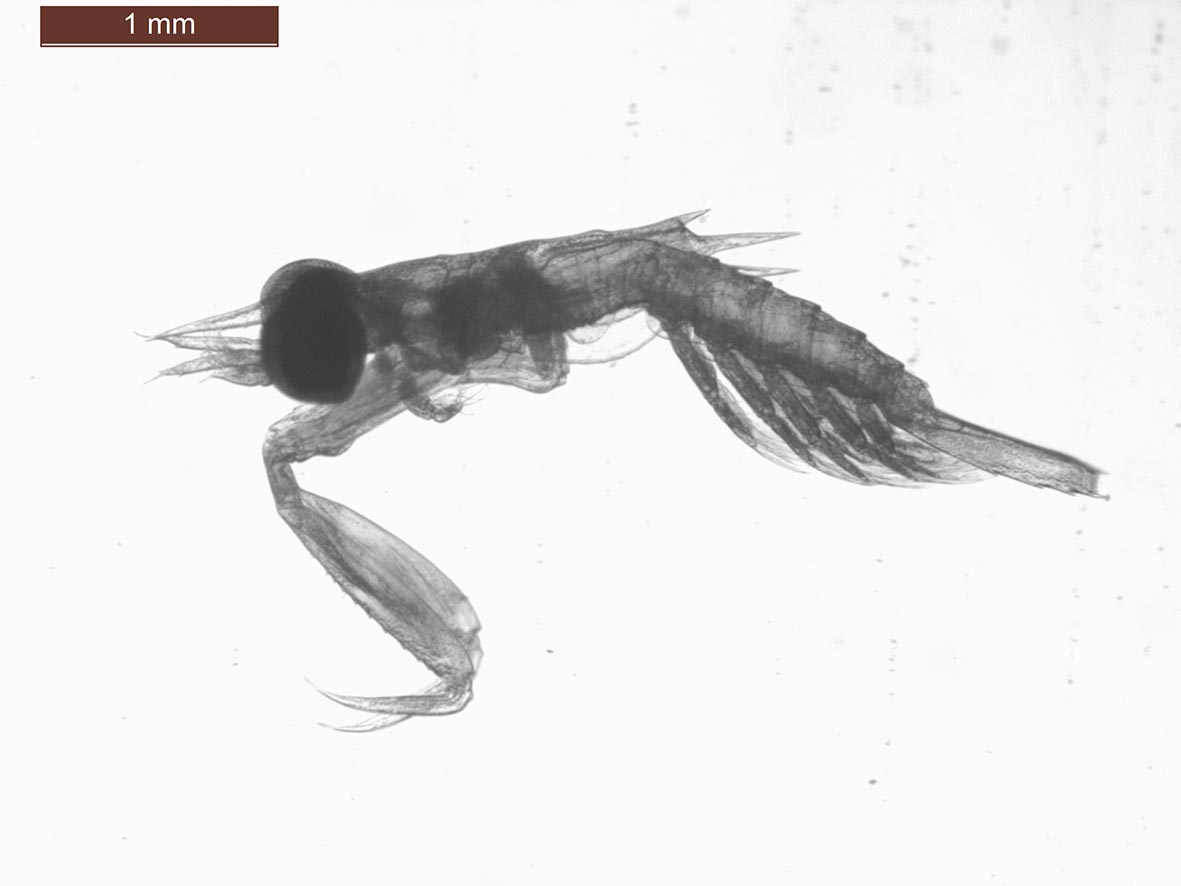
Analyzing the high-speed movies, Harrison, Patek, and Matt McHenry (University of California, Irvine, USA) could see a region on the first portion of the appendage bending to store energy — like a spring — as the larvae wound in the club-like limb ready for a flick. Then, the larvae released an internal latch that had held the appendage in place, releasing the stored energy and catapulting the limb into action. In fact, the larvae’s appendage and the way it operates is remarkably similar to that in the adults, just scaled down.
Most excitingly, the team realized that they could see the minute muscles within the larvae’s glassy bodies contracting as they bowed the exoskeleton, something that could only be imagined in adult mantis shrimp: “We were amazed,” Harrison says.
Development of Strike Ability
But when did the minute larvae develop their ability to annihilate prey with a single blow? Venturing off the Hawaiian shore, Harrison located an egg-laden female and retrieved her mat of eggs, but by the time they arrived at Duke University, the eggs had hatched.
“We weren’t sure we could keep the larvae alive in the lab,” Harrison recalls. However, he nurtured the youngsters patiently until they developed successfully to 28-day-old larvae and discovered that the limb only became fully operational when the youngsters began feeding, at around 9-15 days. It also turned out that the larvae could hurl the limb at rotational speeds of ~16,500deg/s, with eyewatering accelerations as fast as the adults. However, their smaller stature meant that the limb moved at ~0.385m/s, which is slower than the adults, but still quite speedy for a 4.2mm long creature. Even at their smallest, there is no escaping these spring-powered predators.
Reference: “Scaling and development of elastic mechanisms: the tiny strikes of larval mantis shrimp” by Jacob S. Harrison, Megan L. Porter, Matthew J. McHenry, H. Eve Robinson and S. N. Patek, 29 April 2021, Journal of Experimental Biology.
DOI: 10.1242/jeb.235465
Never miss a breakthrough: Join the SciTechDaily newsletter.
Follow us on Google and Google News.