
Using precision instruments and new mapping and machine-learning tools, a research team has been pinpointing sources of the greenhouse gas.
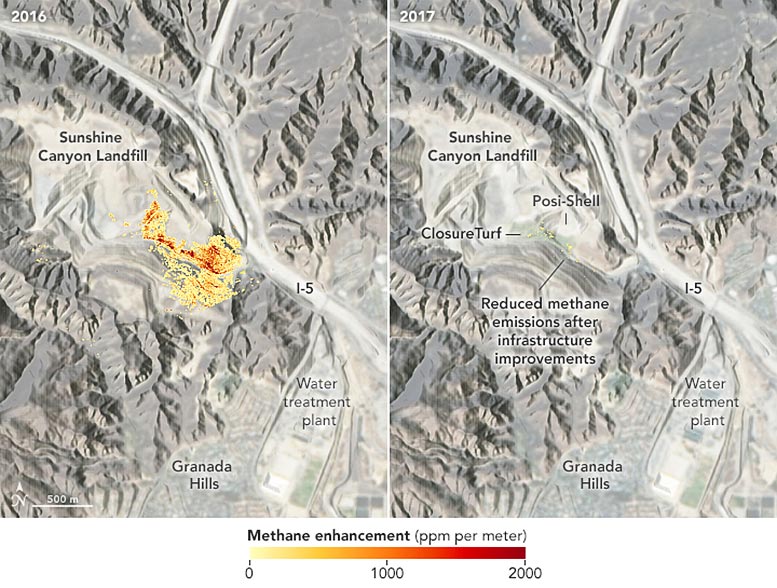
In October 2016, an aircraft equipped with NASA’s Airborne Visible Infrared Imaging Spectrometer–Next-Generation (AVIRIS-NG) instrument detected multiple plumes of methane arising from the Sunshine Canyon landfill near Santa Clarita, California. The plumes were large enough that researchers from the Jet Propulsion Laboratory (JPL) notified facility operators and local enforcement agencies about it. It was an important step in a process of better accounting for local emissions of the gas.
Methane is a short-lived but powerful greenhouse gas that has been responsible for about 20 percent of global warming since the Industrial Revolution. Dairy cows and beef cattle produce methane through their guts and release it in burps. Their manure also produces methane, and when it is stored in manure lagoons it can be a major source of emissions. Oil and natural gas production releases methane from underground, and the infrastructure to store and transport it can leak. And landfills are a source of methane when organic materials are broken down by bacteria in anaerobic conditions.
California’s Ambitious Methane Reduction Goals
The state of California aims to reduce such methane emissions, trying to cut back to 40 percent below 2013 levels by the end of this decade. But in order to reduce emissions, the state needs to get a better handle on the sources.
The California Air Resources Board (CARB)—the state agency that oversees air pollution control efforts—traditionally estimated greenhouse gas emissions by taking inventory of known emitting activities. But this approach can miss leaks or other fugitive emissions, so CARB staff became interested in measuring emissions from the air to improve greenhouse gas accounting and to pinpoint mitigation opportunities.
The images above show methane measurements made by the AVIRIS-NG instrument during October 2016 and 2017 flights over Santa Clarita, California. Methane emissions from the Sunshine Canyon landfill are shown in a yellow to red gradient, with red representing the highest concentrations. The right image shows the reduction in methane concentrations after landfill improvements were implemented.
Mapping and Prioritizing Methane Sources Statewide
The flights were part of the California Methane Survey, an ongoing project to map sources of methane emissions around the state. But before any flights took off, climate scientist Francesca Hopkins of the University of California, Riverside, and Riley Duren of JPL (now at the University of Arizona) set out to map all potential sources of methane around the state in order to better focus limited flight time and prioritize observations.
They decided to use a GIS-based approach, assimilating many publicly available geospatial datasets to develop a map that could help them quickly match methane plumes to likely sources. The research team organized potential methane-emitting infrastructure in California into three sectors: energy, agriculture, and waste. The dataset, called Sources of Methane Emissions (Vista-CA), includes more than 900,000 entries and is available at NASA’s Oak Ridge National Laboratory Distributed Active Archive Center (ORNL DAAC).
From August 2016 to November 2017, a JPL-based team flew aircraft equipped with the AVIRIS-NG instrument over 22,000 square miles of the state. “Currently there is no methane observing system that can efficiently survey the entire land surface at high resolution,” said Duren. “We had to focus on high-priority areas.” The flight paths were planned so that they would cover at least 60 percent of methane point-source infrastructure in California.
To speed up the data analysis, Duren and colleagues then used machine learning techniques (such as neural networks) to automatically identify plumes detected during the flights. In parallel, graduate student Talha Rafiq from UC Riverside developed an algorithm to attribute methane plume observations to the most likely Vista-CA source. The technologies allowed the team to share their findings within weeks with facility operators and regulators in California to alert them of fugitive methane emissions and to help accelerate remediation.
Small Sources, Large Impact
More than 272,000 individual facilities and equipment components were surveyed. Of those sites, emissions from less than 0.2 percent of that infrastructure were responsible for at least one third of California’s methane inventory. Landfills and composting facilities were responsible for 41 percent of the emissions measured. Duren, Hopkins, and others published their findings in Nature in 2019.
In the case of Sunshine Canyon, the landfill operator confirmed the methane emissions and determined that they were due to problems with surface cover and with gas capture systems. Over the next year the operator instituted a number of changes that dramatically reduced emissions. Subsequent flyovers with AVIRIS-NG confirmed a reduction in methane. These findings were documented by Duren, Daniel Cusworth (project scientist at the University of Arizona), and others in Environmental Research Letters in 2020.
Data from the survey can be viewed on the Methane Source Finder portal. Some of the funding for the research came from NASA’s Advancing Collaborative Connections for Earth System Science program and from the Prototype Methane Monitoring System for California in NASA’s Carbon Monitoring System.
NASA Earth Observatory image by Lauren Dauphin, using data from Cusworth, Daniel, et al. (2020), Landsat data from the U.S. Geological Survey and topographic data from the National Elevation Dataset (NED). Story by Emily Cassidy, NASA Earthdata.
Never miss a breakthrough: Join the SciTechDaily newsletter.
Follow us on Google and Google News.