
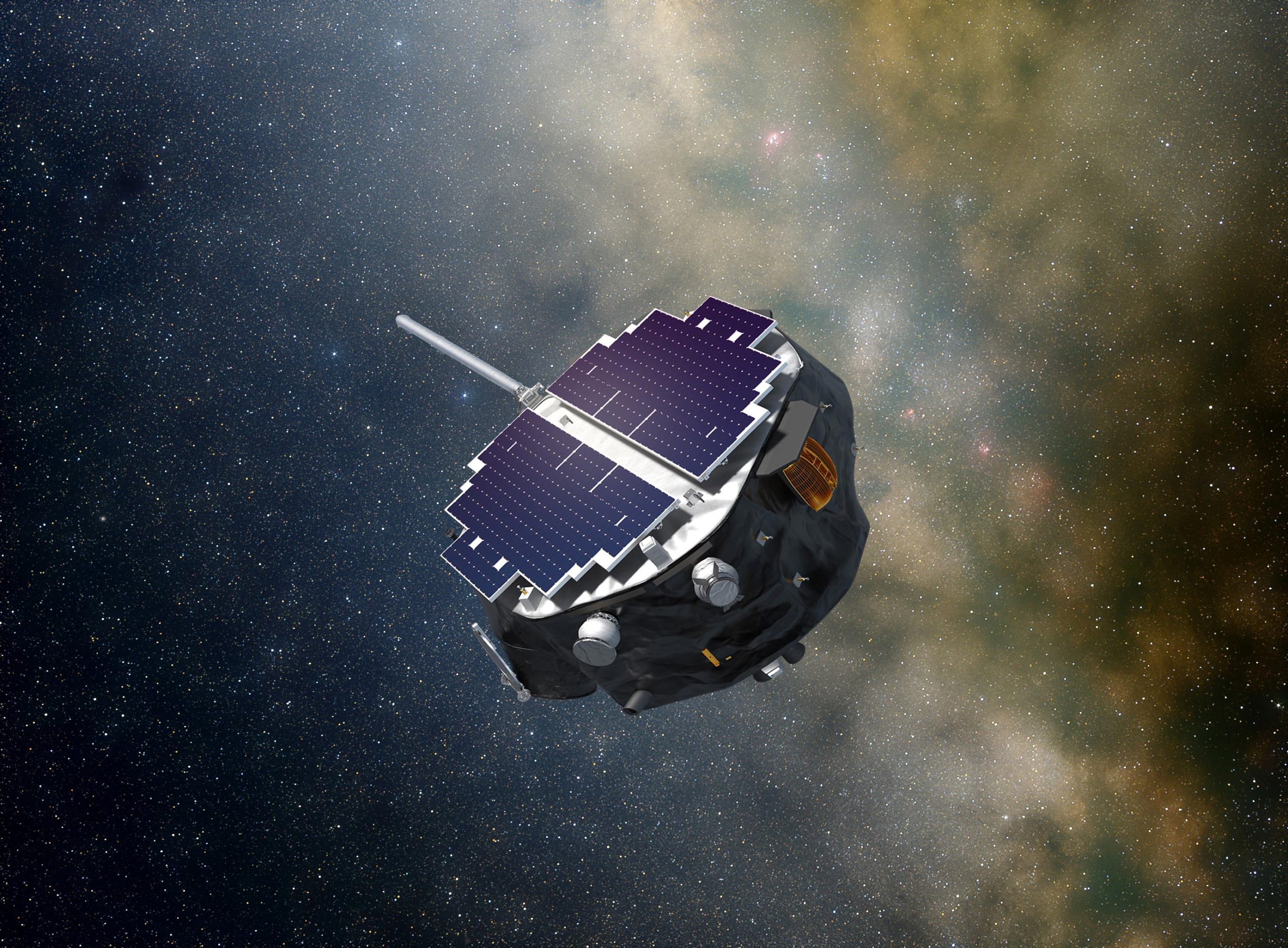
NASA and SpaceX have rescheduled the launch of the IMAP spacecraft to September 2025 to allow more time for preparing its flight systems.
The mission will explore the heliosphere to understand the Sun’s protective bubble and its effects on space weather and life. Accompanying IMAP are two rideshare missions: the Carruthers Geocorona Observatory and NOAA’s Space Weather Follow On – Lagrange 1, which will study Earth’s outer atmosphere and monitor solar activity, respectively. All three spacecraft will operate from Lagrange point 1 to efficiently monitor space conditions.
IMAP Launch Delay and Mission Overview
NASA and SpaceX have rescheduled the launch of the Interstellar Mapping and Acceleration Probe (IMAP) spacecraft to no earlier than September 2025. This revised timeline allows for additional preparation and testing of IMAP’s flight systems before launch.
The IMAP mission is designed to study the heliosphere, a magnetic bubble created by the Sun that acts as a shield for our solar system. By analyzing and mapping particles traveling toward Earth from the edge of interstellar space, IMAP will provide critical insights into this protective boundary. The mission will also investigate the solar wind — a continuous flow of charged particles from the Sun — as well as energetic particles and cosmic rays within the heliosphere. Understanding these particles is vital because they can influence human space exploration, disrupt technological systems, and potentially play a role in the existence of life in the universe.

Rideshare Missions and Objectives
In addition to IMAP, two other spacecraft will launch as rideshare missions:
- NASA’s Carruthers Geocorona Observatory will capture light from Earth’s geocorona, the part of the outer atmosphere that emits ultraviolet light. Studying this will allow researchers to better understand the atmosphere and improve our ability to predict how solar activity can affect the Earth.
- The National Oceanic and Atmospheric Administration’s (NOAA) Space Weather Follow On – Lagrange 1 mission will observe the Sun’s outer atmosphere, or corona, and measure the Sun’s constant stream of particles called the solar wind before it reaches Earth, to monitor the conditions that create space weather.
During their missions, all three spacecraft will orbit at Lagrange point 1, which is one of five areas where the gravity from Earth balances out the gravity from the Sun. Spacecraft that orbit at a Lagrange point need less fuel to remain in that position. Lagrange 1, which is about one million miles from Earth towards the Sun, is an excellent place to observe the Sun and provide advanced warning of space weather conditions headed towards Earth.
Launch Details and Leadership
The IMAP spacecraft, along with two companion missions, will launch aboard a SpaceX Falcon 9 rocket from Space Launch Complex 40 at Cape Canaveral Space Force Station in Florida.
The IMAP mission is led by Princeton University professor David J. McComas, supported by an international team from 25 partner institutions. The spacecraft is built and operated by the Johns Hopkins Applied Physics Laboratory in Laurel, Maryland. IMAP represents the fifth mission in NASA’s Solar Terrestrial Probes program, which is managed by the Explorers and Heliophysics Project Division at NASA’s Goddard Space Flight Center in Greenbelt, Maryland, under the agency’s Heliophysics Division of the Science Mission Directorate.
The Carruthers Geocorona Observatory, led by University of Illinois Urbana-Champaign professor Lara Waldrop, is included as a “mission of opportunity” within the Solar Terrestrial Probes program. Meanwhile, the Space Weather Follow On – Lagrange 1 mission, overseen by NOAA, is funded and managed to provide data operations, product development, and distribution to users.
NASA’s Launch Services Program, based at Kennedy Space Center in Florida, is responsible for coordinating the launch services for these missions.
Never miss a breakthrough: Join the SciTechDaily newsletter.
Follow us on Google and Google News.