
Close Menu
    Facebook X (Twitter) Instagram
    SciTechDaily
    • Biology
    • Chemistry
    • Earth
    • Health
    • Physics
    • Science
    • Space
    • Technology
    Facebook X (Twitter) Pinterest YouTube RSS
    SciTechDaily
    Home»Space»Mars Express Marks 25,000 Orbits With a Spectacular Martian Showcase
    Space

    Mars Express Marks 25,000 Orbits With a Spectacular Martian Showcase

    By European Space Agency (ESA)April 20, 2024No Comments5 Mins Read
    Facebook Twitter Pinterest Telegram LinkedIn WhatsApp Email Reddit
    Share
    Facebook Twitter LinkedIn Pinterest Telegram Email Reddit
    Mars Express 25000 Rotated
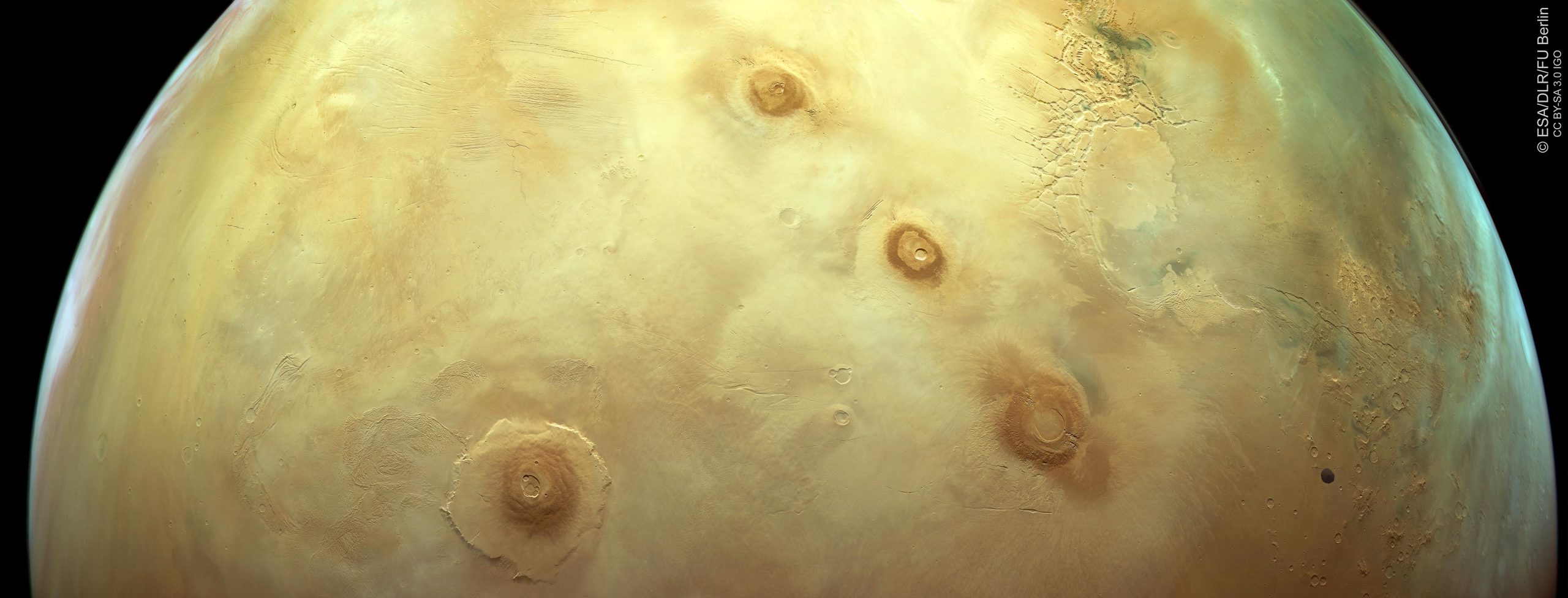
    ESA’s Mars Express orbiter celebrated its 25,000th orbit by capturing a stunning high-altitude image of Mars, featuring the Tharsis region and Phobos. Over two decades, the mission has extensively mapped Mars’s atmosphere, studied its moons, and provided new insights into its surface and geological features, significantly advancing our understanding of the planet. Credit: ESA/DLR/FU Berlin

    Mars Express marks 25,000 orbits with a new image of Mars, showcasing volcanoes and the moon Phobos, highlighting the mission’s ongoing contributions to Martian science.

    ESA’s Mars Express recently looped around Mars for the 25,000th time – and the orbiter has captured yet another spectacular view of the Red Planet to mark the occasion.

    The new high-altitude view was taken by Mars Express’s High Resolution Stereo Camera (HRSC). It features many of Mars’s towering volcanoes and even includes a surprise appearance from the planet’s largest moon, Phobos.

    Mars Express arrived at Mars in late 2003, and completed its 25,000th orbit on October 19, 2023. In the two decades since its arrival, the orbiter has completely transformed our understanding of the planet. It’s mapped the atmosphere more completely than ever before, traced the history of water across Mars’s surface, studied the two small martian moons in unprecedented detail, and returned breathtaking views of the planet in three dimensions.

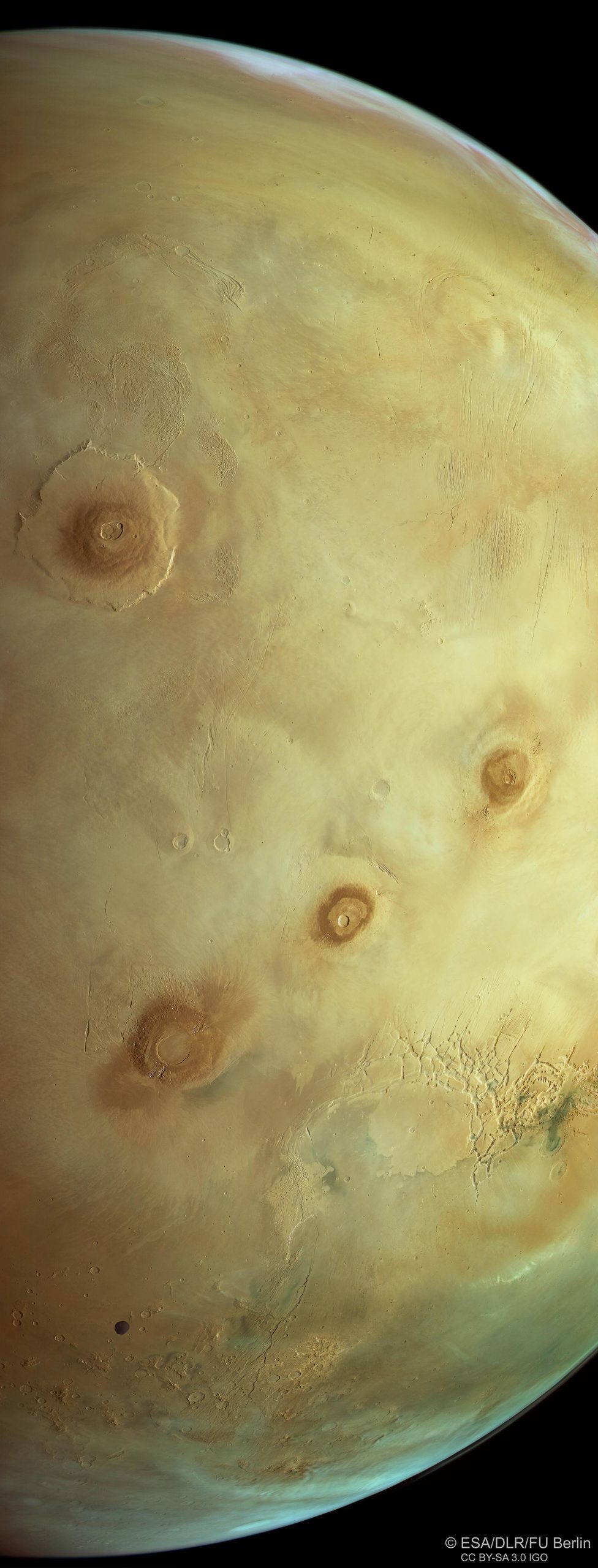
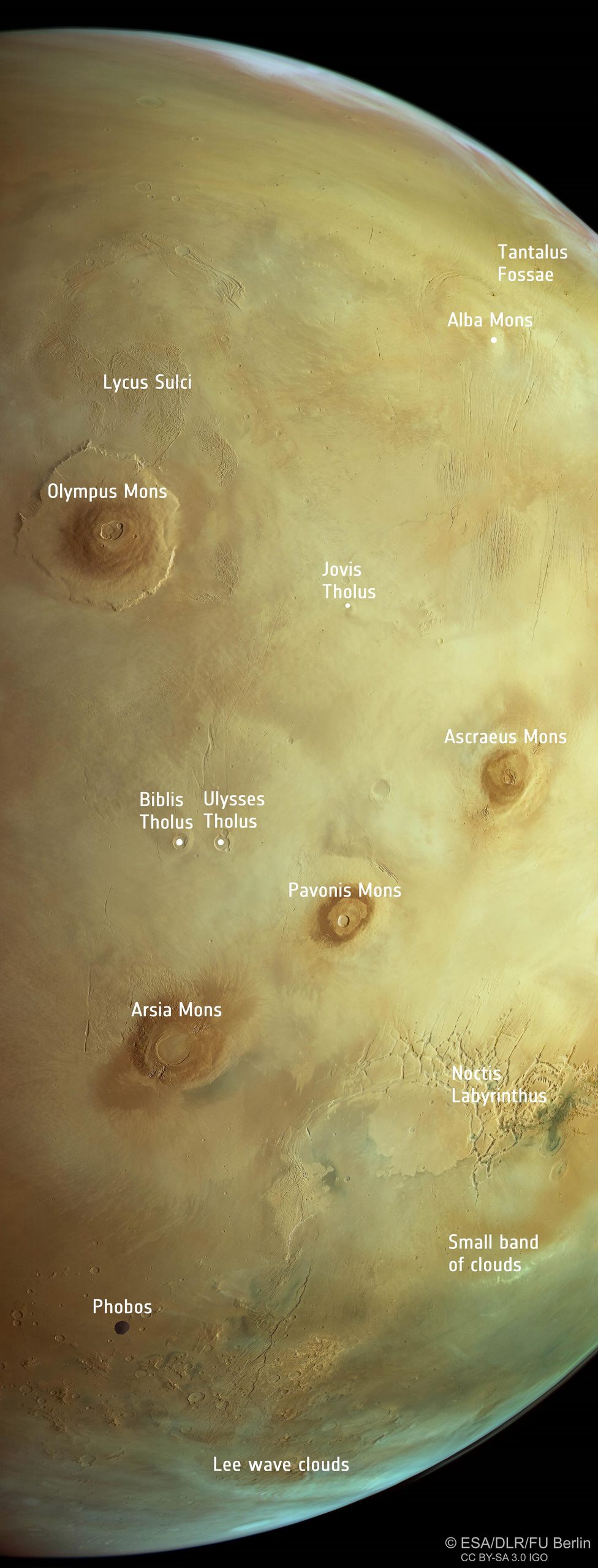
    This new image is no exception. It focuses on the Tharsis region, which covers about one-quarter of the planet’s surface and is home to Mars’s famously colossal volcanoes. Many volcanoes can be seen here: Olympus, Arsia, Pavonis and Ascraeus Mons, and Jovis, Biblis and Ulysses Tholus. Olympus Mons is the largest, reaching nearly 22 km high (compared to Mount Everest’s 8.8 km here on Earth).
    Mars Express 25000
    This image from ESA’s Mars Express shows a slice of Mars imaged to mark a milestone for ESA’s Mars Express: its 25,000th orbit around the Red Planet. The stunning view shows volcanoes, valleys, craters, clouds, and even a flying visit from Mars’s largest moon, Phobos. This image comprises data gathered by Mars Express’s High Resolution Stereo Camera (HRSC) on October 19, 2023, during orbit 25,000. It was created using data from the nadir channel, the field of view aligned perpendicular to the surface of Mars, and the color channels of the HRSC. The ground resolution is <450 m/pixel and the image is centered at about 2°N/248°E. Credit: ESA/DLR/FU Berlin

    Canyons and Clouds

    Fascinating as they are, Mars’s volcanoes are far from the only interesting feature seen here. Excitingly, Mars Express has also captured an unexpected visitor in Mars’s largest moon, Phobos, which can be seen as a dark blob passing through to the lower left. Phobos sits very close to Mars by Solar System standards, orbiting just 6000 km from Mars’s surface. For context, our own moon lies about 385,000 km away from Earth’s surface.

    The fractured, fissured canyons of Noctis Labyrinthus – viewed several times before by Mars Express, including in a visualized fly-through – can also be seen below the trio of volcanoes slicing across the frame. The large landslide of Lycus Sulci can be spotted just north of Olympus Mons, as can the troughs and valleys of Tantalus Fossae to the upper right. These features have also been explored before by Mars Express.
    Mars Express 25000 Annotated
    This image from ESA’s Mars Express shows a slice of Mars imaged to mark a milestone for ESA’s Mars Express: its 25,000th orbit around the Red Planet. The stunning view shows volcanoes, valleys, craters, clouds, and even a flying visit from Mars’s largest moon, Phobos. Numerous labels have been placed across the terrain, highlighting features and regions of note. Credit: ESA/DLR/FU Berlin

    Some fascinating weather features can be seen to the bottom of the frame, where a blue tinge creeps into this otherwise sand-hued scene. The colorful bands are clouds: a small, bright band of clouds to the right, and rippling ‘lee wave’ clouds to the left. Lee wave clouds arise when stacks of airflow over an obstacle on the terrain below, like a raised ridge, and receive a burst of speed in the process. The air then forms a wave-like feature on the sheltered (lee) side of the ridge.
    Topography and Context of Tharsis and Surroundings
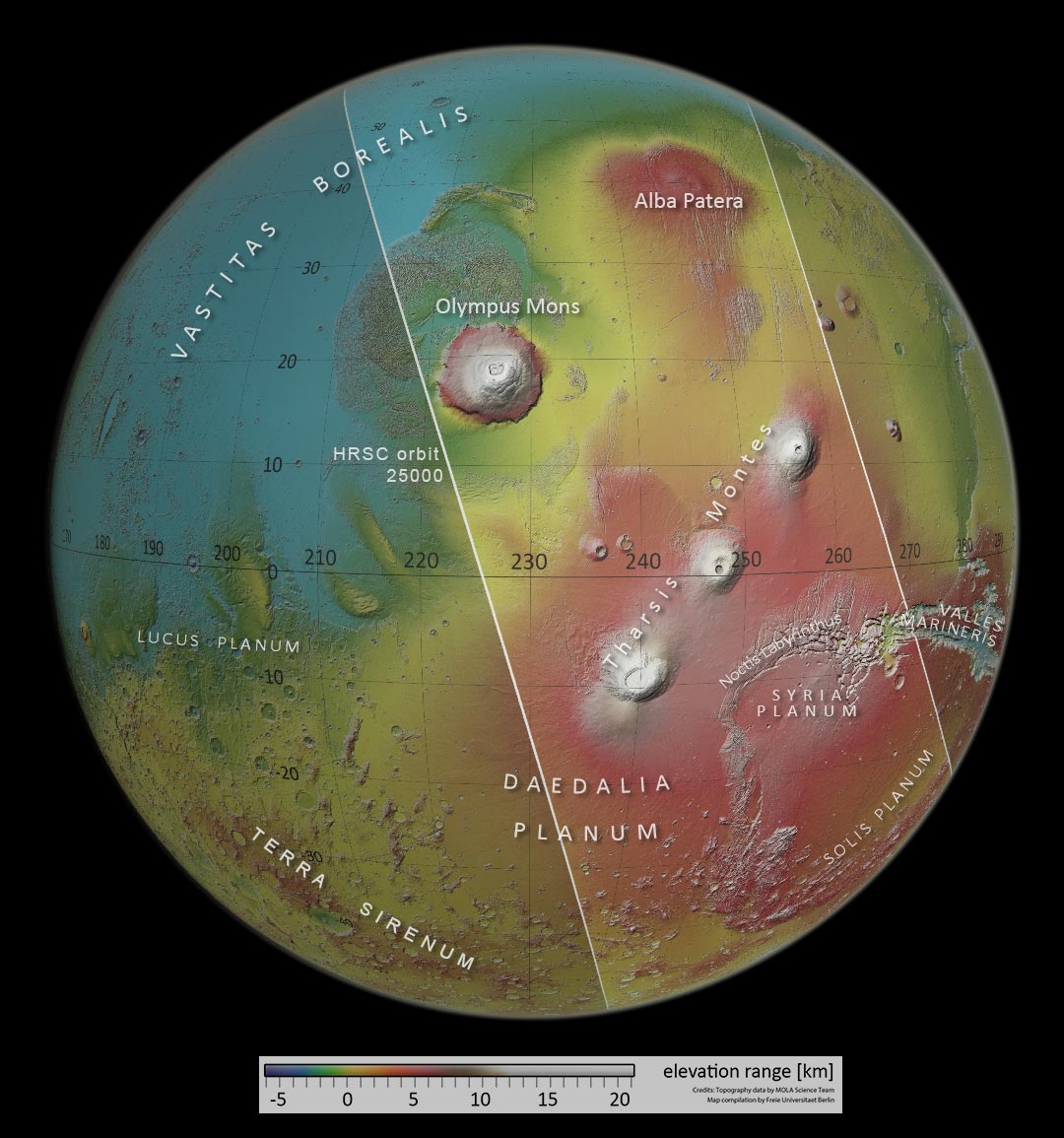
    This color-coded image shows the location and topography of a slice of Mars imaged to mark a milestone for ESA’s Mars Express: its 25,000th orbit around the Red Planet.
    The area outlined by the diagonal rectangular box indicates the area imaged by Mars Express on October 19, 2023. The globe view is based on a digital terrain model of the region, from which the topography of the landscape can be derived. Lower parts of the surface are shown in blues and purples, while higher altitude regions show up in whites and reds, as indicated on the scale at the bottom. The ground resolution is <450 m/pixel and the image is centered at about 2°N/248°E.
    Credit: NASA/JPL/USGS/MOLA; FU Berlin

    Exploring Mars

    Mars Express has revealed a great deal about Mars in the last two decades – and it’s not stopping yet. The orbiter continues to image Mars’s surface, map its minerals, explore the composition and circulation of its atmosphere, probe beneath its crust, and study the Martian environment.

    The spacecraft’s HRSC, responsible for these new images marking 25,000 orbits, has shown us everything from wind-sculpted ridges and grooves to sinkholes on the flanks of colossal volcanoes to impact craters, tectonic faults, river channels, and ancient lava pools. The mission has been immensely productive over its lifetime, creating a far fuller and more accurate understanding of our planetary neighbor than ever before.

    The Mars Express High Resolution Stereo Camera (HRSC) was developed and is operated by the German Aerospace Center (Deutsches Zentrum für Luft- und Raumfahrt; DLR).

    Never miss a breakthrough: Join the SciTechDaily newsletter.
    Follow us on Google and Google News.

    European Space Agency Mars Mars Express Planets
    Share. Facebook Twitter Pinterest LinkedIn Email Reddit

    Related Articles

    Mars As Never Seen Before: ESA’s Mars Express New Global Color Mosaic

    Mars Express Uncovers Collapsed Chains of Craters on Giant Martian Volcano

    Mars’ Mega Volcano: A Tour of Ascraeus Mons’ Rugged Terrain

    Fascinating Geology on Mars: Deep Fractures and Water-Carved Valleys

    Chaotic Crust Contains Clues to Mars’ Watery Past in Search for Signs of Past Life on the Red Planet

    The “Grandest Canyon” in the Solar System: Mars Express Captures Stunning Images of Massive Martian Canyon

    Martian Brain Freeze: Mars Express Reveals Utopia Planitia

    Mars Express: Making a Splash in a Lava Sea

    Intriguing Martian Scars: An Ancient Crater Triplet on Mars

    Leave A Reply Cancel Reply

    • Facebook
    • Twitter
    • Pinterest
    • YouTube

    Don't Miss a Discovery

    Subscribe for the Latest in Science & Tech!

    Trending News

    Enormous Prehistoric Insects Puzzle Scientists

    Scientists Develop Bioengineered Chewing Gum That Could Help Fight Oral Cancer

    After 37 Years, the World’s Longest-Running Soil Warming Experiment Uncovers a Startling Climate Secret

    NASA Satellite Captures First-Ever High-Res View of Massive Pacific Tsunami

    ADHD Isn’t Just a Deficit: Study Reveals Powerful Hidden Strengths

    Scientists Discover Stem Cells That Could Regrow Teeth and Bone

    Early Cannabis Use May Stall Key Brain Skills in Teens

    Popular Vitamin D Supplement Has “Previously Unknown” Negative Effect, Study Finds

    Follow SciTechDaily
    • Facebook
    • Twitter
    • YouTube
    • Pinterest
    • Newsletter
    • RSS
    SciTech News
    • Biology News
    • Chemistry News
    • Earth News
    • Health News
    • Physics News
    • Science News
    • Space News
    • Technology News
    Recent Posts
    • Beyond Inflammation: Scientists Uncover New Cause of Persistent Rheumatoid Arthritis
    • Cancer-Like Mutations Found in the Brain May Be Driving Alzheimer’s Disease
    • A Simple Molecule Could Unlock Safer, Easier Weight Loss
    • Stretching Diamonds Unlocks Powerful New Quantum Sensing Abilities
    • This Robot Could Explore Mars 3x Faster Than Today’s Rovers
    Copyright © 1998 - 2026 SciTechDaily. All Rights Reserved.
    • Science News
    • About
    • Contact
    • Editorial Board
    • Privacy Policy
    • Terms of Use

    Type above and press Enter to search. Press Esc to cancel.