
Close Menu
    Facebook X (Twitter) Instagram
    SciTechDaily
    • Biology
    • Chemistry
    • Earth
    • Health
    • Physics
    • Science
    • Space
    • Technology
    Facebook X (Twitter) Pinterest YouTube RSS
    SciTechDaily
    Home»Earth»Massive Iceberg on Collision Course With South Georgia
    Earth

    Massive Iceberg on Collision Course With South Georgia

    By European Space AgencyNovember 11, 20201 Comment2 Mins Read
    Facebook Twitter Pinterest Telegram LinkedIn WhatsApp Email Reddit
    Share
    Facebook Twitter LinkedIn Pinterest Telegram Email Reddit
    Iceberg on Collision Course With South Georgia
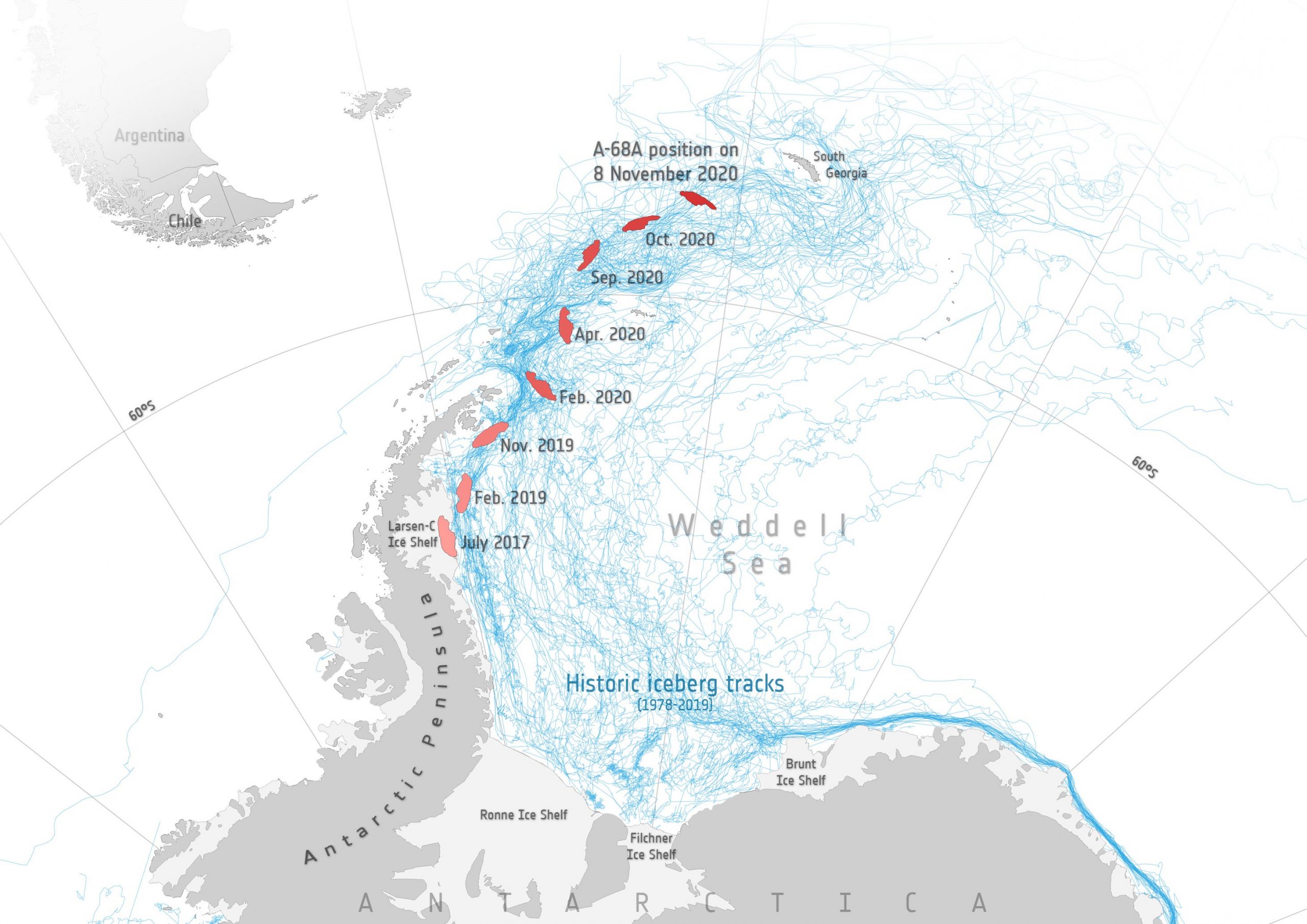
    Over the last three years, satellite missions such as Copernicus Sentinel-1 have been used to track the massive iceberg as it has drifted in the Southern Ocean. This map includes historic iceberg tracks, based on data from a number of satellites including ESA’s ERS-1 and ERS-2 as part of the Antarctic Iceberg Tracking Database, and shows that A-68A is following this well-trodden path. Credit: Contains modified Copernicus Sentinel data (2017–20), processed by ESA; Antarctic Iceberg Tracking Database

    The colossus iceberg that split from Antarctica’s Larsen C ice shelf on July 12, 2017, is on a collision course with South Georgia.

    Over the last three years, satellite missions such as Copernicus Sentinel-1 have been used to track the berg as it has drifted in the Southern Ocean. For the first two years, it remained close to its parent ice sheet, impeded by sea ice. But now, as the map shows, the main chunk of the A-68 berg, known as A-68A, is heading rapidly for South Georgia. It is now about 350 km (220 mi) from the island.

    About the same size as the South Atlantic island, it could ground in the shallow waters offshore and cause real problems for the island wildlife and seafloor-dwelling life. Penguins and seals need access to the sea to feed so the iceberg could easily block their foraging routes and life on the seafloor could be crushed if the berg grounds. The fear is that if the berg does anchor against the South Georgia coast, it could remain there for up to 10 years. When the A38 grounded here in 2004, many dead penguin chicks and seal pups were found along the shoreline.

    The map includes historic iceberg tracks, based on data from a number of satellites including ESA’s ERS-1 and ERS-2 as part of the Antarctic Iceberg Tracking Database, and shows that A-68A is following this well-trodden path. Hopefully, currents will take A-68A around South Georgia and off to the northwest, and eventually break up.

    Never miss a breakthrough: Join the SciTechDaily newsletter.
    Follow us on Google and Google News.

    European Space Agency Iceberg
    Share. Facebook Twitter Pinterest LinkedIn Email Reddit

    Related Articles

    Halloween Crack in Antarctica

    Mega Iceberg – One of the Largest on Record – Released 150 Billion Tons of Freshwater Near Island

    Meet the World’s Largest Iceberg: A-76 Is Over 100 Miles Long

    Massive Iceberg – 10 Times the Size of San Francisco – Breaks Off Brunt Ice Shelf in Antarctica

    A-68A: Is This the End of One of the Largest Icebergs of All Time?

    Huge Chunk of Ice Breaks Off Giant Iceberg As It Drifts Alarmingly Close to South Georgia

    Giant Iceberg on Collision Course With South Georgia Could Wreak Havoc [Video]

    Hit or Miss? Gigantic Iceberg Bears Down on South Georgia Island

    Tracking Colossal Iceberg – Larger Than Delaware – During a 3-Year, 650-Mile Journey

    1 Comment

    1. kamir bouchareb st on November 15, 2020 11:25 pm

      nice topic

      Reply
    Leave A Reply Cancel Reply

    • Facebook
    • Twitter
    • Pinterest
    • YouTube

    Don't Miss a Discovery

    Subscribe for the Latest in Science & Tech!

    Trending News

    The Human Family Tree May Need a Major Rewrite

    Scientists Find a Surprising Cancer-Fighting Effect in Dark Sweet Cherries

    New AI Detects Hidden Warning Signs of Solar Eruptions Hours Before They Emerge

    Scientists Discover an Unexpected Mental Health Benefit of Ozempic

    Paleontologists Spent 20 Years Dating Thousands of Fossils – Here’s What They Found

    Scientists Discover a “New” Frog That Was Hiding in Plain Sight for 100 Years

    Earth’s Inner Core May Hide a Strange State of Matter

    The Brain Makes New Neurons Even in Adulthood. Depression May Stop It

    Follow SciTechDaily
    • Facebook
    • Twitter
    • YouTube
    • Pinterest
    • Newsletter
    • RSS
    SciTech News
    • Biology News
    • Chemistry News
    • Earth News
    • Health News
    • Physics News
    • Science News
    • Space News
    • Technology News
    Recent Posts
    • Scientists Discover Hidden Cells That Help Lung Cancer Evade the Immune System
    • Tomatoes Contain an Invisible Ingredient With Surprising Effects on Liver Health
    • Scientists Push Molecules on a Surface to the Ultimate Quantum Limit
    • World’s First Heat-Powered Cooling System Turns Waste Heat Into Cold
    • Greenland Just Lost a Manhattan-Sized Slab of Ice
    Copyright © 1998 - 2026 SciTechDaily. All Rights Reserved.
    • Science News
    • About
    • Contact
    • Editorial Board
    • Privacy Policy
    • Terms of Use

    Type above and press Enter to search. Press Esc to cancel.