
A-68A: The Epic Journey of a Giant Iceberg
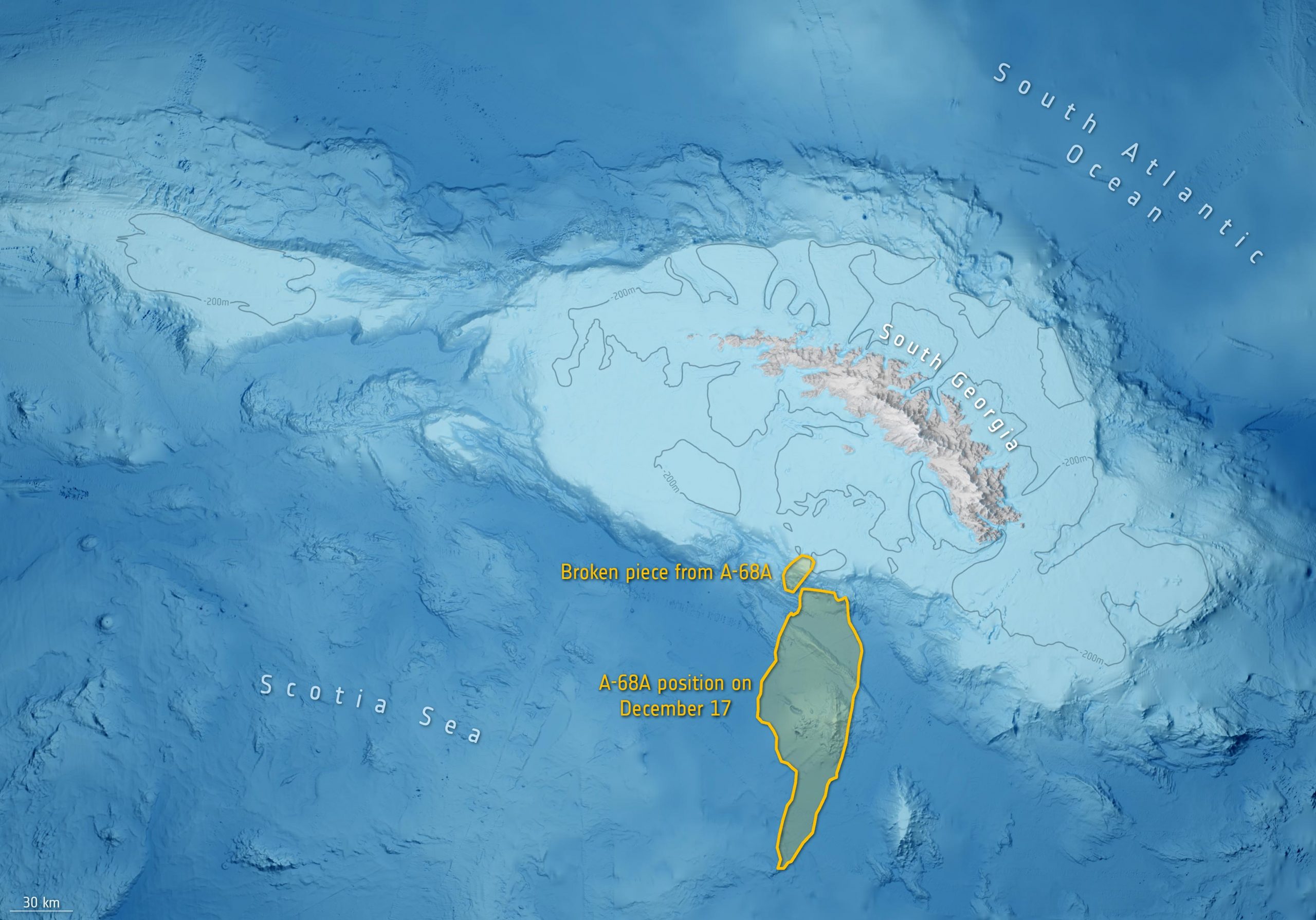
In July 2017, a giant iceberg, named A-68, snapped off Antarctica’s Larsen-C ice shelf and began an epic journey across the Southern Ocean. Three and a half years later, the main part of the iceberg, A-68A, drifted worryingly close to South Georgia. Concerns were that the berg would run aground in the shallow waters offshore. This would not only cause damage to the seafloor ecosystem but also make it difficult for island wildlife, such as penguins, to make their way to the sea to feed. Using measurements from satellites, scientists have charted how A-68A shrunk towards the end of its voyage, which fortunately prevented it from getting stuck. However, the downside is that it released a colossal 152 billion tonnes of freshwater close to the island, potentially having a profound effect on the island’s marine life.
When A-68 was spawned, it had a surface area of more than twice the size of Luxemburg – one of the largest icebergs on record.
It lost a chunk of ice almost immediately after being calved, resulting in the larger berg being renamed A-68A, and its offspring became A-68B. In April 2020, A-68A lost another chunk subsequently called A-68C.
Antarctic icebergs are named from the Antarctic quadrant in which they were originally sighted, then a sequential number, and then if the iceberg breaks, a sequential letter is added.
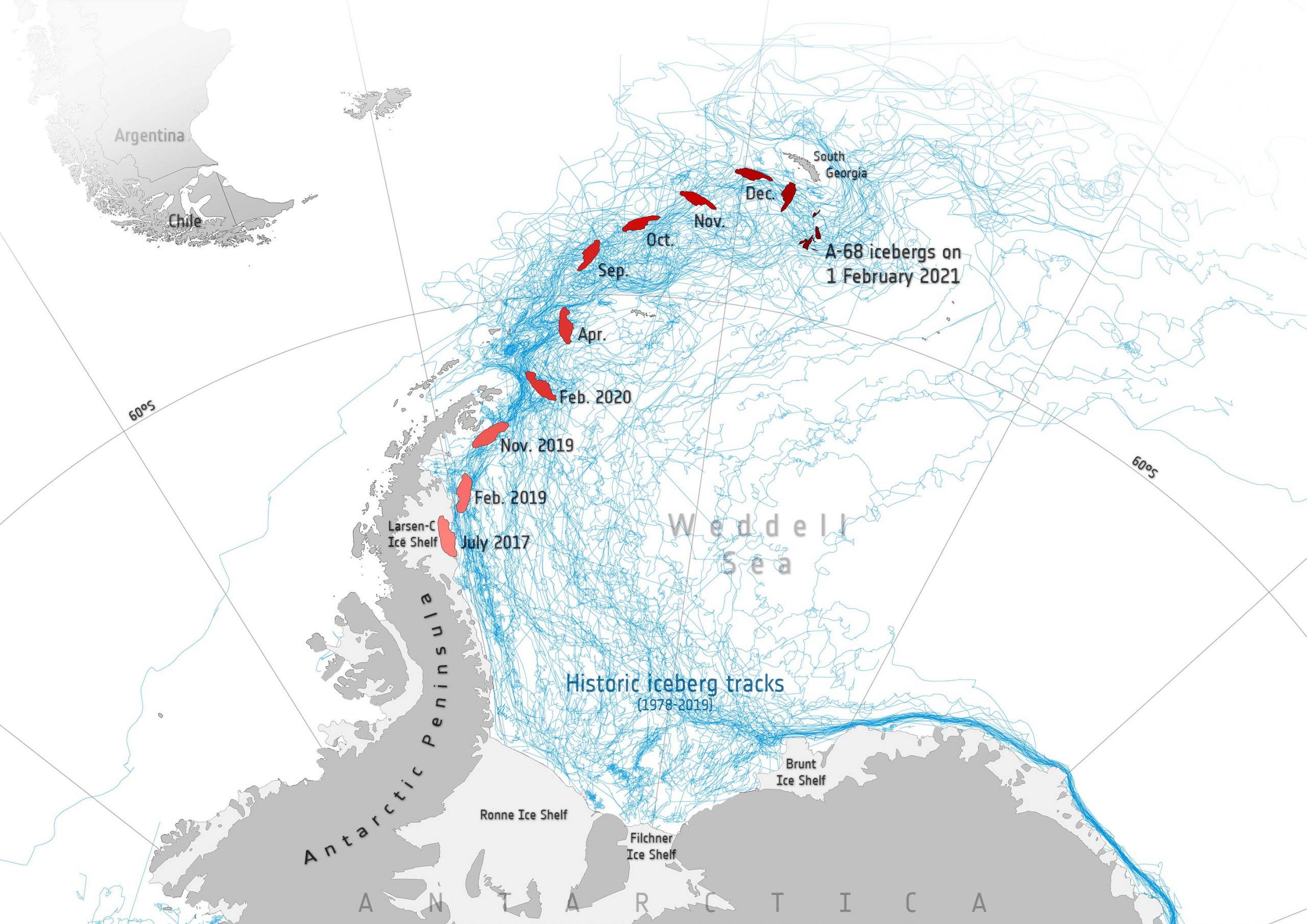
For the first two years of its life, A-68A stayed in the cold waters of the Weddell Sea close to its parent ice shelf. Here, it experienced little in the way of melting. However, once the berg began its northward journey across the Drake Passage, it traveled through increasingly warm waters and began to melt.
Measuring A-68A’s Melting and Freshwater Release
Altogether, the A-68A iceberg thinned by 67 meters (220 feet) from its initial thickness of 235 meters (771 feet), with the rate of melting rising sharply as the berg drifted in the Scotia Sea around South Georgia.
A paper published in Remote Sensing of Environment describes how researchers from the Centre for Polar Observation and Modelling in the UK and the British Antarctic Survey combined measurements from different satellites to chart how A-68A changed in area and thickness throughout its life cycle.
The journey of A-68A was charted using observations from five different satellite missions.
To track how the area of A-68A changed, they used optical imagery from the Copernicus Sentinel-3 mission and from the MODIS instrument on the US Terra mission, along with radar data from the Copernicus Sentinel-1 mission. While the Sentinel-1 radar imagery offers all-weather capability and higher spatial resolution, MODIS and Sentinel-3 optical imagery have higher temporal resolution but cannot be used during the polar night and on cloudy days.
To measure changes in the iceberg’s freeboard, or the height of the ice above the sea surface, they used data from ESA’s CryoSat mission and from the US ICESat-2 mission. Knowing the freeboard of the ice means that the thickness of the entire iceberg can be calculated.
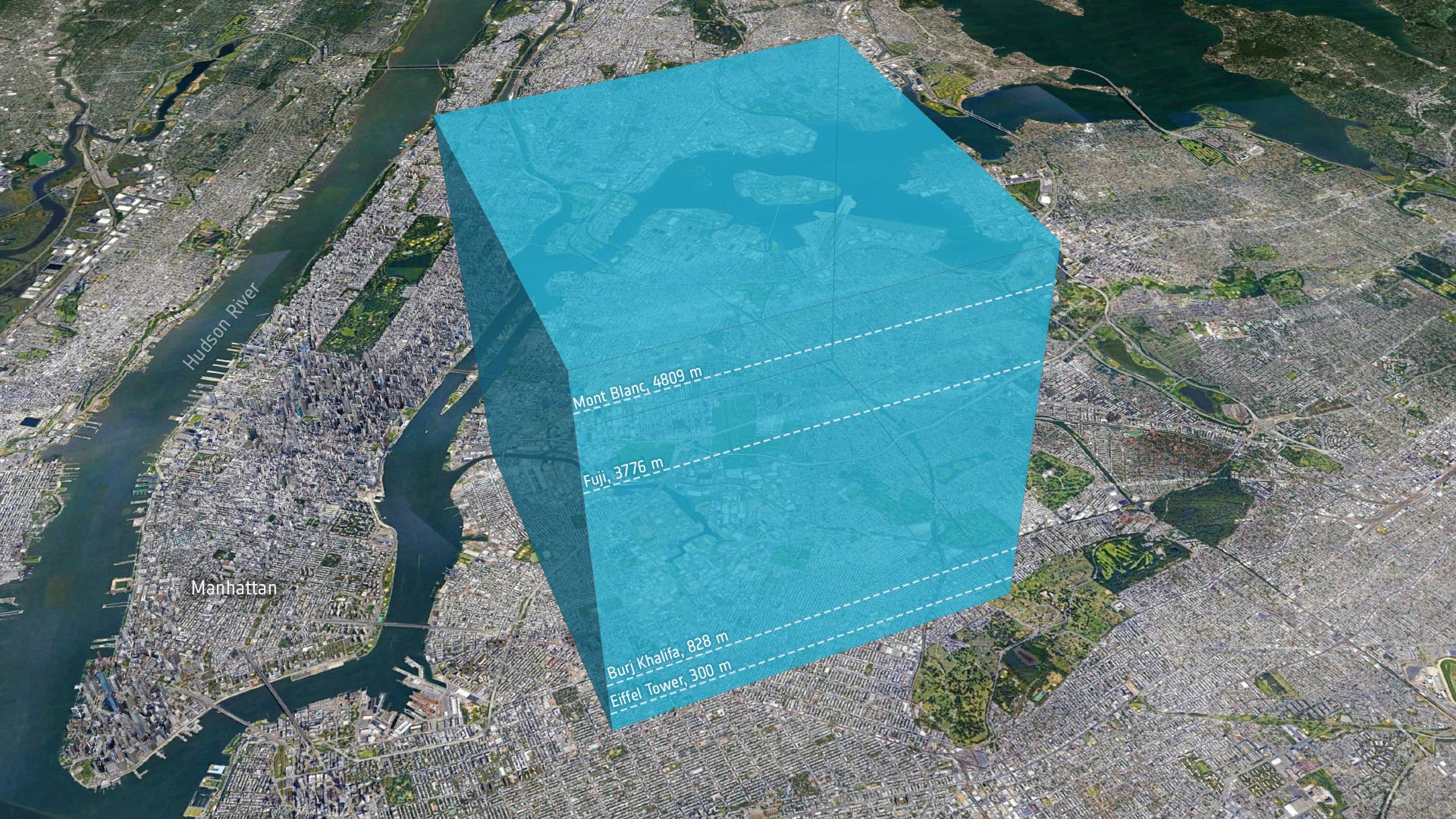
All these measurements together allowed the scientists to calculate how the iceberg’s volume changed and therefore how much freshwater it released.
Tommaso Parrinello, ESA’s CryoSat Mission Manager, said, “Our ability to study every move of the iceberg in such detail is thanks to advances in satellite techniques and the use of a variety of measurements. Imaging satellites record the shape of the iceberg and data from altimetry missions like CryoSat add another important dimension as they measure the height of surfaces – which is essential for calculating changes in volume.”
The new study reveals that A-68A collided only briefly with the sea floor and broke apart shortly afterward, making it less of a risk in terms of blockage. By the time it reached the shallow waters around South Georgia, the iceberg’s keel had reduced to 141 meters (463 feet) below the ocean surface, shallow enough to just avoid the seabed which is around 150 meters (490 feet) deep.
If an iceberg’s keel is too deep it can get stuck on the sea floor. This can be disruptive in many ways; the scour marks can destroy fauna, and the berg itself can block ocean currents and predator foraging routes.
Potential Ecological Impact of 152 Billion Tonnes of Freshwater
However, a side effect of the melting was the release of a colossal 152 billion tonnes of freshwater close to the island – a disturbance that could have a profound impact on the island’s marine habitat.
When icebergs detach from ice shelves, they drift with the ocean currents and wind, releasing cold fresh meltwater and nutrients as they melt. This process influences the local ocean circulation and fosters biological production around the iceberg.
Anne Braakmann-Folgmann, PhD candidate at the Centre for Polar Observation and Modelling and lead author of the study said, “This is a huge amount of meltwater, and the next thing we want to learn is whether it had a positive or negative impact on the ecosystem around South Georgia.
“Because A-68A took a common route across the Drake Passage, we hope to learn more about icebergs taking a similar trajectory, and how they influence the polar oceans.”
For more on this study, see Massive Iceberg Released Over 150 Billion Tons of Fresh Water Into Ocean As It Scraped Past South Georgia.
Reference: “Observing the disintegration of the A68A iceberg from space” by A. Braakmann-Folgmann, A. Shepherd, L. Gerrish, J. Izzard and A. Ridout, 10 January 2022, Remote Sensing of Environment.
DOI: 10.1016/j.rse.2021.112855
Never miss a breakthrough: Join the SciTechDaily newsletter.
Follow us on Google and Google News.
1 Comment
So… how many inches did the ocean levels rise when A-68 was released?