
Close Menu
    Facebook X (Twitter) Instagram
    SciTechDaily
    • Biology
    • Chemistry
    • Earth
    • Health
    • Physics
    • Science
    • Space
    • Technology
    Facebook X (Twitter) Pinterest YouTube RSS
    SciTechDaily
    Home»Earth»Tracking Colossal Iceberg – Larger Than Delaware – During a 3-Year, 650-Mile Journey
    Earth

    Tracking Colossal Iceberg – Larger Than Delaware – During a 3-Year, 650-Mile Journey

    By European Space AgencyJuly 10, 2020No Comments4 Mins Read
    Facebook Twitter Pinterest Telegram LinkedIn WhatsApp Email Reddit
    Share
    Facebook Twitter LinkedIn Pinterest Telegram Email Reddit
    Iceberg A-68A
    A huge iceberg called A-68 calved from the Antarctic Peninsula’s Larsen C ice shelf on July 12, 2017. Three years on, it is in open waters near the South Orkney Islands in the South Atlantic Ocean – about 1050 km (~650 miles) from its birthplace. The berg has already lost two chunks of ice, which were big enough to be given names: A-68B and A68C. Copernicus Sentinel-1 captured this image of the parent berg, A-68A, on July 5, 2020. Credit: Contains modified Copernicus Sentinel data (2020), processed by ESA, CC BY-SA 3.0 IGO

    The colossus iceberg that split from Antarctica’s Larsen C ice shelf on July 12, 2017, is now in the open waters of the South Atlantic near the South Orkney Islands, about 1050 km (~650 miles) from its birthplace. Having lost two chunks of ice, this record berg is a little less huge than it once was – and now that it is in rougher waters, it may break up further.

    When it calved, A-68 was about twice the size of Luxembourg, larger than Delaware, and one of the largest icebergs on record, changing the outline of the Antarctic Peninsula forever. Despite its size, however, it is remarkably thin, just a couple of hundred meters thick.

    Over the last three years, satellite missions such as Copernicus Sentinel-1 have been used to track the berg as it drifted in the Southern Ocean. For the first two years, it remained close to its parent ice sheet, impeded by sea ice.

    However, it lost a chunk of ice almost immediately after being calved, resulting in it being renamed A-68A, and its offspring became A-68B. More recently, in April 2020, A-68A lost another chunk: A-68C.

    Rather unromantically, Antarctic icebergs are named from the Antarctic quadrant in which they were originally sighted, then a sequential number, then, if the iceberg breaks, a sequential letter.

    Although A-68A is a relatively thin iceberg, it has held together reasonably well, but satellites will be key to monitoring how it changes in open waters.

    Captured by the Copernicus Sentinel-1 radar mission, the image above shows the berg on July 5, 2020, a few days before its third birthday. Satellites carrying radar continue to deliver images regardless of the dark and bad weather, which is indispensable when monitoring the remote polar regions which are shrouded in darkness during the winter months.
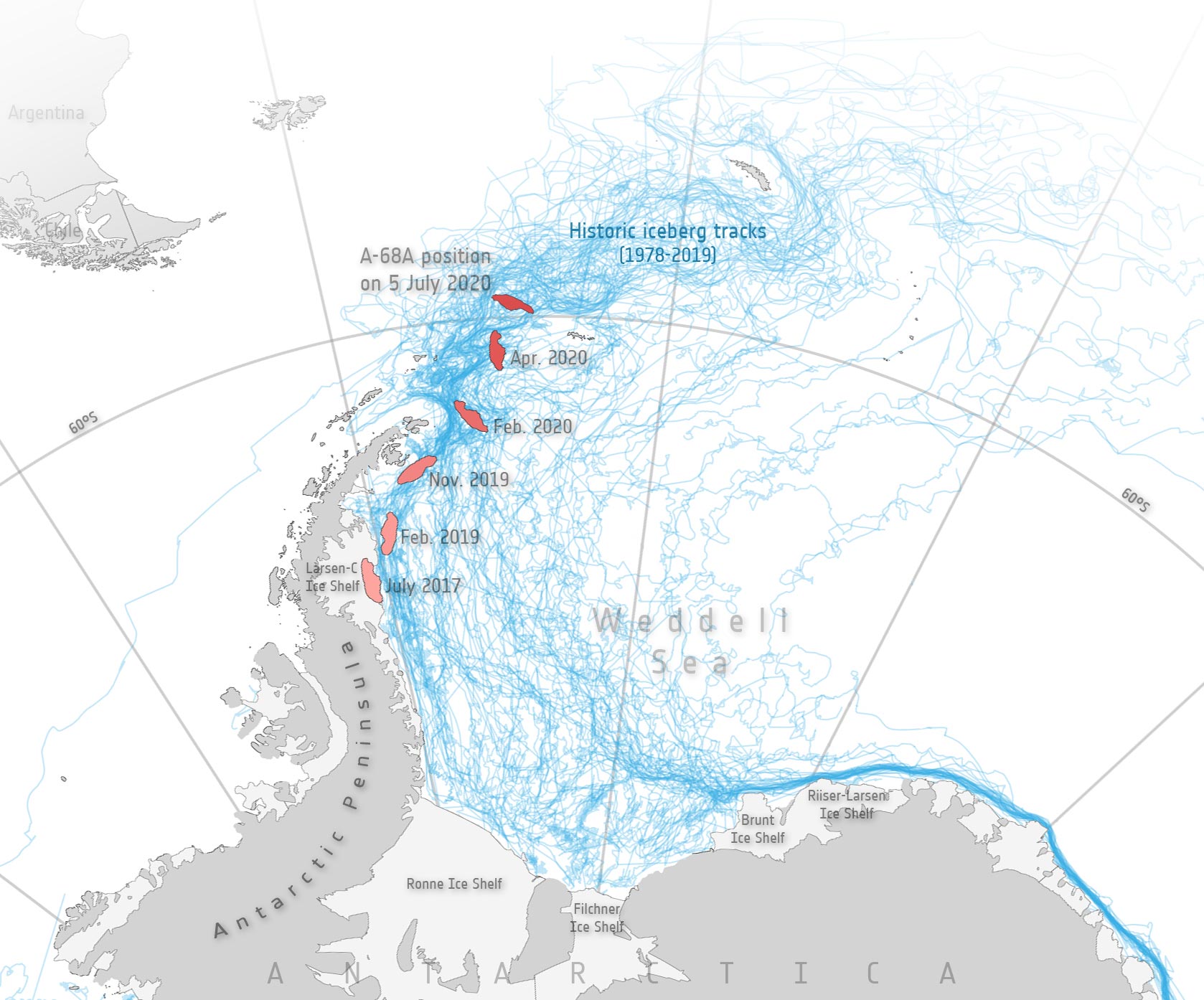
    Iceberg A-68A Path
    The map shows the different positions of iceberg A-68A during its three-year journey. Credit: Contains modified Copernicus Sentinel data (2017–20), processed by ESA; Antarctic Iceberg Tracking Database

    The map shows the different positions of A-68A during its three-year journey. The map not only highlights how long it remained close to the Larsen C ice sheet, but how, over the last year or so, its pace of drift has increased considerably.

    The map also includes historic iceberg tracks, based on data from a number of satellites including ESA’s ERS-1 and ERS-2, and shows that A-68A is following this well-trodden path.

    The wider-view image below from the Copernicus Sentinel-3 mission shows A-68A’s position in February 2020.
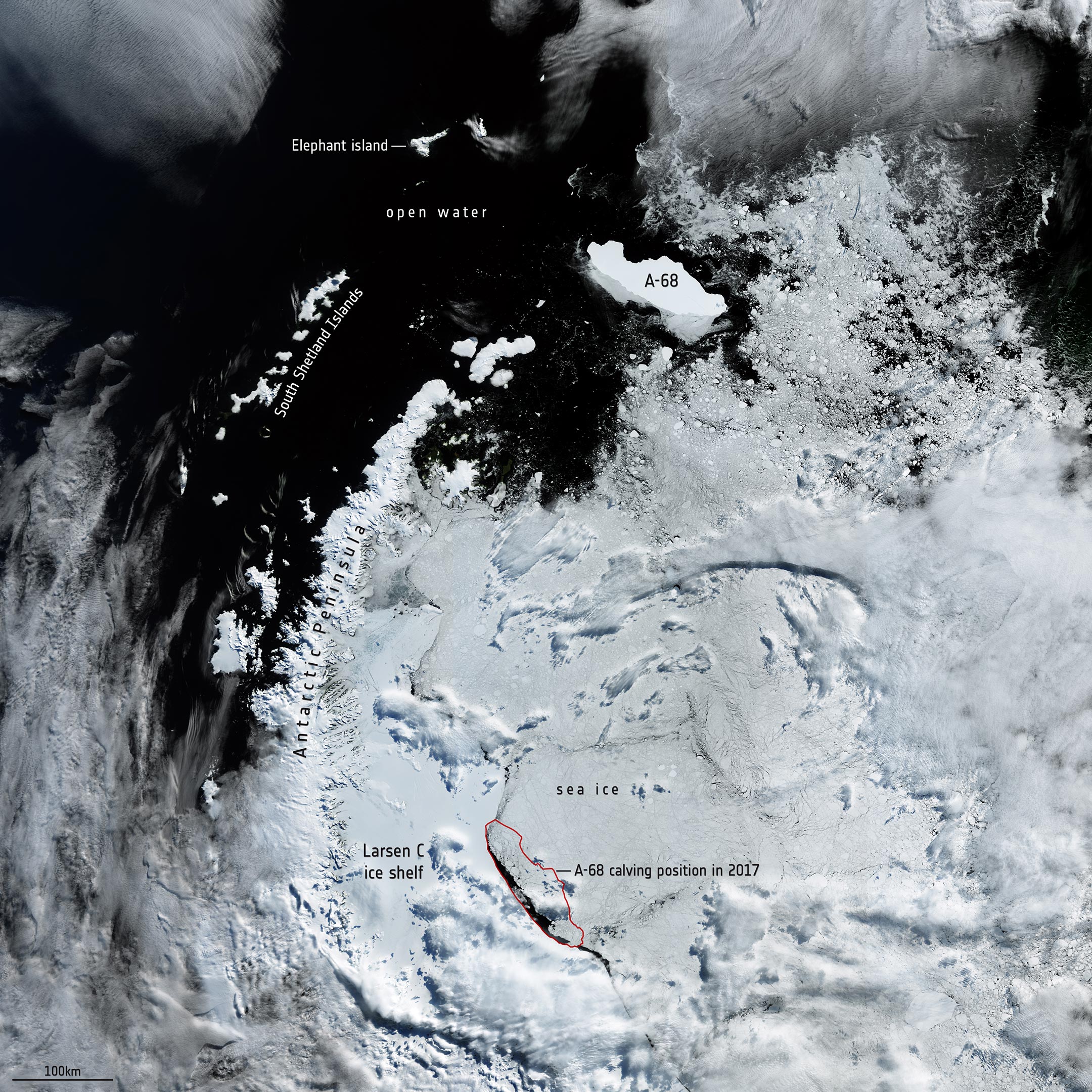
    Iceberg A-68A February 2020
    A huge iceberg called A68 calved from the Antarctic Peninsula’s Larsen C ice shelf on July 12, 2017. This image, which was captured by the Copernicus Sentinel-3 mission, shows its position on February 9, 2020. The berg is now known as A-68A after losing two chunks of ice: A-68B and A-68C. Antarctic icebergs are named from the Antarctic quadrant in which they were originally sighted, then a sequential number, then, if the iceberg breaks, a sequential letter. Credit: Contains modified Copernicus Sentinel data (2020), processed by ESA, CC BY-SA 3.0 IGO

    Never miss a breakthrough: Join the SciTechDaily newsletter.
    Follow us on Google and Google News.

    European Space Agency Iceberg Popular
    Share. Facebook Twitter Pinterest LinkedIn Email Reddit

    Related Articles

    Meet the World’s Largest Iceberg: A-76 Is Over 100 Miles Long

    Massive Iceberg – 10 Times the Size of San Francisco – Breaks Off Brunt Ice Shelf in Antarctica

    Jaw-Dropping Video Shows Nitrogen Dioxide Emissions Drop Over Italy Due to Coronavirus

    Worst-Case Climate Change Scenario: Greenland and Antarctica Losing Ice 6x Faster Than Expected

    Massive Iceberg 5 Times Larger Than Manhattan Shatters Into Pieces – Satellite Video

    Taal Volcano in the Philippines Erupted – See the Incredible Satellite View

    Icebergs as a Source of Nutrients – Climate Change Could Lead to More Iron Fertilization

    GOCE Gravity Mapper Reveals What’s Going on Deep Below Antarctica

    CryoSat Satellite Shows Increased Volume of Arctic Sea Ice

    Leave A Reply Cancel Reply

    • Facebook
    • Twitter
    • Pinterest
    • YouTube

    Don't Miss a Discovery

    Subscribe for the Latest in Science & Tech!

    Trending News

    Scientists Uncover Potential Brain Risks of Popular Fish Oil Supplements

    Scientists Discover a Surprising Way To Make Bread Healthier and More Nutritious

    After 60 Years, Scientists Uncover Unexpected Brain Effects of Popular Diabetes Drug Metformin

    New Research Uncovers Hidden Side Effects of Popular Weight-Loss Drugs

    Scientists Rethink Extreme Warming After Surprising Ocean Discovery

    Landmark Study Links Never Marrying to Significantly Higher Cancer Risk

    Researchers Discover Unknown Beetle Species Just Steps From Their Lab

    Largest-Ever Study Finds Medicinal Cannabis Ineffective for Anxiety, Depression, PTSD

    Follow SciTechDaily
    • Facebook
    • Twitter
    • YouTube
    • Pinterest
    • Newsletter
    • RSS
    SciTech News
    • Biology News
    • Chemistry News
    • Earth News
    • Health News
    • Physics News
    • Science News
    • Space News
    • Technology News
    Recent Posts
    • Researchers Uncover Source of Strange Deformation in Earth’s Largest Continental Rift
    • Scientists Solve Mystery of Where the Colorado River Vanished Millions of Years Ago
    • Not Just Alzheimer’s: Scientists Uncover Clues to a Second, Overlooked Disorder
    • Scientists Uncover Dangerous Connection Between Serotonin and Heart Valve Disease
    • Scientists Discover a “Protector” Protein That Could Help Reverse Hair Loss
    Copyright © 1998 - 2026 SciTechDaily. All Rights Reserved.
    • Science News
    • About
    • Contact
    • Editorial Board
    • Privacy Policy
    • Terms of Use

    Type above and press Enter to search. Press Esc to cancel.