

Researchers have developed MED6-189, a new drug effective against drug-sensitive and drug-resistant strains of human malaria parasites.
MED6-189 targets the apicoplast and vesicular trafficking pathways in Plasmodium falciparum, blocking parasite development and preventing drug resistance. This synthetic compound, inspired by marine sponges, has shown efficacy in both humanized mouse models and against other zoonotic parasites.
Global Malaria Challenge and Research Advances
In 2022, Plasmodium falciparum, the most virulent, prevalent, and deadly malaria parasite, was responsible for nearly 619,000 deaths worldwide. For decades, this parasite has consistently demonstrated resistance to existing antimalarial drugs, presenting a significant obstacle for researchers aiming to curb the disease.
A collaborative effort from scientists at UC Riverside, UC Irvine, and Yale School of Medicine has led to the development of a novel antimalarial drug named MED6-189 and the identification of its mechanism of action. This new drug has proven effective against both drug-sensitive and drug-resistant strains of P. falciparum in lab tests and humanized mouse models, which have been genetically modified to possess human blood.
Innovative Antimalarial Drug Development
The researchers report today (September 26) in the journal Science that MED6-189 works by targeting and disrupting not only the apicoplast, an organelle found in P. falciparum cells, but also the vesicular trafficking pathways. They found that this dual mode of action prevents the pathogen from developing resistance, making the drug a highly effective antimalarial compound and a promising new lead in the fight against malaria.
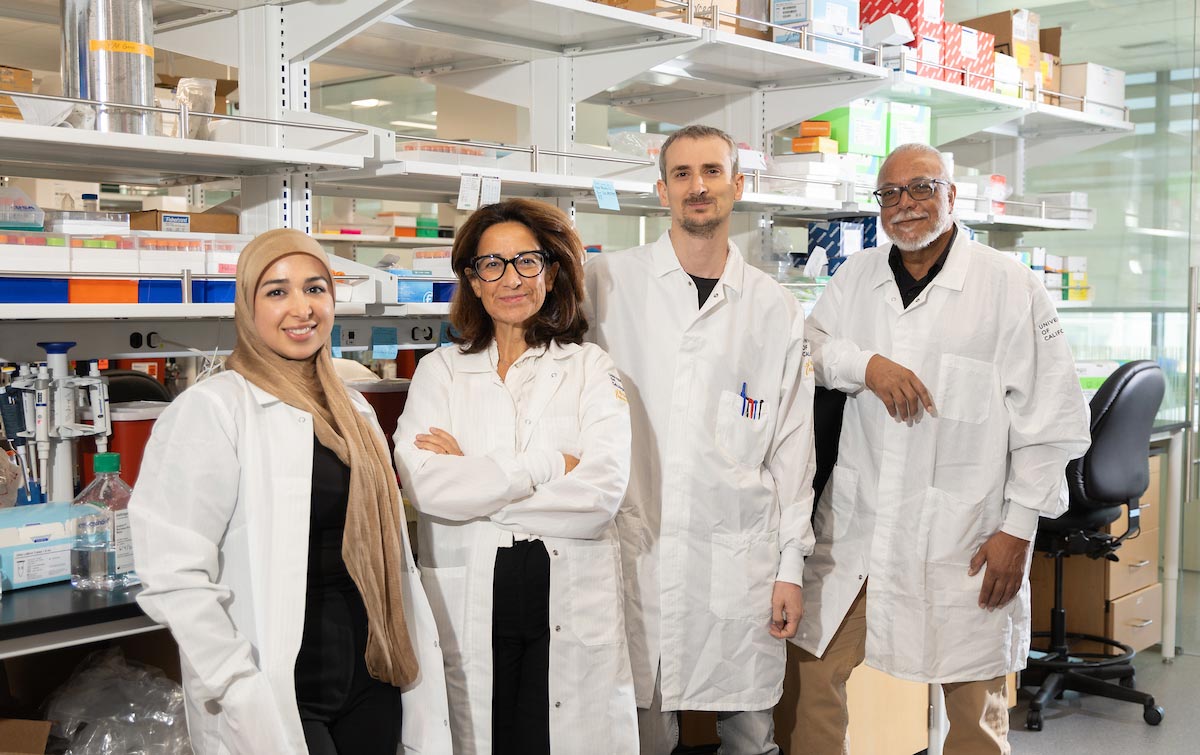
“Disruption of the apicoplast and vesicular trafficking blocks the parasite’s development and thus eliminates infection in red blood cells and in our humanized mouse model of P. falciparum malaria,” said Karine Le Roch, a professor of molecular, cell and systems biology at UCR and the paper’s senior author. “We found MED6-189 was also potent against other zoonotic Plasmodium parasites, such as P. knowlesi and P. cynomolgi.”
Natural Inspiration for Synthetic Solutions
MED6-189 is a synthetic compound inspired by a compound extracted from marine sponges. The lab of Christopher Vanderwal, a professor of chemistry and pharmaceutical sciences at UC Irvine, synthesized the compound.
“Many of the best antimalarial agents are natural products, or are derived from them,” he said. “For example, artemisinin, initially isolated from the sweet wormwood plant, and analogs thereof, are critically important for treatment of malaria. MED6-189 is a close relative of a different class of natural products, called isocyanoterpenes, that seem to target multiple pathways in P. falciparum. That is beneficial because had only one pathway been targeted, the parasite could develop resistance to the compound more quickly.”
Future Prospects and Research Directions
When researchers at GSK, a pharmaceutical company in Spain, administered MED6-189 to the mice infected with P. falciparum, they found it cleared the mice of the parasite. In collaboration with Choukri Ben Mamoun, a professor of medicine and microbial pathogenesis at the Yale School of Medicine, the team also tested the compound against P. knowlesi, a parasite that infects monkeys, and found it worked as intended, clearing the monkey’s parasite-infected red blood cells.
Next, the team plans to continue the optimization of MED6-189 and further confirm the modified compound’s mechanisms of action using a systems biology approach. Systems biology is a biomedical research approach to understanding the larger picture of a biological system. It offers researchers a way to examine how different living organisms and cells interact at larger scales.
Reference: “A kalihinol analog disrupts apicoplast function and vesicular trafficking in P. falciparum malaria” by Z. Chahine, S. Abel, T. Hollin, G. L. Barnes, J. H. Chung, M. E. Daub, I. Renard, J. Y. Choi, P. Vydyam, A. Pal, M. Alba-Argomaniz, C. A. S. Banks, J. Kirkwood, A. Saraf, I. Camino, P. Castaneda, M. C. Cuevas, J. De Mercado-Arnanz, E. Fernandez-Alvaro, A. Garcia-Perez, N. Ibarz, S. Viera-Morilla, J. Prudhomme, C. J. Joyner, A. K. Bei, L. Florens, C. Ben Mamoun, C. D. Vanderwal and K. G. Le Roch, 27 September 2024, Science.
DOI: 10.1126/science.adm7966
Le Roch, Vanderwal, and Ben Mamoun were joined in the research by fellow scientists at the Stowers Institute for Medical Research in Kansas City, Missouri; GSK; and the University of Georgia.
The research was supported by a grant to Le Roch, Vanderwal, and Ben Mamoun and the National Institute of Allergy and Infectious Diseases of the National Institutes of Health. At UCR, Le Roch directs the Center for Infectious Disease and Vector Research.
Never miss a breakthrough: Join the SciTechDaily newsletter.
Follow us on Google and Google News.