
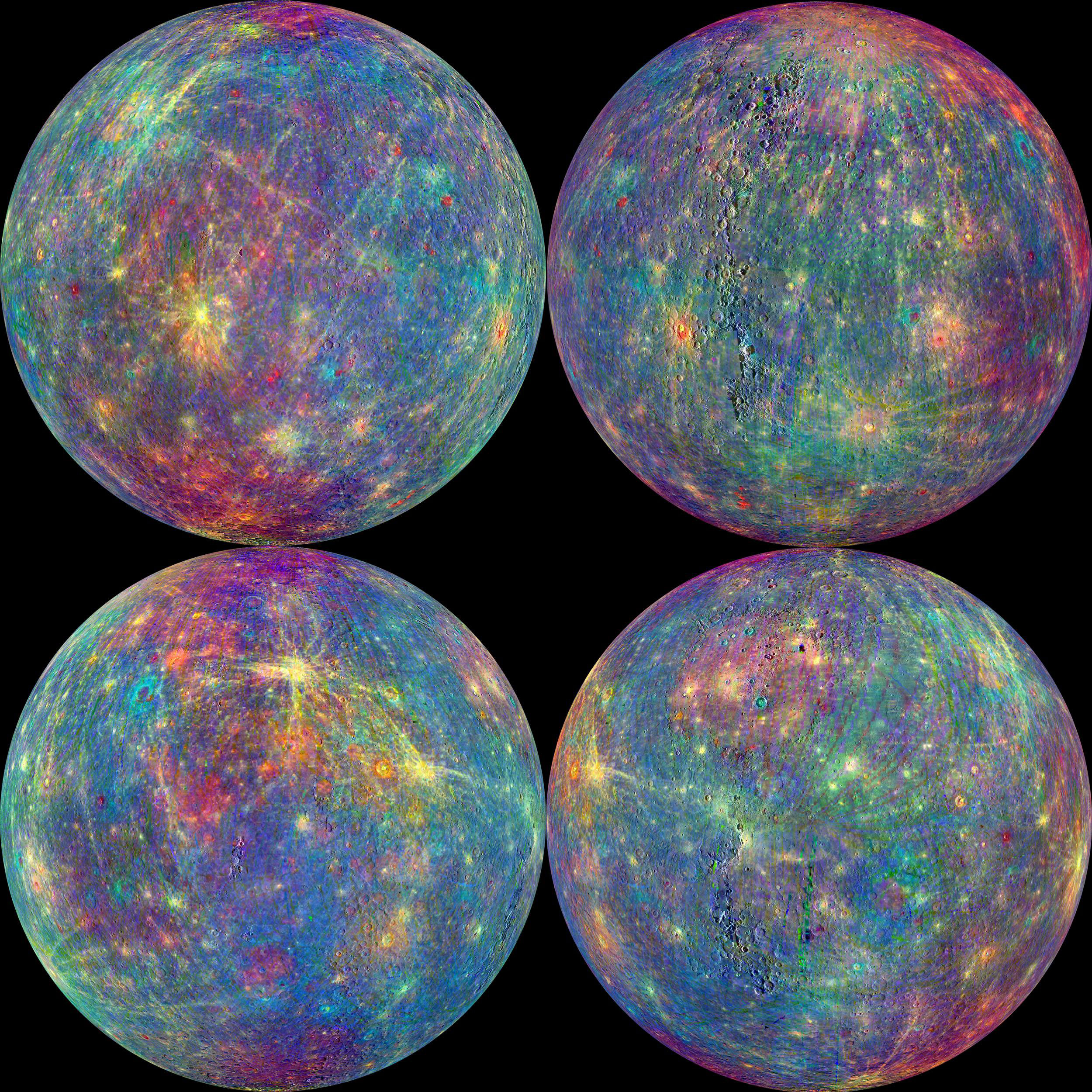
New research sheds light on how certain types of comets influence the lopsided bombardment of Mercury’s surface by tiny dust particles called micrometeoroids.
Mercury, our smallest planetary neighbor, has very little to call an atmosphere, but it does have a strange weather pattern: morning micro-meteor showers.
Recent modeling along with previously published results from NASA’s MESSENGER spacecraft — short for Mercury Surface, Space Environment, Geochemistry, and Ranging, a mission that observed Mercury from 2011 to 2015 — has shed new light on how certain types of comets influence the lopsided bombardment of Mercury’s surface by tiny dust particles called micrometeoroids. This study also gave new insight into how these micrometeoroid showers can shape Mercury’s very thin atmosphere, called an exosphere.
The research, led by Petr Pokorný, Menelaos Sarantos, and Diego Janches of NASA’s Goddard Space Flight Center in Greenbelt, Maryland, simulated the variations in meteoroid impacts, revealing surprising patterns in the time of day impacts occur. These findings were reported in The Astrophysical Journal Letters on June 19, 2017.
“Observations by MESSENGER indicated that dust must predominantly arrive at Mercury from specific directions, so we set out to prove this with models,” Pokorný said. This is the first such simulation of meteoroid impacts on Mercury. “We simulated meteoroids in the solar system, particularly those originating from comets, and let them evolve over time.”
Earlier findings based on data from MESSENGER’s Ultraviolet and Visible Spectrometer revealed the effect of meteoroid impacts on Mercury’s surface throughout the planet’s day. The presence of magnesium and calcium in the exosphere is higher at Mercury’s dawn — indicating that meteoroid impacts are more frequent on whatever part of the planet is experiencing dawn at a given time.
This dawn-dusk asymmetry is created by a combination of Mercury’s long day, in comparison to its year, and the fact that many meteoroids in the solar system travel around the Sun in the direction opposite the planets. Because Mercury rotates so slowly — once every 58 Earth days, compared to a Mercury year, a complete trip around the Sun, lasting only 88 Earth days — the part of the planet at dawn spends a disproportionately long time in the path of one of the solar system’s primary populations of micrometeoroids. This population, called retrograde meteoroids, orbits the Sun in the direction opposite the planets and comprises pieces from disintegrated long-period comets. These retrograde meteoroids are traveling against the flow of planetary traffic in our solar system, so their collisions with planets — Mercury, in this case — hit much harder than if they were traveling in the same direction.
These harder collisions helped the team further key in on the source of the micrometeoroids pummeling Mercury’s surface. Meteoroids that originally came from asteroids wouldn’t be moving fast enough to create the observed impacts. Only meteoroids created from two certain types of comets — Jupiter-family and Halley-type — had the speed necessary to match the observations.
“The velocity of cometary meteoroids, like Halley-type, can exceed 224,000 miles per hour,” Pokorný said. “Meteoroids from asteroids only impact Mercury at a fraction of that speed.”
Jupiter-family comets, which are primarily influenced by our largest planet’s gravity, have a relatively short orbit of less than 20 years. These comets are thought to be small pieces of objects originating in the Kuiper Belt, where Pluto orbits. The other contributor, Halley-type comets, have a longer orbit lasting upwards of 200 years. They come from the Oort Cloud, the most distant objects of our solar system — more than a thousand times farther from the Sun than Earth.
The orbital distributions of both types of comets make them ideal candidates to produce the tiny meteoroids that influence Mercury’s exosphere.
Pokorný and his team hope that their initial findings will improve our understanding of the rate at which comet-based micrometeoroids impact Mercury, further improving the accuracy of models of Mercury and its exosphere.
Publication: “Reconciling the Dawn–Dusk Asymmetry in Mercury’s Exosphere with the Micrometeoroid Impact Directionality” by Petr Pokorný Menelaos Sarantos and Diego Janches, 19 June 2017, The Astrophysical Journal Letters.
DOI: 10.3847/2041-8213/aa775d
Never miss a breakthrough: Join the SciTechDaily newsletter.
Follow us on Google and Google News.