
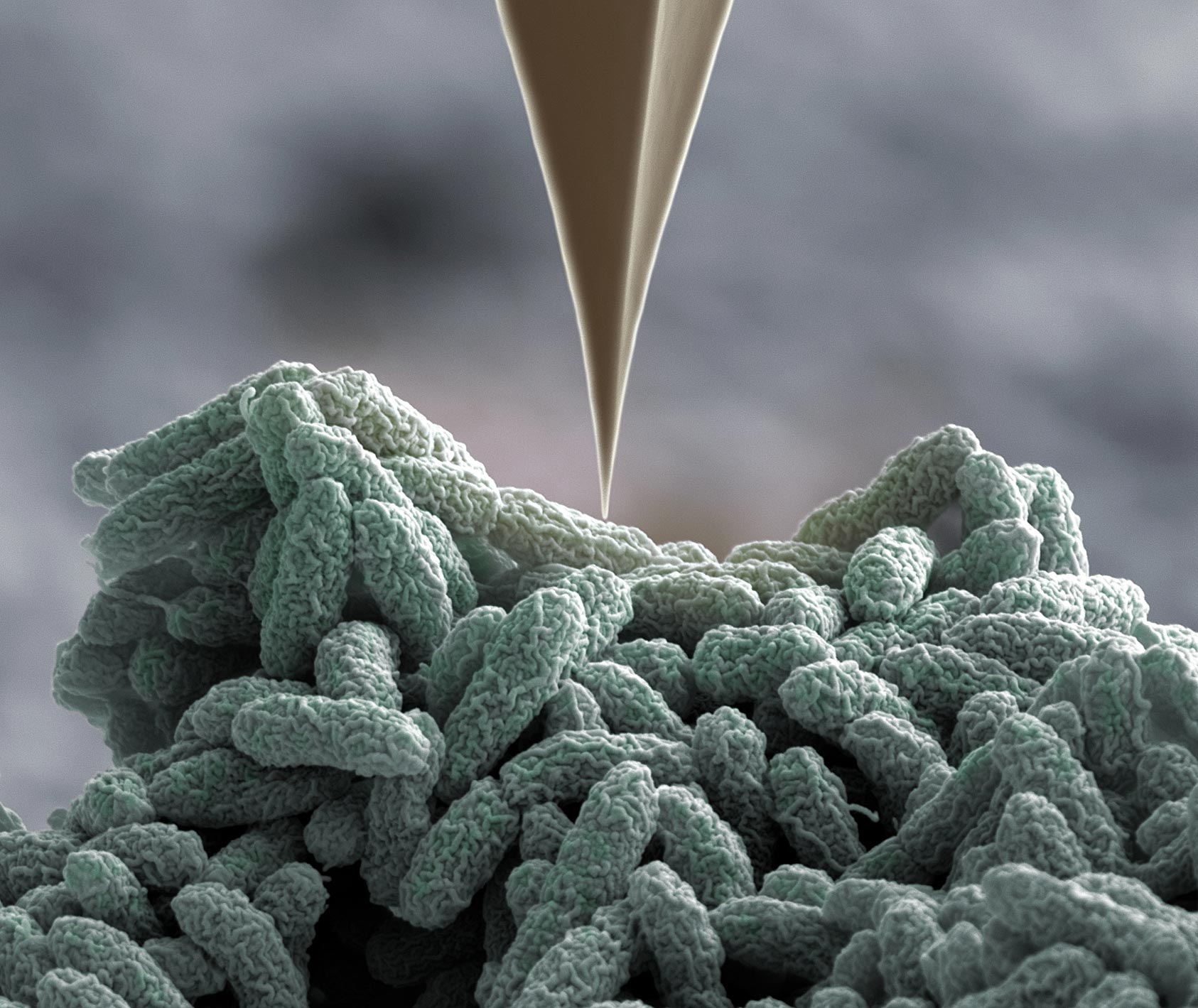
Researchers found that Pseudomonas aeruginosa bacteria rapidly assemble their T6SS nanoweapons in response to outer membrane damage, enabling precise retaliation against competitors.
Some bacteria deploy tiny spearguns to retaliate against rival attacks. Researchers at the University of Basel simulated these attacks by poking bacteria with an ultra-sharp tip. Through this approach, they discovered that bacteria assemble their nanoweapons in response to cell envelope damage and rapidly strike back with high precision.
In the microbial world, peaceful coexistence coexists with fierce competition for nutrients and space. Certain bacteria outcompete rivals and defend against attackers by injecting them with a lethal cocktail using tiny, nano-sized spearguns known as type VI secretion systems (T6SS).
Bacteria respond to cell envelope damage
The research group led by Professor Marek Basler at the Biozentrum, University of Basel, has been studying the T6SS of different bacterial species for many years. “We knew that Pseudomonas aeruginosa uses its T6SS to fire back when attacked”, explains Basler. “But we did not know what exactly triggers the assembly of the nano-speargun: the contact with neighbors, toxic molecules, or simply cell damage?”
In close collaboration with Roderick Lim, Argovia Professor for Nanobiology at the Biozentrum and the Swiss Nanoscience Institute (SNI), the researchers have now demonstrated: Pseudomonas aeruginosa responds to ruptures in the outer membrane – initiated by mechanical force, such as poking with a sharp tip. The study has been published in Science Advances.
Puncturing bacterial envelope with a tiny “needle”
Roderick Lim’s lab has long-standing expertise in atomic force microscopy (AFM) technology. “Using AFM, we have been able to mimic a bacterial T6SS attack,” says Mitchell Brüderlin, PhD student at the SNI PhD School and first author of the study. “With the needle-like, ultra-sharp AFM tip, we can touch the bacterial surface and, with gradually increasing the pressure, puncture the outer and the inner membrane in a controlled manner.”
In combination with fluorescence microscopy, the researchers revealed that the bacteria respond to outer membrane damage. “Within ten seconds the bacteria assemble their T6SS, often repeatedly, at the site of damage and fire back with pinpoint accuracy,” adds Basler. “Our work clearly shows that breaking the outer membrane is necessary and sufficient to trigger T6SS assembly.”
New insights into bacterial defense mechanisms
The biggest challenge for the researchers was the size and the shape of the bacteria. “So far, we have only used the AFM to study eukaryotic cells, including human cells,” explains Lim. “But Pseudomonas bacteria are more than ten times smaller than human cells, so it was demanding to poke them at a specific site.”
In the microbial ecosystem, survival is all about strategy, and Pseudomonas aeruginosa has certainly mastered the art of defense. “The targeted and swift retaliation against local attacks minimizes misfiring and optimizes the cost-benefit ratio”, says Basler. This clever tactic gives Pseudomonas a survival advantage, enabling it to incapacitate attackers and thrive in diverse and often challenging environments.
Reference: “Pseudomonas aeruginosa assembles H1-T6SS in response to physical and chemical damage of the outer membrane” by Mitchell Brüderlin, Maxim Kolesnikov, Florian Röthlin, Roderick Y. H. Lim and Marek Basler, 5 March 2025, Science Advances.
DOI: 10.1126/sciadv.adr1713
Never miss a breakthrough: Join the SciTechDaily newsletter.
Follow us on Google and Google News.