
Close Menu
    Facebook X (Twitter) Instagram
    SciTechDaily
    • Biology
    • Chemistry
    • Earth
    • Health
    • Physics
    • Science
    • Space
    • Technology
    Facebook X (Twitter) Pinterest YouTube RSS
    SciTechDaily
    Home»Space»Milky Way’s Supermassive Black Hole Born From Incredible Cosmic Collision
    Space

    Milky Way’s Supermassive Black Hole Born From Incredible Cosmic Collision

    By University of Nevada, Las VegasOctober 5, 20242 Comments4 Mins Read
    Facebook Twitter Pinterest Telegram LinkedIn WhatsApp Email Reddit
    Share
    Facebook Twitter LinkedIn Pinterest Telegram Email Reddit
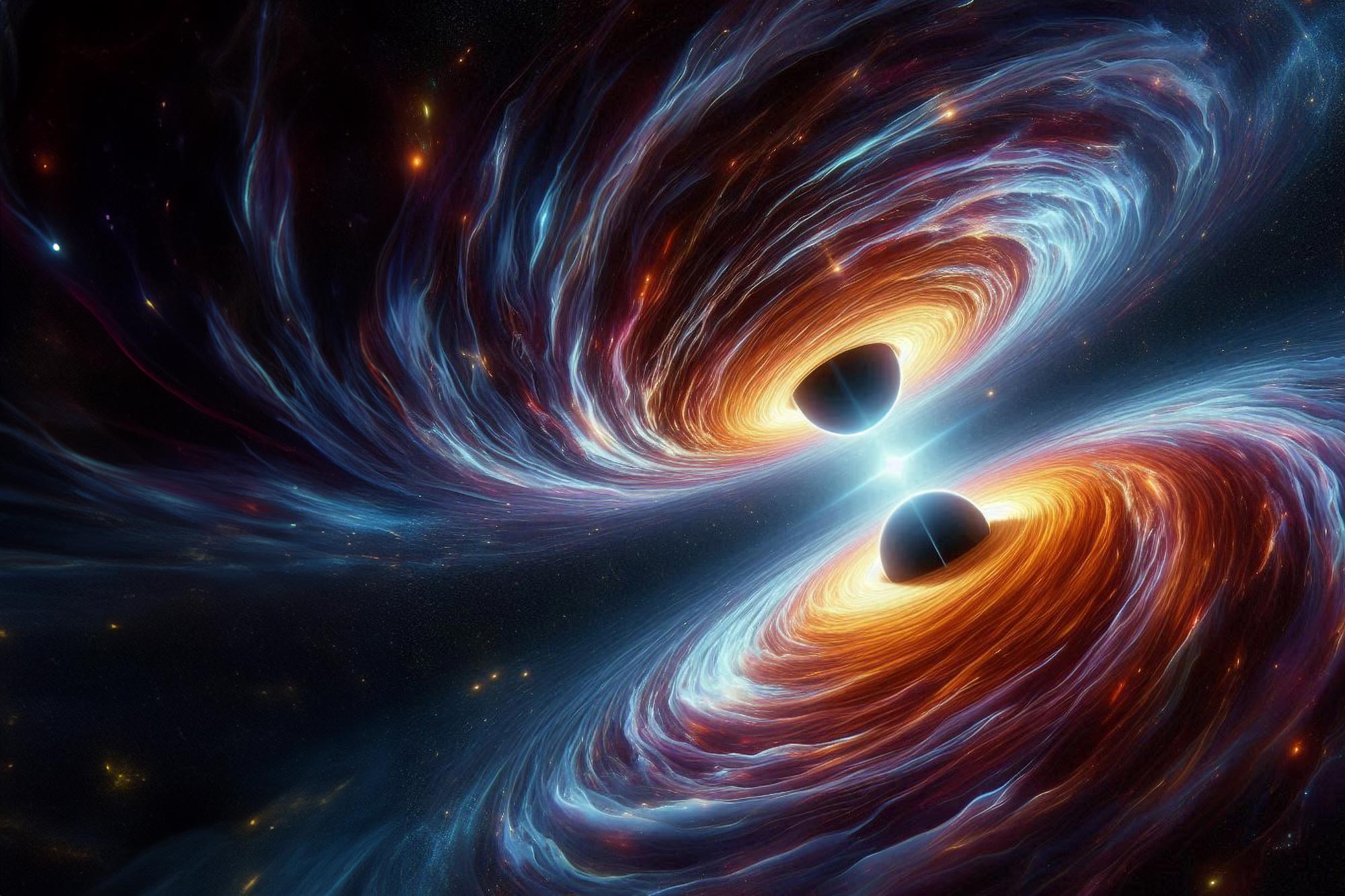
    Black Hole Merger Concept Art
    The central black hole of the Milky Way likely emerged from a cosmic collision, findings backed by Event Horizon Telescope imagery suggest, illuminating the black hole’s formation and the dynamic history of our galaxy. Credit: SciTechDaily.com

    New research suggests that the Milky Way’s central supermassive black hole formed from a merger with another black hole around 9 billion years ago.

    This finding uses data from the Event Horizon Telescope and helps explain the black hole’s rapid spin and misalignment with the galaxy.

    Supermassive Black Hole Origins

    The origins of aptly named supermassive black holes – which can weigh in at more than a million times the mass of the sun and reside in the center of most galaxies – remain one of the great mysteries of the cosmos.

    Researchers at the Nevada Center for Astrophysics at UNLV (NCfA) have now uncovered compelling evidence indicating that the supermassive black hole at the center of our Milky Way galaxy, known as Sagittarius A* (Sgr A*), likely formed from a past cosmic merger.

    Published recently in the journal Nature Astronomy, the study builds on recent observations from the Event Horizon Telescope (EHT), which captured the first direct image of Sgr A* in 2022. The EHT, the result of a global research collaboration, syncs data from eight existing radio observatories worldwide to create a massive, Earth-sized virtual telescope.
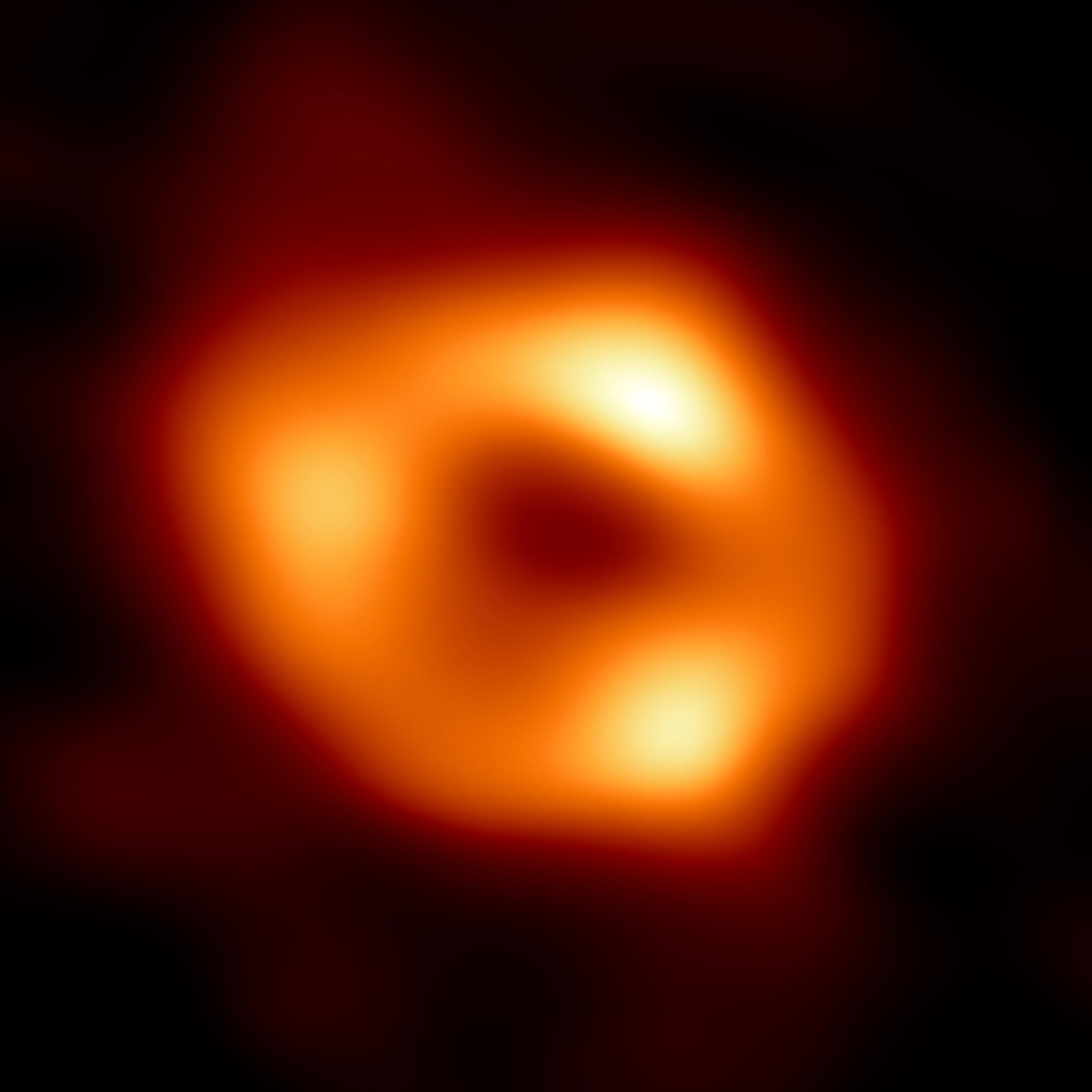
    First Image of Our Black Hole Sagittarius A*
    This is the first image of Sgr A*, the supermassive black hole at the center of our galaxy. It’s the first direct visual evidence of the presence of this black hole. It was captured by the Event Horizon Telescope (EHT), an array that linked together eight existing radio observatories across the planet to form a single “Earth-sized” virtual telescope. The telescope is named after the event horizon, the boundary of the black hole beyond which no light can escape. Credit: EHT Collaboration

    Investigating Sagittarius A* Formation

    UNLV astrophysicists Yihan Wang and Bing Zhang utilized the data from the EHT observation of Sgr A* to look for evidence on how it may have formed. Supermassive black holes are thought to grow either by the accretion of matter over time, or by the merger of two existing black holes.

    The UNLV team investigated various growth models to understand the peculiar rapid spin and misalignment of Sgr A* relative to the Milky Way’s angular momentum. The team demonstrated that these unusual characteristics are best explained by a major merger event involving Sgr A* and another supermassive black hole, likely from a satellite galaxy.

    “This discovery paves the way for our understanding of how supermassive black holes grow and evolve,” said Wang, the lead author of the study and an NCfA postdoctoral fellow at UNLV. “The misaligned high spin of Sgr A* indicates that it may have merged with another black hole, dramatically altering its amplitude and orientation of spin.”

    Using sophisticated simulations, the researchers modeled the impact of a merger, considering various scenarios that align with the observed spin properties of Sgr A*. Their results indicate that a 4:1 mass ratio merger with a highly inclined orbital configuration could reproduce the spin properties observed by the EHT.

    Merger Timeline and Galactic History

    “This merger likely occurred around 9 billion years ago, following the Milky Way’s merger with the Gaia-Enceladus galaxy,” said Zhang, a distinguished professor of physics and astronomy at UNLV and the founding director of the NCfA. “This event not only provides evidence of the hierarchical black hole merger theory but also provides insights into the dynamic history of our galaxy.”

    Sgr A* sits at the center of the galaxy more than 27,000 light years away from Earth, and sophisticated tools like the EHT provide direct imaging that helps scientists put predictive theories to the test.

    Future Implications and Space-Based Detectors

    Researchers say that the findings from the study will have significant implications for future observations with upcoming space-borne gravitational wave detectors, such as the Laser Interferometer Space Antenna (LISA), which is planned to launch in 2035 and is expected to detect similar supermassive black hole mergers across the universe.

    Reference: “Evidence of a past merger of the Galactic Centre black hole” by Yihan Wang, and Bing Zhang, 6 September 2024, Nature Astronomy.
    DOI: 10.1038/s41550-024-02358-w

    Never miss a breakthrough: Join the SciTechDaily newsletter.
    Follow us on Google and Google News.

    Astronomy Astrophysics Black Hole Event Horizon Telescope Popular University of Nevada Las Vegas
    Share. Facebook Twitter Pinterest LinkedIn Email Reddit

    Related Articles

    Black Hole Shadows Could Reveal the Limits of Einstein’s Theory of Relativity

    Stunning Reveal: First Image of the Black Hole at the Center of Our Milky Way Galaxy

    World’s Most Powerful Telescopes Unite in Unprecedented Observations of Famous Black Hole

    Not All Theories Can Explain the Gargantuan Black Hole M87*

    Telescopes Unite in Unprecedented Observations of Famous Black Hole Across the Entire Electromagnetic Spectrum

    Event Horizon Telescope Images Magnetic Fields at the Edge of M87’s Supermassive Black Hole

    Event Horizon Telescope Reveals Turbulent Black Hole Evolution: Wobbling Shadow of the M87 Black Hole

    Astronomers Reveal First Direct Visual Evidence of a Supermassive Black Hole

    Event Horizon Telescope Set to View the Black Hole at the Center of the Milky Way

    2 Comments

    1. Fixed gravity for you. on October 6, 2024 3:55 am

      Recent articles like this seem to indicate BH state spin information isn’t limited by an event horizon. First thought is to make the BH non-spherical, maybe part of a system of flattened objects. First time I saw the image I wanted to find artifacts of gravitational retroreflection, so it looks like reflections from three fuzzed-up orthogonal planes of retroreflector.

      Reply
    2. A scientist on October 14, 2024 1:26 pm

      Supermassive black holes can weigh in at billions of times the suns mass not just millions.

      Reply
    Leave A Reply Cancel Reply

    • Facebook
    • Twitter
    • Pinterest
    • YouTube

    Don't Miss a Discovery

    Subscribe for the Latest in Science & Tech!

    Trending News

    First-of-Its-Kind Discovery: Homer’s Iliad Found Embedded in a 1,600-Year-Old Egyptian Mummy

    Beyond Inflammation: Scientists Uncover New Cause of Persistent Rheumatoid Arthritis

    A Simple Molecule Could Unlock Safer, Easier Weight Loss

    Scientists Just Built a Quantum Battery That Charges Almost Instantly

    Researchers Unveil Groundbreaking Sustainable Solution to Vitamin B12 Deficiency

    Millions of People Have Osteopenia Without Realizing It – Here’s What You Need To Know

    Researchers Discover Boosting a Single Protein Helps the Brain Fight Alzheimer’s

    World-First Study Reveals Human Hearts Can Regenerate After a Heart Attack

    Follow SciTechDaily
    • Facebook
    • Twitter
    • YouTube
    • Pinterest
    • Newsletter
    • RSS
    SciTech News
    • Biology News
    • Chemistry News
    • Earth News
    • Health News
    • Physics News
    • Science News
    • Space News
    • Technology News
    Recent Posts
    • Mezcal “Worm” in a Bottle Mystery: DNA Testing Reveals a Surprise
    • Scientists Turn Red Lettuce Green, Unlocking Hidden Nutrients
    • Researchers Discover Natural Compound That Disarms Deadly Superbug
    • New Research Reveals That Your Morning Coffee Activates an Ancient Longevity Switch
    • Researchers Identify the Most Common Recessive Neurodevelopmental Disorder Ever Discovered
    Copyright © 1998 - 2026 SciTechDaily. All Rights Reserved.
    • Science News
    • About
    • Contact
    • Editorial Board
    • Privacy Policy
    • Terms of Use

    Type above and press Enter to search. Press Esc to cancel.