
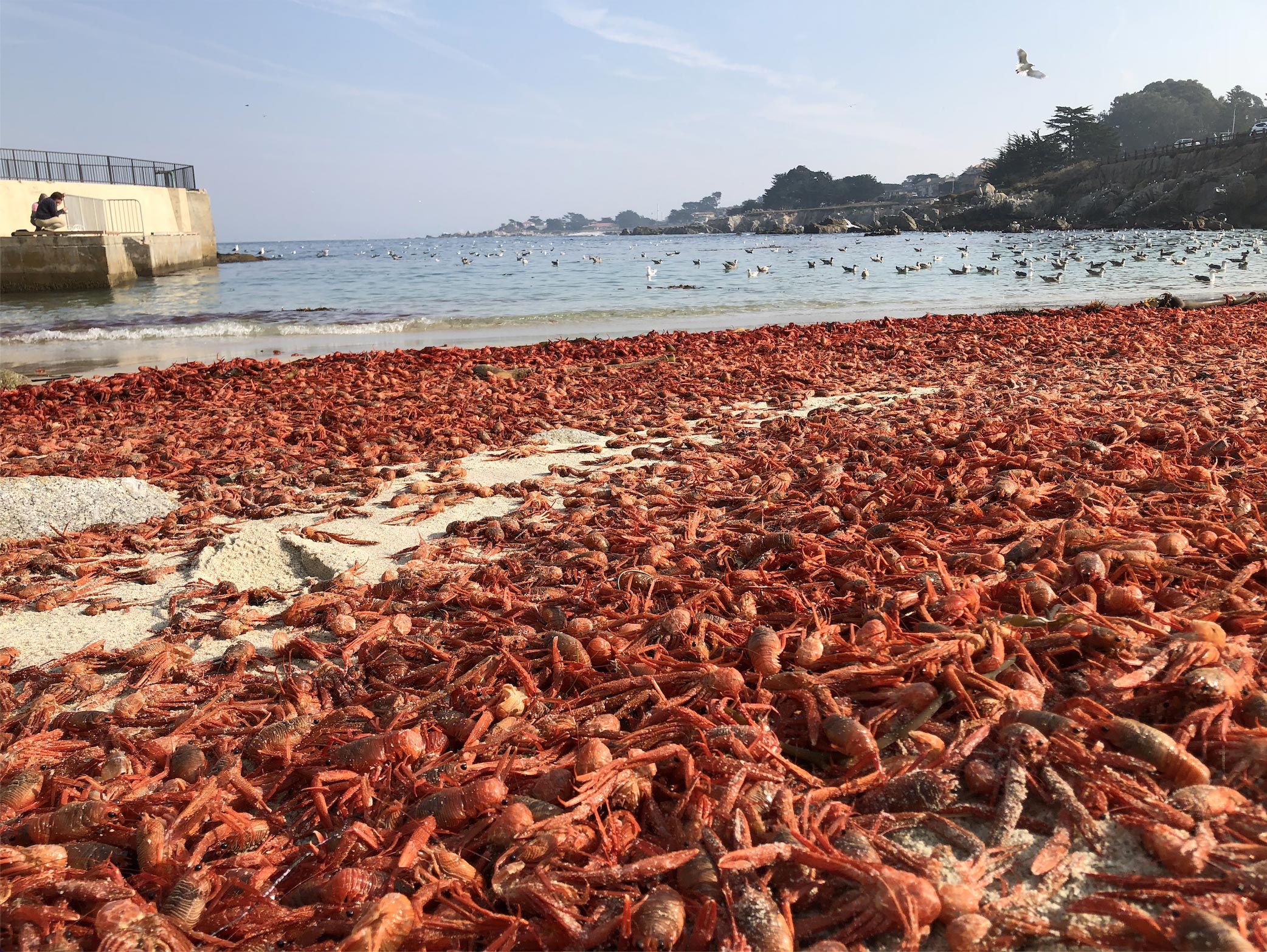
New findings suggest that abnormal ocean currents cause the occasional appearance of pelagic red crabs outside their native range.
For decades, people have wondered why pelagic red crabs — also called tuna crabs — sometimes wash ashore in the millions on the West Coast of the United States. New research shows that atypical currents, rather than abnormal temperatures, likely bring them up from their home range off Baja California.
Alongside the discovery, the scientists also created a seawater flow index that could help researchers and managers detect abnormal current years.
The new study, published on July 1, 2021, in Limnology and Oceanography, began after lead author Megan Cimino biked past a pelagic red crab stranding on her way to her office in Monterey in 2018. Cimino, a biological oceanographer at the National Oceanic and Atmospheric Administration (NOAA) and the University of California, Santa Cruz through the Institute of Marine Sciences Fisheries Collaborative Program, had witnessed a different stranding near where she grew up in Southern California a few years prior.
“At that time, I had no clue what a red crab was, what was going on, why they would be there,” she said. “But it was very clear something different was going on in the ocean — something unusual.”
She brought the question to her colleagues, and the lab decided to dive into the mechanism behind the seemingly random appearances.
The group spent months compiling data about the crabs and their recorded range. They scoured oceanographic research surveys, video data from remotely operated vehicles, citizen science programs, and even online media, such as Twitter.
Integrating the different data types proved challenging, but eventually, the team had a clear idea of the species’ range and strandings from 1950 to 2019.
Currents vs. Temperature: What Matters More?
Comparing these data with ocean conditions like temperature and current movements, the scientists found that the appearance of red crabs outside of their normal range correlated with the amount of seawater flowing from Baja California to central California. The finding supports strong currents as the key indicator for the presence of the crabs over the other major hypothesis — that warm water brought by marine heatwaves and El Niño events causes the appearances.
To study the currents, the researchers used a regional ocean model of the California Current System, developed by researchers in the UC Santa Cruz ocean modeling group.
“What you’re doing is putting a tracer — you could think of it like a dye — into a particular part of the ocean and then running the model backward in time to see where that came from,” said Michael Jacox, a physical oceanographer with dual affiliation with NOAA and UC Santa Cruz.
The Southern Source Water Index (SSWI)
Based on those tracer experiments, the team created the “southern source water index” (SSWI), which shows how much water off the central California coast comes from south of the U.S.-Mexico border.
“It’s that pathway of water that brings up some of these unusual species,” said Ryan Rykaczewski, a fisheries oceanographer at NOAA and the University of Hawai’i at Mānoa. “It’s not just the pelagic red crabs, even though those might be the most conspicuous species that we see on the coast.”
The red crabs draw the public’s interest and serve as an important food source for lots of other species. These factors made them a good study subject, but they’re not the only thing brought up by currents. They represent a larger phenomenon that researchers can use the SSWI to better understand.
“The index could be used as a kind of early warning system about what the ocean state is that year and whether we’re going to expect southern species in northern regions,” said Cimino. “That can help us plan and manage and give expectations for bycatch or different fisheries.”
As climate change increases variability in ocean conditions, the locations of species will begin to shift. Knowing where to look for particular organisms helps researchers make more accurate observations and population estimates.
“We can go back and look at that source water index and use that perhaps as a predictive tool of how the composition of coastal species is going to change,” said Rykaczewski. “And that might help us with ecosystem management.”
Currents: An Overlooked Climate Factor
The way currents shift is an often-overlooked piece of the puzzle when it comes to understanding climate change. Scientists are now in the process of testing whether the southern source water index is sensitive to it.
“We think a lot about the changes in things like temperature and oxygen, but changes in the contribution of waters from different locations in the broader North Pacific is also really important for understanding climate change,” said Rykaczewski.
The movement of pelagic red crabs provides just one example of the practical applications of such studies.
“I think it’s really, really important that when we think about climate change, we don’t just think about ‘warm temperature equals some response’, and we really try to dig into the mechanisms,” said Jacox.
With the case study of red crabs and the creation of the southern source water index, researchers now have another tool for doing just that.
Reference: “Anomalous poleward advection facilitates episodic range expansions of pelagic red crabs in the eastern North Pacific” by Megan A. Cimino, Michael G. Jacox, Steven J. Bograd, Stephanie Brodie, Gemma Carroll, Elliott L. Hazen, Bertha E. Lavaniegos, Mark M. Morales, Erin Satterthwaite and Ryan R. Rykaczewski, 1 July 2021, Limnology and Oceanography.
DOI: 10.1002/lno.11870
In addition to quoted researchers, coauthors include Steven Bograd, Stephanie Brodie, Gemma Carroll and Elliot Hazen at NOAA and UC Santa Cruz as well as Bertha Lavaniegos at the Centro de Investigación Cientifica y Educación Superior de Ensenada in Baja California, Mark Morales at UC Santa Cruz and Erin Satterthwaite at NOAA, UC Santa Barbara and Colorado State University.
Never miss a breakthrough: Join the SciTechDaily newsletter.
Follow us on Google and Google News.