
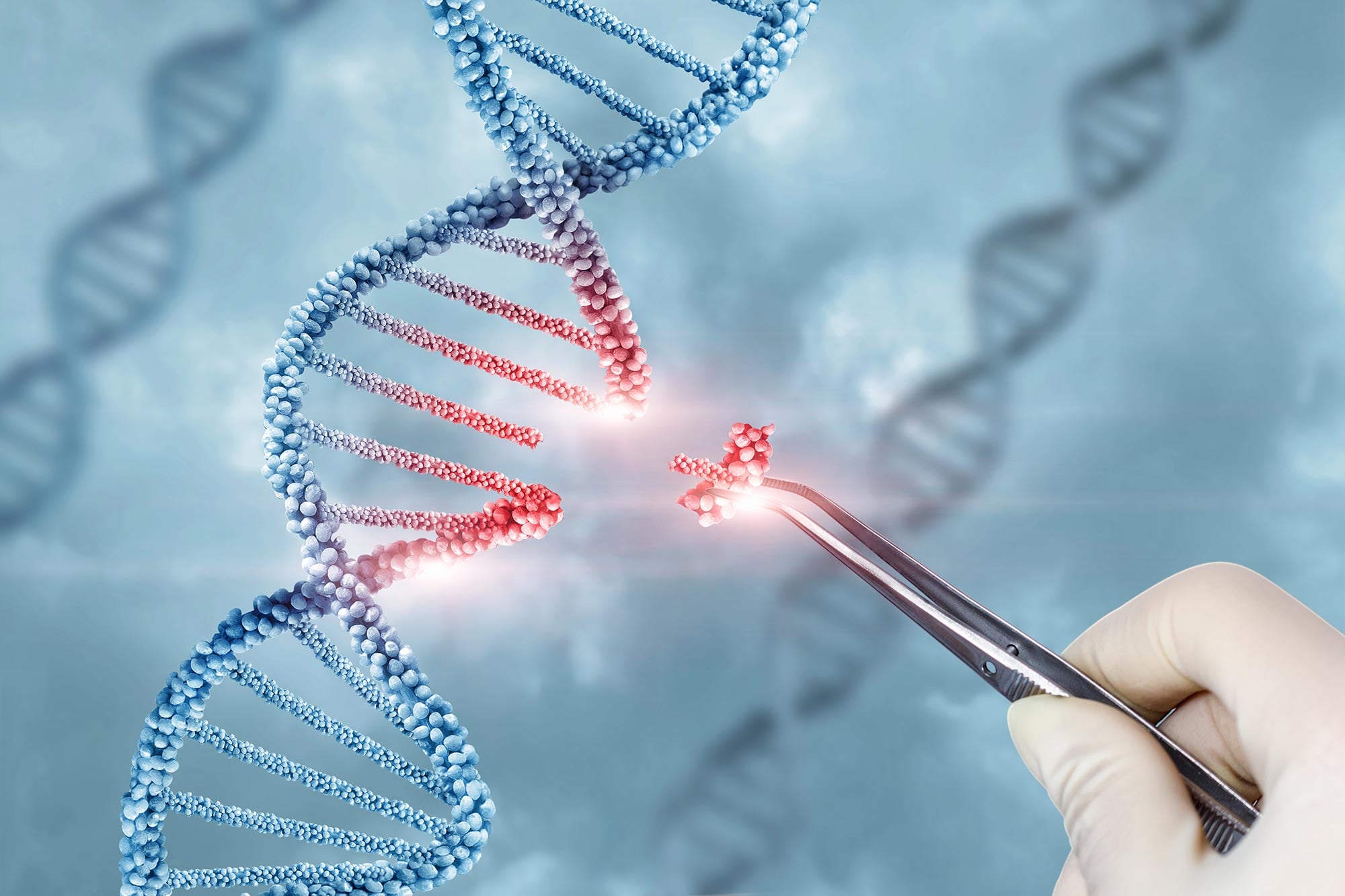
MIT researchers have dramatically lowered the error rate of prime editing, a technique with promise for treating numerous genetic disorders.
A genome editing method called prime editing could one day treat many illnesses by fixing defective genes so they function correctly. The technique, however, has a small risk of creating unintended changes that might be harmful.
MIT scientists have identified a way to greatly cut that error rate by engineering the proteins that power prime editing. According to the researchers, this improvement could make it easier to develop gene therapies for a broad range of diseases.
“This paper outlines a new approach to doing gene editing that doesn’t complicate the delivery system and doesn’t add additional steps, but results in a much more precise edit with fewer unwanted mutations,” says Phillip Sharp, an MIT Institute Professor Emeritus, a member of MIT’s Koch Institute for Integrative Cancer Research, and one of the senior authors of the new study.
With their new strategy, the MIT team was able to improve the error rate of prime editors from about one error in seven edits to one in 101 for the most-used editing mode, or from one error in 122 edits to one in 543 for a high-precision mode.
“For any drug, what you want is something that is effective, but with as few side effects as possible,” says Robert Langer, the David H. Koch Institute Professor at MIT, a member of the Koch Institute, and one of the senior authors of the new study. “For any disease where you might do genome editing, I would think this would ultimately be a safer, better way of doing it.”
Koch Institute research scientist Vikash Chauhan is the lead author of the paper, which appears today in Nature.
The potential for error
The earliest forms of gene therapy, first tested in the 1990s, involved delivering new genes carried by viruses. Subsequently, gene-editing techniques that use enzymes such as zinc finger nucleases to correct genes were developed. These nucleases are difficult to engineer, however, so adapting them to target different DNA sequences is a very laborious process.
Many years later, the CRISPR genome-editing system was discovered in bacteria, offering scientists a potentially much easier way to edit the genome. The CRISPR system consists of an enzyme called Cas9 that can cut double-stranded DNA at a particular spot, along with a guide RNA that tells Cas9 where to cut. Researchers have adapted this approach to cut out faulty gene sequences or to insert new ones, following an RNA template.
In 2019, researchers at the Broad Institute of MIT and Harvard reported the development of prime editing: a new system, based on CRISPR, that is more precise and has fewer off-target effects. A recent study reported that prime editors were successfully used to treat a patient with chronic granulomatous disease (CGD), a rare genetic disease that affects white blood cells.
“In principle, this technology could eventually be used to address many hundreds of genetic diseases by correcting small mutations directly in cells and tissues,” Chauhan says.
One of the advantages of prime editing is that it doesn’t require making a double-stranded cut in the target DNA. Instead, it uses a modified version of Cas9 that cuts just one of the complementary strands, opening up a flap where a new sequence can be inserted. A guide RNA delivered along with the prime editor serves as the template for the new sequence.
Once the new sequence has been copied, however, it must compete with the old DNA strand to be incorporated into the genome. If the old strand outcompetes the new one, the extra flap of new DNA hanging off may accidentally get incorporated somewhere else, giving rise to errors.
Many of these errors might be relatively harmless, but it’s possible that some could eventually lead to tumor development or other complications. With the most recent version of prime editors, this error rate ranges from one per seven edits to one per 121 edits for different editing modes.
“The technologies we have now are really a lot better than earlier gene therapy tools, but there’s always a chance for these unintended consequences,” Chauhan says.
Precise editing
To reduce those error rates, the MIT team decided to take advantage of a phenomenon they had observed in a 2023 study. In that paper, they found that while Cas9 usually cuts in the same DNA location every time, some mutated versions of the protein show a relaxation of those constraints. Instead of always cutting the same location, those Cas9 proteins would sometimes make their cut one or two bases further along the DNA sequence.
This relaxation, the researchers discovered, makes the old DNA strands less stable, so they get degraded, making it easier for the new strands to be incorporated without introducing any errors.
In the new study, the researchers were able to identify Cas9 mutations that dropped the error rate to 1/20th its original value. Then, by combining pairs of those mutations, they created a Cas9 editor that lowered the error rate even further, to 1/36th the original amount.
To make the editors even more accurate, the researchers incorporated their new Cas9 proteins into a prime editing system that has an RNA binding protein that stabilizes the ends of the RNA template more efficiently. This final editor, which the researchers call vPE, had an error rate just 1/60th of the original, ranging from one in 101 edits to one in 543 edits for different editing modes. These tests were performed in mouse and human cells.
The MIT team is now working on further improving the efficiency of prime editors, through further modifications of Cas9 and the RNA template. They are also working on ways to deliver the editors to specific tissues of the body, which is a longstanding challenge in gene therapy.
They also hope that other labs will begin using the new prime editing approach in their research studies. Prime editors are commonly used to explore many different questions, including how tissues develop, how populations of cancer cells evolve, and how cells respond to drug treatment.
“Genome editors are used extensively in research labs,” Chauhan says. “So the therapeutic aspect is exciting, but we are really excited to see how people start to integrate our editors into their research workflows.”
Reference: “Engineered prime editors with minimal genomic errors” by Vikash P. Chauhan, Phillip A. Sharp and Robert Langer, 17 September 2025, Nature.
DOI: 10.1038/s41586-025-09537-3
The research was funded by the Life Sciences Research Foundation, the National Institute of Biomedical Imaging and Bioengineering, the National Cancer Institute, and the Koch Institute Support (core) Grant from the National Cancer Institute.
Never miss a breakthrough: Join the SciTechDaily newsletter.
Follow us on Google and Google News.
2 Comments
“The technique, however, has a small risk of creating unintended changes that might be harmful.”
Where does FANZOR fit onto the editing model?