
Close Menu
    Facebook X (Twitter) Instagram
    SciTechDaily
    • Biology
    • Chemistry
    • Earth
    • Health
    • Physics
    • Science
    • Space
    • Technology
    Facebook X (Twitter) Pinterest YouTube RSS
    SciTechDaily
    Home»Technology»MOF Powered by Sunlight Could Help Drastically Cut Carbon Emissions
    Technology

    MOF Powered by Sunlight Could Help Drastically Cut Carbon Emissions

    By Monash UniversityFebruary 13, 20131 Comment3 Mins Read
    Facebook Twitter Pinterest Telegram LinkedIn WhatsApp Email Reddit
    Share
    Facebook Twitter LinkedIn Pinterest Telegram Email Reddit
    Carbon Sponge Powered by Sunlight
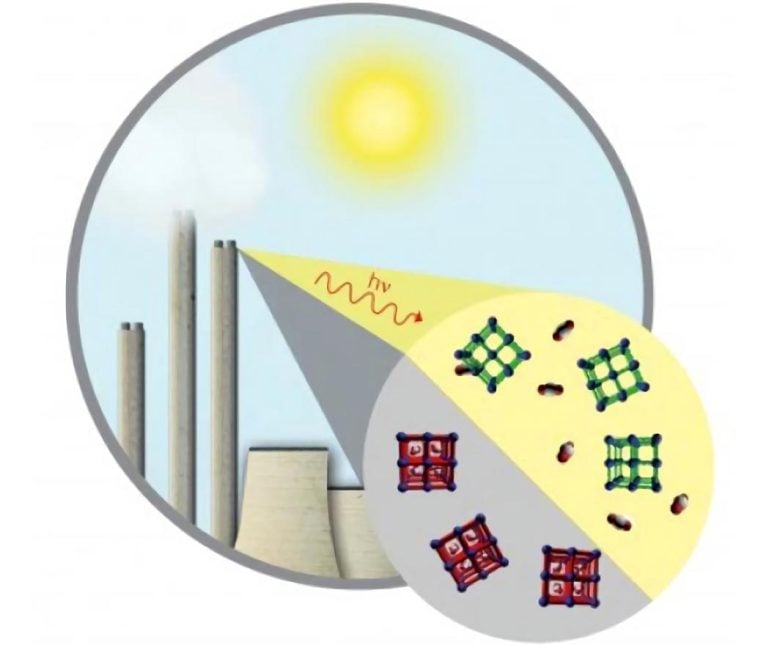
    A new material powered by sunlight could help to drastically cut carbon emissions. Credit: Monash University

    Researchers from Monash University and CSIRO have discovered a photosensitive metal-organic framework (MOF) that utilizes sunlight to release large amounts of stored carbon.

    Emissions from coal power stations could be drastically reduced by a new, energy-efficient material that adsorbs large amounts of carbon dioxide, then releases it when exposed to sunlight.

    In a study published on February 10 in Angewandte Chemie, Monash University and CSIRO scientists for the first time discovered a photosensitive metal-organic framework (MOF) – a class of materials known for their exceptional capacity to store gases. This has created a powerful and cost-effective new tool to capture and store, or potentially recycle, carbon dioxide.

    By utilizing sunlight to release the stored carbon, the new material overcomes the problems of expense and inefficiency associated with current, energy-intensive methods of carbon capture. Current technologies use liquid capture materials that are then heated in a prolonged process to release the carbon dioxide for storage.

    Associate Professor Bradley Ladewig of the Monash Department of Chemical Engineering said the MOF was an exciting development in emissions reduction technology.

    “For the first time, this has opened up the opportunity to design carbon capture systems that use sunlight to trigger the release of carbon dioxide,” Associate Professor Ladewig said.

    “This is a step-change in carbon capture technologies.”

    A promising and novel class of materials, MOFs are clusters of metal atoms connected by organic molecules. Due to their extremely high internal surface area – that could cover an entire football field in a single gram – they can store large volumes of gas.

    PhD student Richelle Lyndon and lead author of the paper said the technology, known as dynamic photo-switching was accomplished using light-sensitive azobenzene molecules.

    “The MOF can release the adsorbed carbon dioxide when irradiated with light found in sunlight, just like wringing out a sponge,” Ms. Lyndon said.

    “The MOF we discovered had a particular affinity for carbon dioxide. However, the light-responsive molecules could potentially be combined with other MOFs, making the capture and release technology appropriate for other gases.”

    The researchers, led by Professor Matthew Hill of CSIRO, will now optimize the material to increase the efficiency of carbon dioxide to levels suitable for an industrial environment.

    Reference: “Dynamic Photo-Switching in Metal–Organic Frameworks as a Route to Low-Energy Carbon Dioxide Capture and Release” by Richelle Lyndon, Dr. Kristina Konstas, Prof. Bradley P. Ladewig, Dr. Peter D. Southon, Prof Cameron J. Kepert and Dr. Matthew R. Hill, 10 February 2013, Angewandte Chemie.
    DOI: 10.1002/anie.201206359

    The study was supported by the Science and Industry Endowment Fund.

    Never miss a breakthrough: Join the SciTechDaily newsletter.
    Follow us on Google and Google News.

    Carbon Capture Carbon Emissions Green Technology Materials Science Monash University
    Share. Facebook Twitter Pinterest LinkedIn Email Reddit

    Related Articles

    This New Building Material Doesn’t Emit Carbon – It Traps It

    New Solar-Energy Device is 100 Times More Efficient Than Previous Design

    Layered Oxide Heterostructures Produce Efficient Solar Cells

    Researchers Develop a Self-Charging Power Cell

    Black Silicon Improves the Efficiency of Solar Cells

    Highly Transparent Polymer Solar Cell Produces Energy by Absorbing Near-Infrared Light

    Converting Waste Into Useful Energy by Improving Microbial Fuel Cells

    Solid-Oxide Fuel Cell That Converts Hydrogen Into Electricity Also Capable of Battery-Like Storage

    Limestone Based Cement Reduces Energy Consumption and CO2 Production by 97%

    1 Comment

    1. John Macdonald on December 3, 2014 10:46 am

      Fascinating work but I would like to understand why we would want to release CO2 from the MOFs using sunlight? Presumably we would not want to release it to the atmosphere as this would defeat the purpose of capturing it.

      Reply
    Leave A Reply Cancel Reply

    • Facebook
    • Twitter
    • Pinterest
    • YouTube

    Don't Miss a Discovery

    Subscribe for the Latest in Science & Tech!

    Trending News

    Largest-Ever Study Finds Medicinal Cannabis Ineffective for Anxiety, Depression, PTSD

    250-Million-Year-Old Egg Solves One of Evolution’s Biggest Mysteries

    Living With Roommates Might Be Changing Your Gut Microbiome Without You Knowing

    Century-Old Cleaning Chemical Linked to 500% Increased Risk of Parkinson’s Disease

    What if Your Memories Never Happened? Physicists Take a New Look at the Boltzmann Brain Paradox

    One of the Universe’s Largest Stars May Be Getting Ready To Explode

    Scientists Discover Enzyme That Could Supercharge Ozempic-Like Weight Loss Drugs

    Popular Sweetener Linked to DNA Damage – “It’s Something You Should Not Be Eating”

    Follow SciTechDaily
    • Facebook
    • Twitter
    • YouTube
    • Pinterest
    • Newsletter
    • RSS
    SciTech News
    • Biology News
    • Chemistry News
    • Earth News
    • Health News
    • Physics News
    • Science News
    • Space News
    • Technology News
    Recent Posts
    • 5.5 Million Bees Discovered Living Beneath a New York Cemetery
    • Scientists Reverse Brain Aging With Simple Nasal Spray
    • The Surprising Diet Rule That Makes “Good” Parasites Work
    • This Simple Blood Test Could Outperform “Bad Cholesterol” in Preventing Heart Disease
    • Scientists Uncover Potential Brain Risks of Popular Fish Oil Supplements
    Copyright © 1998 - 2026 SciTechDaily. All Rights Reserved.
    • Science News
    • About
    • Contact
    • Editorial Board
    • Privacy Policy
    • Terms of Use

    Type above and press Enter to search. Press Esc to cancel.