

Scientists in Japan have uncovered a surprising twist, literally, in how molecules organize themselves. By introducing tiny leftover fragments from previous assemblies, they discovered a way to flip the direction of helical molecular structures.
Using specific intensities of UV and visible light, they controlled whether these molecules formed left-handed or right-handed spirals, revealing a new method to fine-tune optical and electronic properties. This groundbreaking insight could unlock novel ways to engineer smarter, more responsive materials.
Revealing the Power of Molecular Self-Assembly
In molecular science, self-assembly, also known as self-organization, describes the process by which molecules spontaneously come together to form ordered structures. This unique behavior is fundamental to creating advanced optical and electronic materials.
In a recent breakthrough, researchers in Japan discovered a way to fine-tune this process. They found that even a small amount of leftover molecular clusters, known as residual aggregates, can significantly influence how photo-responsive molecules self-assemble. The study was led by Professor Shiki Yagai from the Graduate School of Engineering at Chiba University, with key contributions from Assistant Professor Takuho Saito (Nagoya University, at the time of research), Mr. Daisuke Inoue, and Assistant Professor Yuichi Kitamoto from Tohoku University. Their findings were published today (April 11) in Nature Nanotechnology.
The Delicate Balance of Molecular Structure
In recent years, scientists have been working to better control the size and structure of these self-assembled aggregates to tailor their properties for specific functions. But because self-assembly is a highly dynamic process, where molecules constantly associate and break apart, it requires careful control. “During the process of self-assembly, the molecules repeatedly continue to associate and dissociate,” explains Prof. Yagai. “Even minute impurities or slight changes in the conditions can impact the final structure of the formed aggregates.”
Light-Driven Molecular Chirality Switch
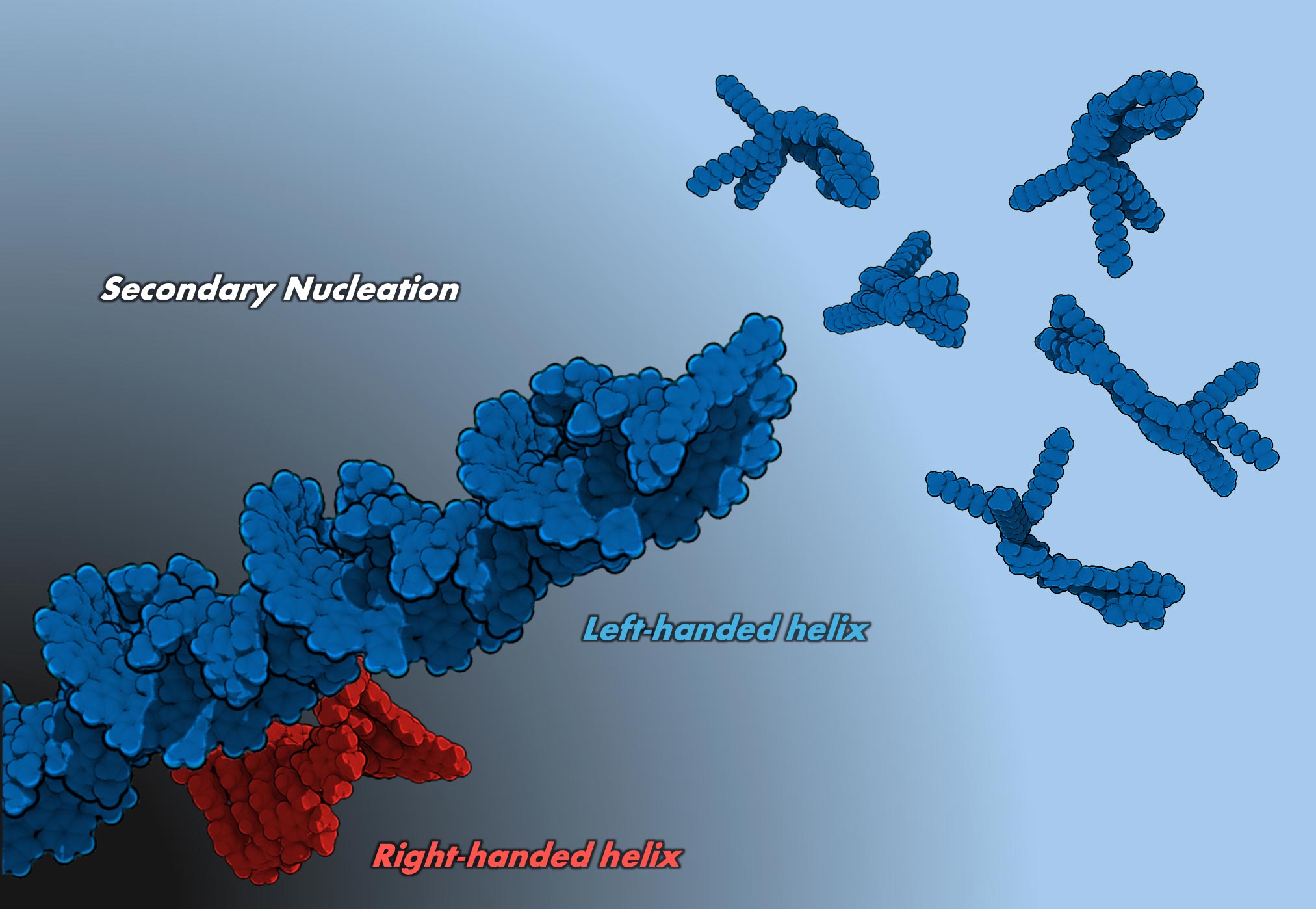
For the study, the research team focused on the self-assembly of a chiral, photoresponsive azobenzene that naturally forms left-handed helical aggregates. The team discovered that the presence of a small amount of residual aggregates within the solution induces a drastic change in the assembly process and leads to the formation of right-handed helical aggregates instead. Moreover, being photoresponsive, controlling the exposure to light also modifies the timing of molecular assembly. Using precise control of these two properties together, the researchers successfully manipulated the formation of either left-handed or right-handed helical aggregates as required.
Understanding Chirality Through Folding and Twisting
In spectroscopic and molecular modeling studies, the team found that when the scissor-shaped azobenzene molecule is dissolved in an organic solvent at room temperature, it forms a closed scissor-like folded structure that further extends into a helical assembly. Prof. Yagai explains the formation of left-handed assembly, saying, “The molecule contains a carbon atom that has four different atomic groups and therefore exhibits chirality. These molecules fold like left-handed scissors and twist to form a left-handed helical stacking of the assembly.”
Since these are photoresponsive molecules, when the stacked helical structures are exposed to weak ultraviolet (UV) light, the helical assembly disassembles back into individual molecules, and upon subsequent exposure to visible light, the molecules reassemble into helical structures again. Interestingly, under certain conditions, the resulting helical aggregates were found to be right-handed instead of left-handed, and exposure to stronger UV light followed by visible light led to the regeneration of the original left-handed helical aggregates.
Discovery of Secondary Nucleation Effects
By closely investigating this mechanism, the team found that when solutions were exposed to weak UV light, there was a minute amount of residual left-handed helical aggregates that remained unchanged, and these aggregates acted as nucleation sites forming oppositely directed helical assemblies. “This remarkable phenomenon is called ‘secondary nucleation,’ which explains why meta-stable right-handed aggregates are preferably formed instead of left-handed aggregates,” says Prof. Yagai.
In addition to this, the team also discovered the role of light intensity in the molecular assembly process. Prof. Yagai explains, “We identified that the intensity of visible light potentially affected the timing of the assembly. Strong visible light promoted rapid assembly while minimizing the influence of the residual aggregates. In contrast, weaker intensity magnifies the effect of the residual aggregates.”
Toward Tailored Functional Materials
Therefore, by optimizing the intensities of UV and visible light, the researchers successfully controlled the switching between left- and right-handed helical structures which were dependent on the influence of the residual aggregates. Moreover, it was also found that the stable left-handed aggregates and meta-stable right-handed aggregates also exhibit opposite electron spin polarization, which signifies the tuning of electronic characteristics of the helices.
Overall, this study aimed to explore the critical role of residual aggregates and explained how light-enabled fine-tuning can result in the fabrication of novel functional materials, giving promising insights into the field of material science.
Reference: “Inversion of supramolecular chirality by photo-enhanced secondary nucleation” by Takuho Saito, Daisuke Inoue, Yuichi Kitamoto, Hiroki Hanayama, Takatoshi Fujita, Yuki Watanabe, Masayuki Suda, Takashi Hirose, Takashi Kajitani and Shiki Yagai, 11 April 2025, Nature Nanotechnology.
DOI: 10.1038/s41565-025-01882-8
Never miss a breakthrough: Join the SciTechDaily newsletter.
Follow us on Google and Google News.