
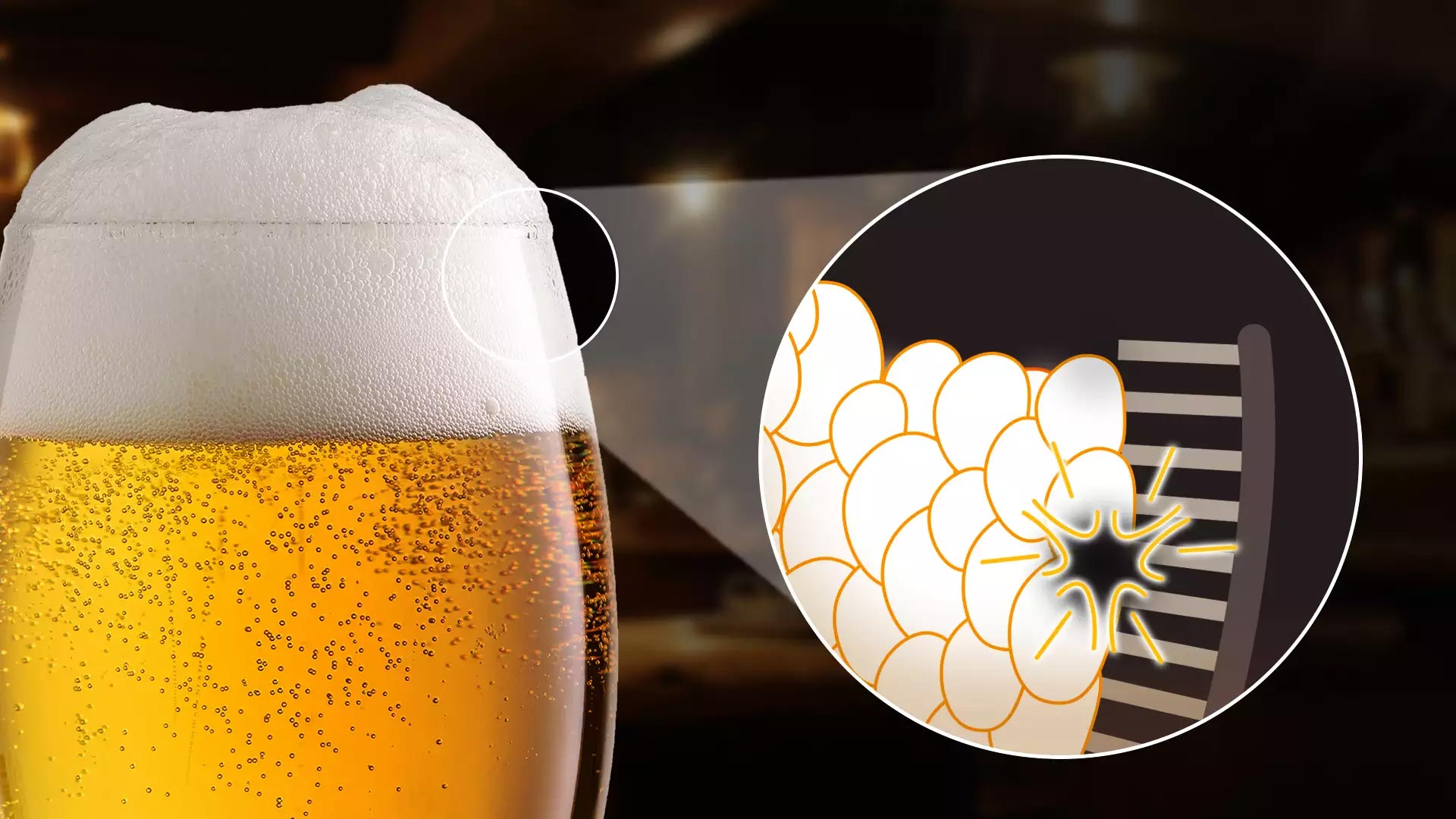
Superamphiphobic surfaces can prevent and dissipate foam by destabilizing bubbles, offering a chemical-free solution for industrial processes.
While foam is certainly desirable in the bathtub or on beer, preventing foam — for example in industrial processes — is a much-discussed topic. Often, oils or particles are added to liquids to prevent foaming. If these are harmful to health or the environment, they must be removed again using complex methods. A team of researchers at the Max Planck Institute for Polymer Research has now shown that so-called “superamphiphobic surfaces” can be used to prevent foaming
Foam formation and a long lifetime of the foam is desired for beer in a glass, for example — but foam should be avoided in beer bottling in order to speed up the bottling process. Foam formation is also often undesirable in other industrial processes, especially if it leads to spillages and environmental contamination.
In foams, adjacent air bubbles are separated from each other by a thin film of liquid. To generate and stabilize the foam, surface-active substances such as surfactants, often lipids or proteins are added.
Many liquids, such as beer and soaps, contain such surface-active molecules which stabilize foam. To prevent foaming, additional chemicals must therefore be added, such as oils, waxes, or microparticles. These help neighboring air bubbles to fuse together quickly, causing foam to break down rapidly.
Scientists working with Doris Vollmer, group leader at the Max Planck Institute for Polymer Research in Hans-Jürgen Butt’s department, have now investigated the effect of superamphiphobic surfaces on foam in more detail. These surfaces have a microscopic roughness and thus prevent liquids from adhering to them: The liquid sits on small columns of only a few micrometers — millionths of a meter — and a continuous film of air, similar to a fakir on a pinboard. This effect is known, for example, from the lotus leaf.
How Superamphiphobic Surfaces Dissipate Foam
“We asked ourselves whether we could use surfaces like this to prevent foam from forming or even dissolve existing foam,” says William Wong, lead author of the study. The idea is that the fine columns destabilize the bubbles of foam on contact and cause them to burst, much like when a needle is poked into a balloon. The air within the foam is then released and escapes through the continuous layer of air in the superamphiphobic layer. The result: the foam dissolves/dissipates without the need for chemical additives or mechanical (energy-consuming) agitation.
To experimentally prove their idea, the researchers coated the inside of glasses with a thin, superamphiphobic layer and filled the glasses with beer and soapy water. In order to accurately study the foam formation or decomposition in detail, a wide variety of scientific methods were used, including high-speed photography and digital holography.
“In our opinion, the properties of such surfaces in connection with foam have long been underestimated,” says Doris Vollmer. “We were able to show that superamphiphobic surfaces can efficiently destroy pre-existing foam as well as prevent foam formation in the first place.”
According to the scientists, the coated glass surfaces could help speed up filling processes in the future without having to add additional substances.
The results have now been published in Nature Communications.
Reference: “Super liquid repellent surfaces for anti-foaming and froth management” by William S. Y. Wong, Abhinav Naga, Lukas Hauer, Philipp Baumli, Hoimar Bauer, Katharina I. Hegner, Maria D’Acunzi, Anke Kaltbeitzel, Hans-Jürgen Butt and Doris Vollmer, 9 September 2021, Nature Communications.
DOI: 10.1038/s41467-021-25556-w
Never miss a breakthrough: Join the SciTechDaily newsletter.
Follow us on Google and Google News.
2 Comments
If you reduce foaming, I would expect that you would reduce the amount of CO2 gas which causes bloating.
Actually if you reduce foaming, you increase the amount of CO2 that remains in the beer, causing more bloating.