
Close Menu
    Facebook X (Twitter) Instagram
    SciTechDaily
    • Biology
    • Chemistry
    • Earth
    • Health
    • Physics
    • Science
    • Space
    • Technology
    Facebook X (Twitter) Pinterest YouTube RSS
    SciTechDaily
    Home»Space»Murchison Widefield Array Maps Cosmic Rays In The Magellanic Clouds
    Space

    Murchison Widefield Array Maps Cosmic Rays In The Magellanic Clouds

    By Pete Wheeler, ICRARSeptember 5, 20181 Comment4 Mins Read
    Facebook Twitter Pinterest Telegram LinkedIn WhatsApp Email Reddit
    Share
    Facebook Twitter LinkedIn Pinterest Telegram Email Reddit
    Radio Telescope Maps Cosmic Rays
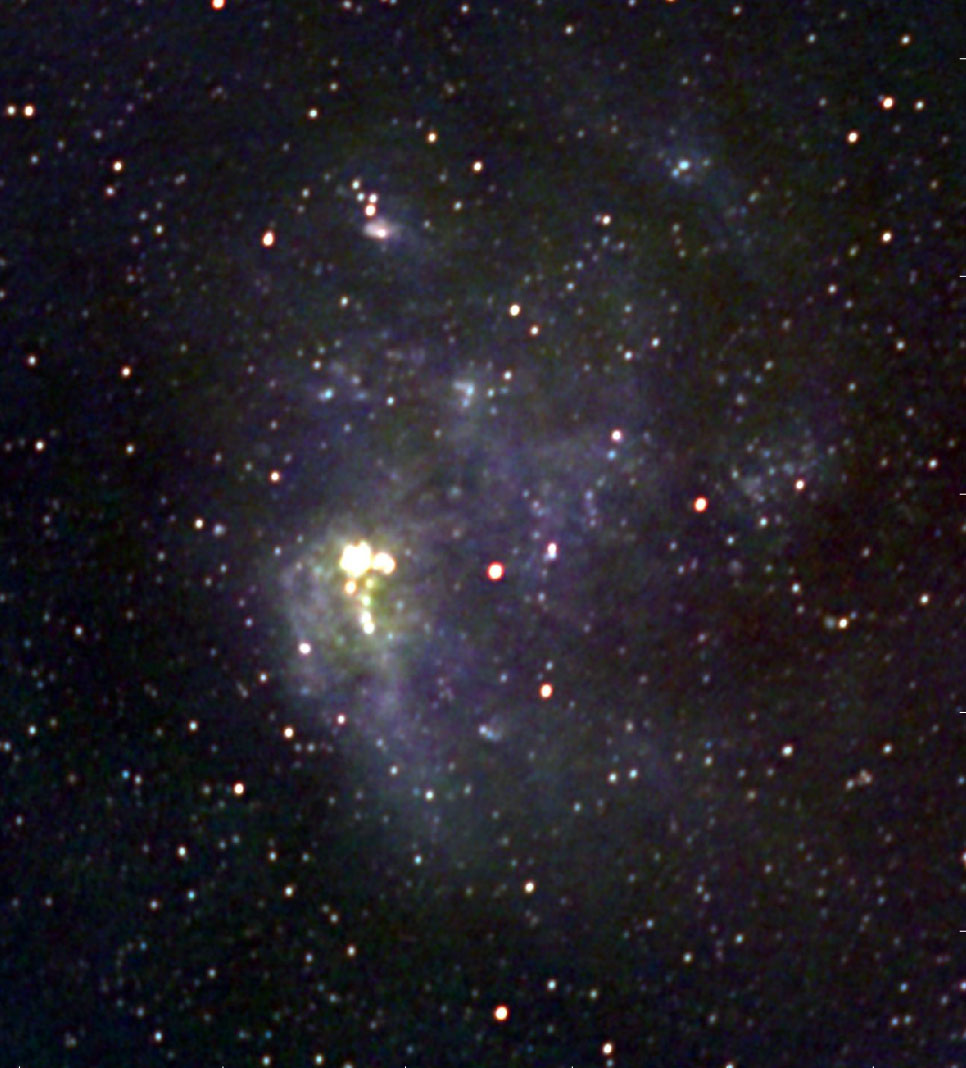
    A red, green, and blue composite image of the Large Magellanic Cloud made from radio wavelength observations at 123MHz, 181MHz, and 227MHz. At these wavelengths, emissions from cosmic rays and the hot gases belonging to the star-forming regions and supernova remnants of the galaxy are visible. Credit: ICRAR

    A radio telescope in outback Western Australia has been used to observe radiation from cosmic rays in two neighboring galaxies, showing areas of star formation and echoes of past supernovae.

    The Murchison Widefield Array (MWA) telescope was able to map the Large Magellanic Cloud and Small Magellanic Cloud galaxies in unprecedented detail as they orbit around the Milky Way.

    By observing the sky at very low frequencies, astronomers detected cosmic rays and hot gas in the two galaxies and identified patches where new stars are born and remnants from stellar explosions can be found.

    The research was published today in Monthly Notices of the Royal Astronomical Society, one of the world’s leading astronomy journals.

    International Center for Radio Astronomy Research (ICRAR) astrophysicist Professor Lister Staveley-Smith said cosmic rays are very energetic charged particles that interact with magnetic fields to create radiation we can see with radio telescopes.
    Telescope Maps Cosmic Rays
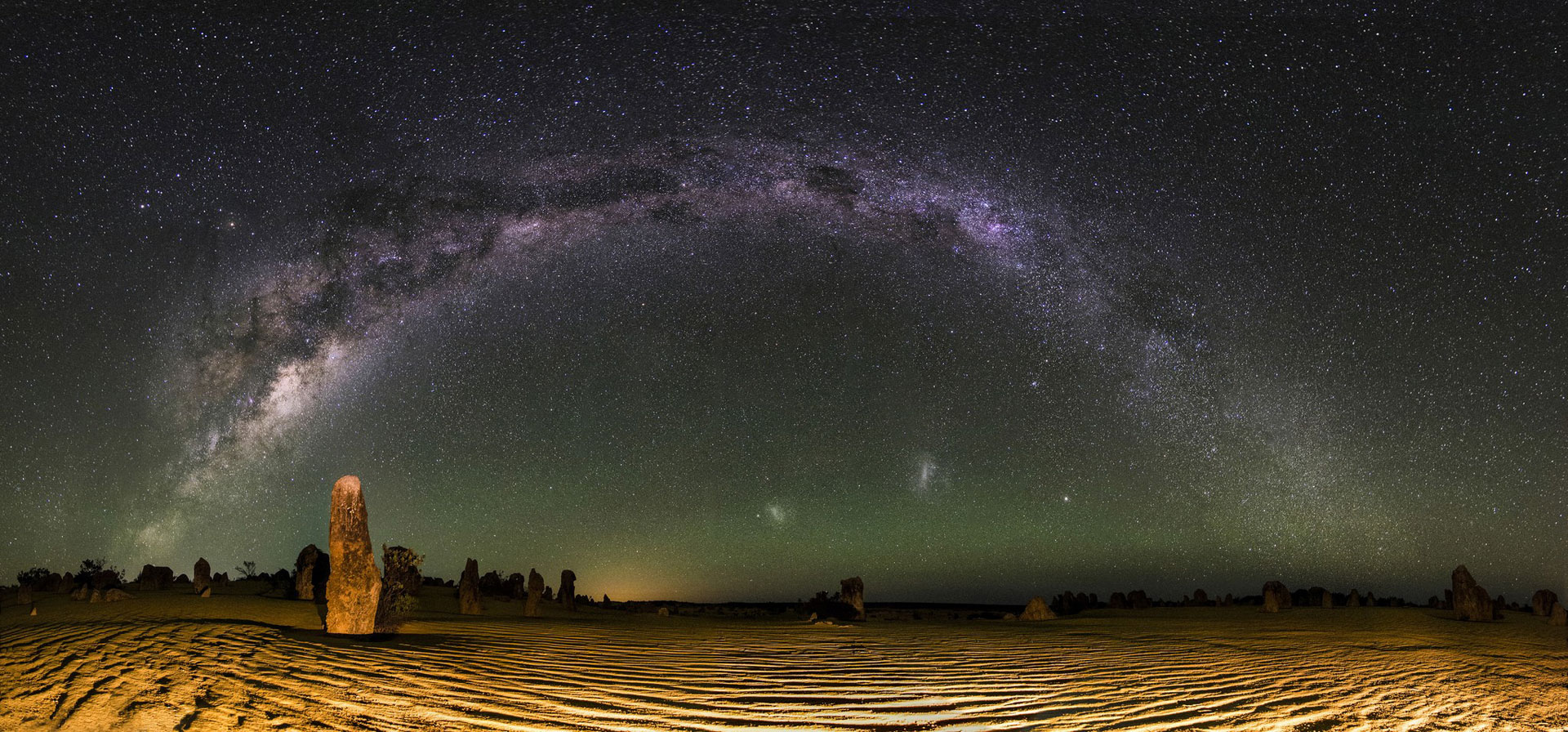
    The Milky Way arching over the Large and Small Magellanic Clouds as viewed from the Pinnacles Desert in Western Australia. Credit: inefekt69 / Flickr

    “These cosmic rays actually originate in supernova remnants—remnants from stars that exploded a long time ago,” he said.

    “The supernova explosions they come from are related to very massive stars, much more massive than our own Sun.”

    “The number of cosmic rays that are produced depends on the rate of formation of these massive stars millions of years ago.”

    The Large and Small Magellanic Clouds are very close to our own Milky Way—less than 200,000 light-years away—and can be seen in the night sky with the naked eye.

    Murchison Widefield Array Maps Cosmic Rays
    A red, green, and blue composite image of the Large Magellanic Cloud (left) and Small Magellanic Cloud (right) made from radio wavelength observations taken at 123MHz, 181MHz, and 227MHz. At these wavelengths, emissions from cosmic rays and the hot gases belonging to the star-forming regions and supernova remnants of the galaxy are visible. Credit: ICRAR

    ICRAR astronomer Dr. Bi-Qing For, who led the research, said this was the first time the galaxies had been mapped in detail at such low radio frequencies.

    “Observing the Magellanic Clouds at these very low frequencies—between 76 and 227MHz—meant we could estimate the number of new stars being formed in these galaxies,” she said.

    “We found that the rate of star formation in the Large Magellanic Cloud is roughly equivalent to one new star the mass of our Sun being produced every ten years.”

    “In the Small Magellanic Cloud, the rate of star formation is roughly equivalent to one new star the mass of our Sun every forty years.”

    Included in the observations are 30 Doradus, an exceptional region of star formation in the Large Magellanic Cloud that is brighter than any star formation region in the Milky Way, and Supernova 1987A, the brightest supernova since the invention of the telescope.

    Professor Staveley-Smith said the results are an exciting glimpse into the science that will be possible with next-generation radio telescopes.

    “It shows an indication of the results that we will see with the upgraded MWA, which now has twice the previous resolution,” he said.

    Furthermore, the forthcoming Square Kilometer Array (SKA) will deliver exceptionally fine images.

    “With the SKA the baselines are eight times longer again, so we’ll be able to do so much better,” Professor Staveley-Smith said.

    Reference: “A Multi-Frequency Radio Continuum Study of the Magellanic Clouds. I. Overall Structure and Star Formation Rates” by B-Q For, L Staveley-Smith, N Hurley-Walker, T Franzen, A D Kapińska, M D Filipović, J D Collier, C Wu, K Grieve, J R Callingham, M E Bell, G Bernardi, J D Bowman, F Briggs, R J Cappallo, A A Deshpande, K S Dwarakanath, B M Gaensler, L J Greenhill, P Hancock, B J Hazelton, L Hindson, M Johnston-Hollitt, D L Kaplan, E Lenc, C J Lonsdale, B McKinley, S R McWhirter, D A Mitchell, M F Morales, E Morgan, J Morgan, D Oberoi, A Offringa, S M Ord, T Prabu, P Procopio, N Udaya Shankar, K S Srivani, R Subrahmanyan, S J Tingay, R B Wayth, R L Webster, A Williams, C L Williams and Q Zheng, 23 July 2018, The Monthly Notices of the Royal Astronomical Society.
    DOI: 10.1093/mnras/sty1960

    Never miss a breakthrough: Join the SciTechDaily newsletter.
    Follow us on Google and Google News.

    Astronomy Cosmology Large Magellanic Cloud Murchison Widefield Array
    Share. Facebook Twitter Pinterest LinkedIn Email Reddit

    Related Articles

    ESO Captures Dazzling Image of Newly-Forming Stars in the LMC

    Astrophysicists Predict Milky Way is Headed For Catastrophic Collision

    Large and Small Magellanic Clouds May Have Had a Third Companion

    ALMA Discovers Surprisingly Complex Organic Molecules in Nearby Galaxy

    New Model May Rule Out the Presence of Dark Matter

    Lyman-Alpha Blobs are Some of the Largest Individual Objects in the Observable Universe

    Links Between Core Collapse Supernovae and Star Formation Established

    The Bolshoi Simulation: Boxing the Universe

    Baryon Oscillation Spectroscopic Survey Measures the Universe’s Expansion and Dark Energy

    1 Comment

    1. Lita Arnold on September 6, 2018 6:33 pm

      That’s a very impressive photograph of the Milky Way taken at Pinnacles Desert in Australia. I don’t understand why the Milky Way looks bowed, like a rainbow. I thought the solar system is in a plane and we Earth creatures are looking out into the galaxy along that plane. Is there an easy explanation?

      Reply
    Leave A Reply Cancel Reply

    • Facebook
    • Twitter
    • Pinterest
    • YouTube

    Don't Miss a Discovery

    Subscribe for the Latest in Science & Tech!

    Trending News

    Scientists Say This Natural Hormone Reverses Obesity by Targeting the Brain

    35-Million-Year-Old Mystery: Strange Arachnid Discovered Preserved in Amber

    Is AI Really Just a Tool? It Could Be Altering How You See Reality

    JWST Reveals a “Forbidden” Planet With a Baffling Composition

    The Protein “Sabotaging” Aging Muscle Recovery Could Be Key to Surviving Aging

    This Diet–Gut Interaction Could Transform Fat Into a Calorie-Burning Machine

    Scientists Discover Hidden Virus Linked to Colorectal Cancer

    Scientists Discover 132-Million-Year-Old Dinosaur Tracks on South Africa’s Coast

    Follow SciTechDaily
    • Facebook
    • Twitter
    • YouTube
    • Pinterest
    • Newsletter
    • RSS
    SciTech News
    • Biology News
    • Chemistry News
    • Earth News
    • Health News
    • Physics News
    • Science News
    • Space News
    • Technology News
    Recent Posts
    • Scientists Create “Optical Tornadoes” That Twist Light Into a Swirling Vortex
    • Scientists Uncover Hidden Superconductivity in Material Once Thought Only Magnetic
    • Scientists Baffled by Bizarre “Living Fossil” From 275 Million Years Ago
    • 500 Million Years Ago, Life Changed Forever: Scientists Reveal the DNA Changes That Helped Animals Move Onto Land
    • Surprise RNA Discovery Challenges Long-Held Beliefs About How Genes Work
    Copyright © 1998 - 2026 SciTechDaily. All Rights Reserved.
    • Science News
    • About
    • Contact
    • Editorial Board
    • Privacy Policy
    • Terms of Use

    Type above and press Enter to search. Press Esc to cancel.