
Close Menu
    Facebook X (Twitter) Instagram
    SciTechDaily
    • Biology
    • Chemistry
    • Earth
    • Health
    • Physics
    • Science
    • Space
    • Technology
    Facebook X (Twitter) Pinterest YouTube RSS
    SciTechDaily
    Home»Space»New Study Completely Changes Our Understanding of Stellar Evolution
    Space

    New Study Completely Changes Our Understanding of Stellar Evolution

    By Hinako Fukushi, National Astronomical Observatory of JapanSeptember 5, 20181 Comment3 Mins Read
    Facebook Twitter Pinterest Telegram LinkedIn WhatsApp Email Reddit
    Share
    Facebook Twitter LinkedIn Pinterest Telegram Email Reddit
    Veiled Supernovae Provide Clues to Stellar Evolution
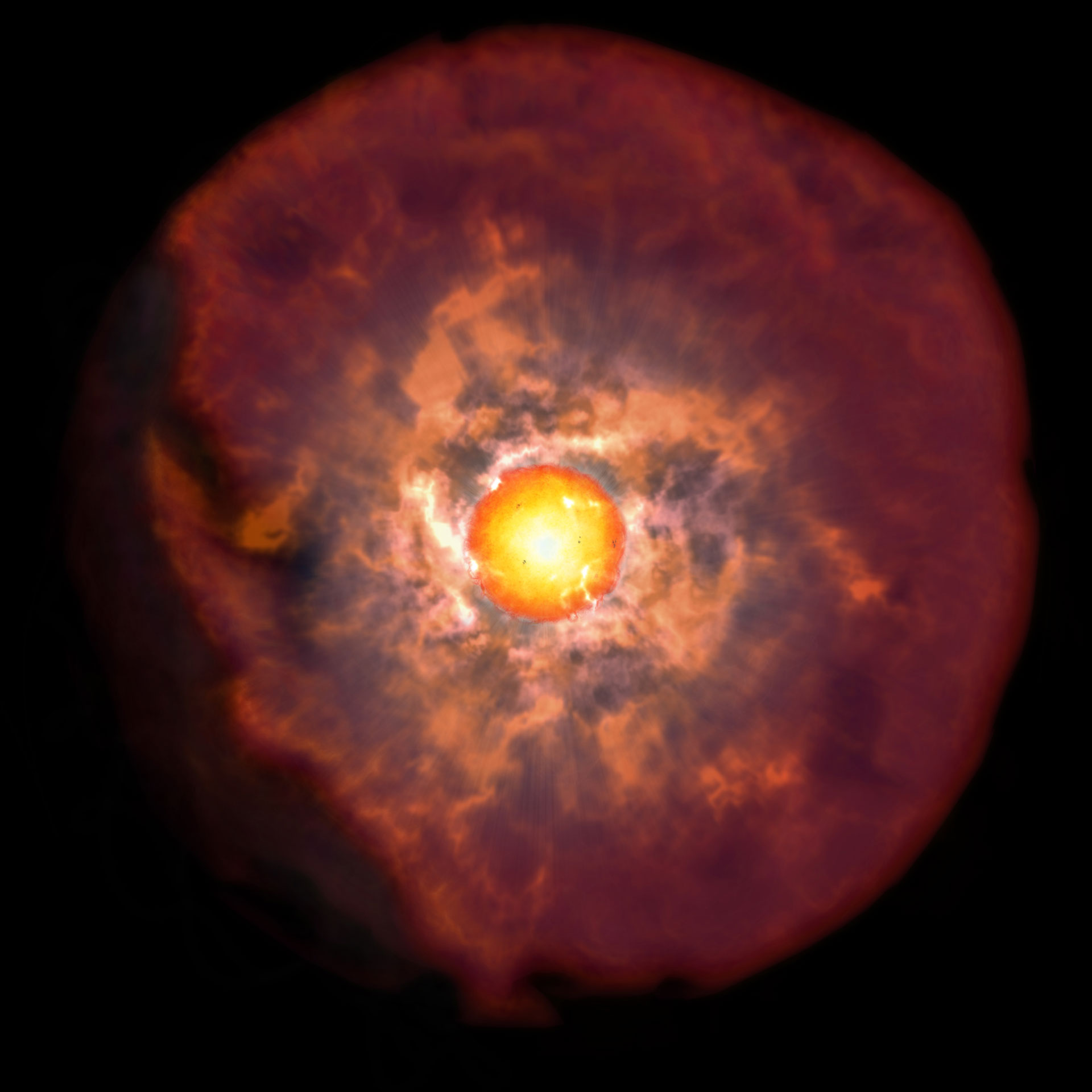
    Artist’s impression of a red supergiant surrounded with thick circumstellar matter. (Credit: NAOJ)

    At the end of its life, a red supergiant star explodes in a hydrogen-rich supernova. By comparing observation results to simulation models, an international research team found that in many cases this explosion takes place inside a thick cloud of circumstellar matter shrouding the star. This result completely changes our understanding of the last stage of stellar evolution.

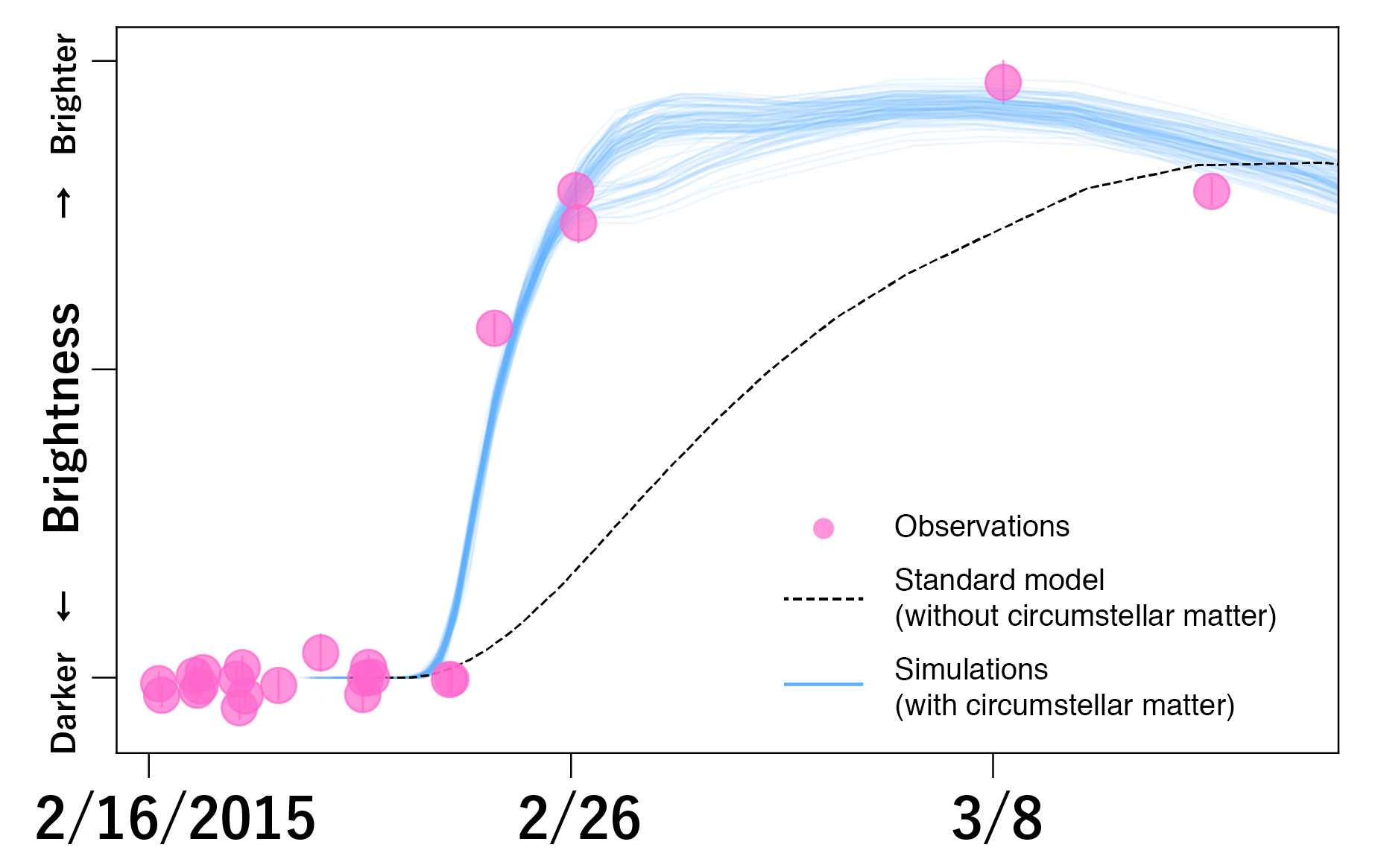
    The research team led by Francisco Förster at the University of Chile used the Blanco Telescope to find 26 supernovae coming from red supergiants. Their goal was to study the shock breakout, a brief flash of light preceding the main supernova explosion. But they could not find any signs of this phenomenon. On the other hand, 24 of the supernovae brightened faster than expected.

    To solve this mystery, Takashi Moriya at the National Astronomical Observatory of Japan (NAOJ) simulated 518 models of supernovae brightness variations and compared them with the observational results. The team found that models with a layer of circumstellar matter about 10 percent the mass of the Sun surrounding the supernovae matched the observations well. This circumstellar matter hides the shock breakout, trapping its light. The subsequent collision between the supernova ejecta and the circumstellar matter creates a strong shock wave that produces extra light, causing it to brighten more quickly.
    New Clues to Stellar Evolution
    Light curve (points) of “SNHiTS15aw,” one of the observed supernovae, compared to standard model (dashed line), and simulations of this study (continuous lines). The observed light curve rises up faster than the standard model and matches the simulation results very well. (Credit: Förster et al. Nature Astronomy 2018, modified)

    Moriya explains, “Near the end of its life, some mechanism in the star’s interior must cause it to shed mass that then forms a layer around the star. We don’t yet have a clear idea of the mechanism causing this mass loss. Further study is needed to get a better understanding of the mass loss mechanism. This will also be important in revealing the supernova explosion mechanism and the origin of the diversity in supernovae.”

    These observations were performed by the Blanco Telescope at Cerro Tololo Inter-American Observatory during six nights in 2014 and eight nights in 2015. The simulations by Moriya were performed on the NAOJ Center for Computational Astrophysics PC cluster. This research was published in Nature Astronomy on September 3, 2018.

    Reference: “The delay of shock breakout due to circumstellar material evident in most type II supernovae” by F. Förster, T. J. Moriya, J. C. Maureira, J. P. Anderson, S. Blinnikov, F. Bufano, G. Cabrera-Vives, A. Clocchiatti, T. de Jaeger, P. A. Estévez, L. Galbany, S. González-Gaitán, G. Gräfener, M. Hamuy, E. Y. Hsiao, P. Huentelemu, P. Huijse, H. Kuncarayakti, J. Martínez, G. Medina, F. Olivares E., G. Pignata, A. Razza, I. Reyes, J. San Martín, R. C. Smith, E. Vera, A. K. Vivas, A. de Ugarte Postigo, S.-C. Yoon, C. Ashall, M. Fraser, A. Gal-Yam, E. Kankare, L. Le Guillou, P. A. Mazzali, N. A. Walton and D. R. Young, 3 September 2018, Nature Astronomy.
    DOI: 10.1038/s41550-018-0563-4

    Never miss a breakthrough: Join the SciTechDaily newsletter.
    Follow us on Google and Google News.

    Astronomy Astrophysics Cosmology National Astronomical Observatory of Japan Stellar Evolution Supernova
    Share. Facebook Twitter Pinterest LinkedIn Email Reddit

    Related Articles

    Carbon-Rich Stardust Grains Unlock Astrophysical Mysteries

    Chandra Reveals the Location of Elements in the Remains of Cas A

    New ScienceCasts Video: Evidence for Supernovas Near Earth

    Dark Energy Survey Reveals a Rare Superluminous Supernova

    First Direct Confirmation of a Wolf-Rayet Star Self-Destructing in a Type IIb Supernova

    New Model Shows How a Collapsing Star Results in Two Black Holes that Form and Fuse

    Astronomers Shed New Light on the Rarest and Brightest Exploding Stars

    12 Billion-Year Old Supernova Discovered by Astronomers

    Links Between Core Collapse Supernovae and Star Formation Established

    1 Comment

    1. katesisco on September 6, 2018 7:50 am

      Would be nice to hear about the study before 3 years has past.

      Reply
    Leave A Reply Cancel Reply

    • Facebook
    • Twitter
    • Pinterest
    • YouTube

    Don't Miss a Discovery

    Subscribe for the Latest in Science & Tech!

    Trending News

    Artificial Sweeteners May Harm Future Generations, Study Suggests

    Splashdown! NASA Artemis II Returns From Record-Breaking Moon Mission

    What If Consciousness Exists Beyond Your Brain

    Scientists Finally Crack the 100-Million-Year Evolutionary Mystery of Squid and Cuttlefish

    Beyond “Safe Levels”: Study Challenges What We Know About Pesticides and Cancer

    Researchers Have Found a Dietary Compound That Increases Longevity

    Scientists Baffled by Bizarre “Living Fossil” From 275 Million Years Ago

    Your IQ at 23 Could Predict Your Wealth at 27, Study Finds

    Follow SciTechDaily
    • Facebook
    • Twitter
    • YouTube
    • Pinterest
    • Newsletter
    • RSS
    SciTech News
    • Biology News
    • Chemistry News
    • Earth News
    • Health News
    • Physics News
    • Science News
    • Space News
    • Technology News
    Recent Posts
    • Geologists Reveal the Americas Collided Earlier Than We Thought
    • 20x Difference: Study Reveals True Source of Airborne Microplastics
    • Scientists Uncover Hidden Force Powering Yellowstone’s Supervolcano
    • This Metal Melts in Your Hand – and Scientists Just Discovered Something Strange
    • Why Losing Too Much Fat Can Be Just As Dangerous as Obesity
    Copyright © 1998 - 2026 SciTechDaily. All Rights Reserved.
    • Science News
    • About
    • Contact
    • Editorial Board
    • Privacy Policy
    • Terms of Use

    Type above and press Enter to search. Press Esc to cancel.