
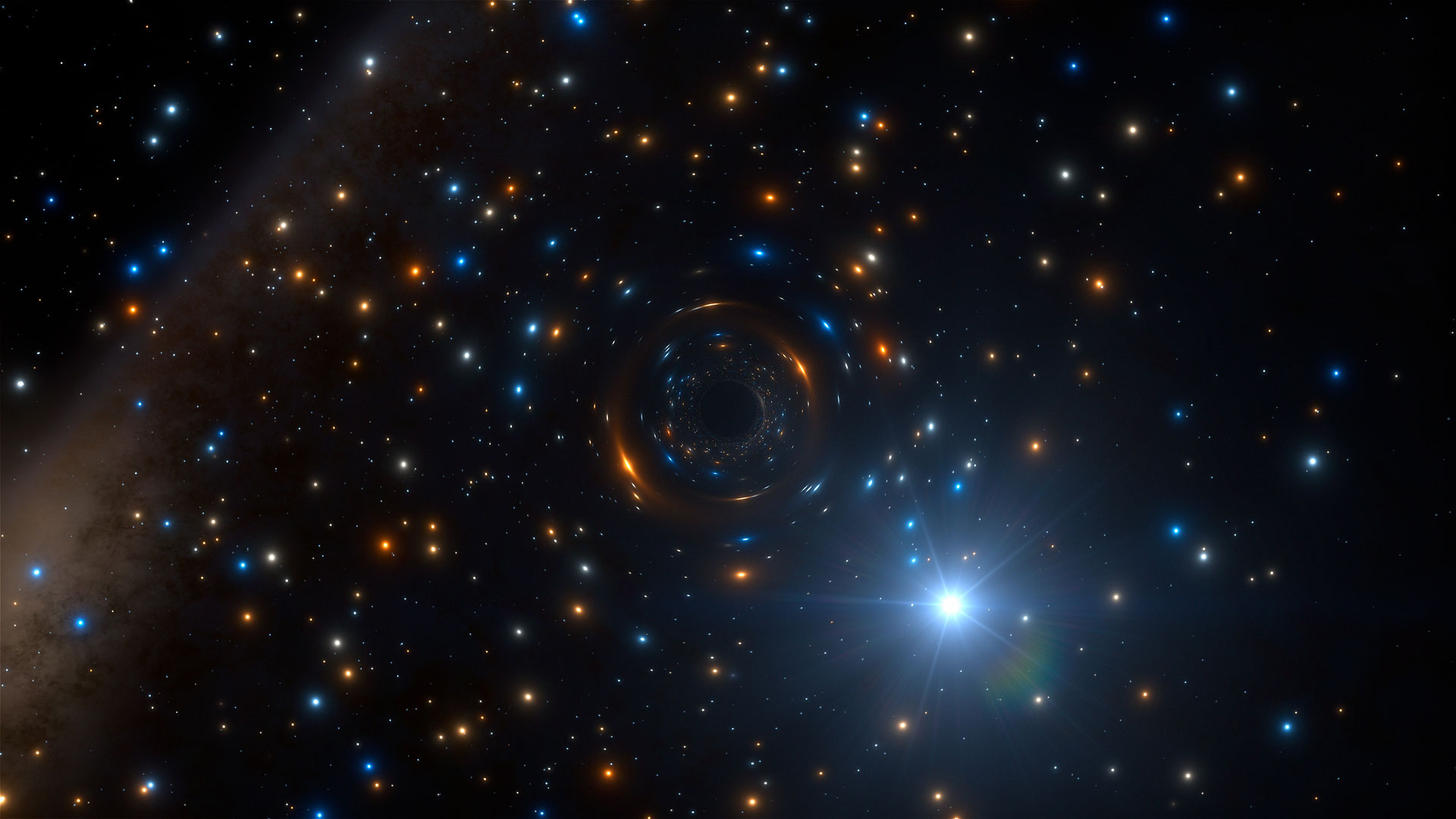
Astronomers using ESO’s MUSE instrument on the Very Large Telescope in Chile have discovered a star in the cluster NGC 3201 that is behaving very strangely. It appears to be orbiting an invisible black hole with about four times the mass of the Sun — the first such inactive stellar-mass black hole found in a globular cluster and the first found by directly detecting its gravitational pull. This important discovery impacts on our understanding of the formation of these star clusters, black holes, and the origins of gravitational wave events.
Globular star clusters are huge spheres of tens of thousands of stars that orbit most galaxies. They are among the oldest known stellar systems in the Universe and date back to near the beginning of galaxy growth and evolution. More than 150 are currently known to belong to the Milky Way.
A new national facility at ESO’s La Silla Observatory has successfully made its first observations. The ExTrA telescopes will search for and study Earth-sized planets orbiting nearby red dwarf stars. ExTrA’s novel design allows for much improved sensitivity compared to previous searches. Astronomers now have a powerful new tool to help in the search for potentially habitable worlds.
One particular cluster, called NGC 3201 and situated in the southern constellation of Vela (The Sails), has now been studied using the MUSE instrument on ESO’s Very Large Telescope in Chile. An international team of astronomers has found that one of the stars in NGC 3201 is behaving very oddly — it is being flung backwards and forwards at speeds of several hundred thousand kilometers per hour, with the pattern repeating every 167 days.
Lead author Benjamin Giesers (Georg-August-Universität Göttingen, Germany) was intrigued by the star’s behavior: “It was orbiting something that was completely invisible, which had a mass more than four times the Sun — this could only be a black hole! The first one found in a globular cluster by directly observing its gravitational pull.”
The relationship between black holes and globular clusters is an important but mysterious one. Because of their large masses and great ages, these clusters are thought to have produced a large number of stellar-mass black holes — created as massive stars within them exploded and collapsed over the long lifetime of the cluster.
This artist’s impression shows how the star and its massive but invisible black hole companion may look, as they orbit each other in the rich heart of the globular star cluster. Credit: ESO/L. Calçada/spaceengine.org
ESO’s MUSE instrument provides astronomers with a unique ability to measure the motions of thousands of far away stars at the same time. With this new finding, the team have for the first time been able to detect an inactive black hole at the heart of a globular cluster — one that is not currently swallowing matter and is not surrounded by a glowing disc of gas. They could estimate the black hole’s mass through the movements of a star caught up in its enormous gravitational pull.
From its observed properties the star was determined to be about 0.8 times the mass of our Sun, and the mass of its mysterious counterpart was calculated at around 4.36 times the Sun’s mass — almost certainly a black hole.
The ExTrA telescopes are sited at ESO’s La Silla Observatory in Chile. They will be used to search for and study Earth-sized planets orbiting nearby red dwarf stars. ExTrA’s novel design allows for much improved sensitivity compared to previous searches. Credit: ESO/Petr Horálek
Recent detections of radio and X-ray sources in globular clusters, as well as the 2016 detection of gravitational-wave signals produced by the merging of two stellar-mass black holes, suggest that these relatively small black holes may be more common in globular clusters than previously thought.
Giesers concludes: “Until recently, it was assumed that almost all black holes would disappear from globular clusters after a short time and that systems like this should not even exist! But clearly this is not the case — our discovery is the first direct detection of the gravitational effects of a stellar-mass black hole in a globular cluster. This finding helps in understanding the formation of globular clusters and the evolution of black holes and binary systems — vital in the context of understanding gravitational wave sources.”
Reference: “A detached stellar-mass lack hole candidate in the globular cluster NGC 3201” by Benjamin Giesers, Stefan Dreizler, Tim-Oliver Husser, Sebastian Kamann, Guillem Anglada Escudé, Jarle Brinchmann, C Marcella Carollo, Martin M Roth, Peter M Weilbacher and Lutz Wisotzki, 15 January 2018, MNRAS.
DOI: 10.1093/mnrasl/slx203
PDF
Never miss a breakthrough: Join the SciTechDaily newsletter.
Follow us on Google and Google News.