
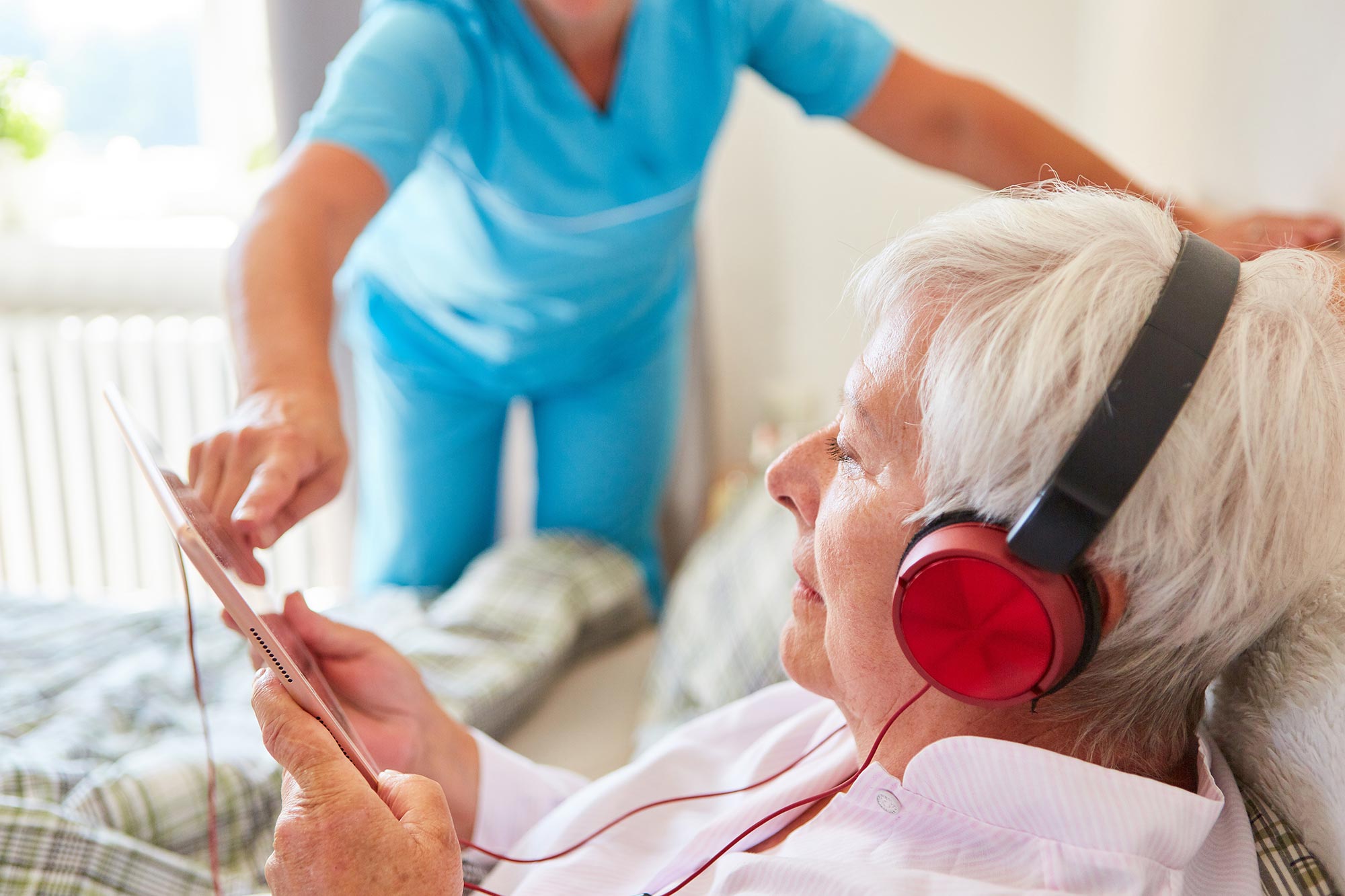
In a groundbreaking NHS pilot, music therapy is helping dementia patients feel calmer and less distressed—without the use of medication. Early findings suggest this simple, low-cost approach could transform care on hospital wards.
Music Therapy: A New Hope for Dementia Care
A new approach using music therapy on dementia wards may offer better care and comfort for some of the NHS’s most at-risk patients.
Researchers from Anglia Ruskin University (ARU), in partnership with the Cambridgeshire and Peterborough NHS Foundation Trust, tested a music-based intervention called MELODIC in two NHS dementia wards.
There is an urgent need for alternatives to psychotropic drugs to help dementia patients who experience intense distress.
Clinical Trial: How Music Was Delivered
As part of the trial, a music therapist worked directly within hospital wards, leading clinical music sessions and developing personalized music care plans for each patient. The findings have been published in Frontiers in Psychiatry.
The therapy sessions included singing, listening to music, or playing instruments. Therapists also offered guidance to carers and family members on how to incorporate music into a patient’s everyday care.
Patient data from the study showed a modest improvement in quality-of-life scores. There was also a decrease in how severely patients exhibited distress and disruptive behavior, though there was a slight rise in agitation levels.
Importantly, there were no increases in routinely reported incidents, and no adverse effects were linked to the use of music therapy. This is significant for future studies, as few have explored such interventions in mental health wards for dementia patients.
Insights from the Study’s Lead Researcher
Lead author Naomi Thompson, a researcher at the Cambridge Institute for Music Therapy Research at Anglia Ruskin University (ARU), said: “People with dementia on inpatient mental health wards are often experiencing very high levels of distress, and staff are under immense pressure to manage this in ways that are safe and compassionate.
“Our study yielded promising results and importantly showed that the MELODIC tool can be used effectively in these highly complex settings, giving an alternative option to current ways of managing severe distress, such as psychotropic medication.”
A Collaborative, Low-Cost Intervention
The approach was shaped by interviews with 49 healthcare professionals, patients, and their families about their experiences managing distress on dementia wards and using music in everyday care and life to inform the development of the intervention, with findings published in the Journal of Geriatric Psychiatry.
Importantly, the intervention, which has been co-designed by clinicians, researchers, and people with lived experience, costs just £2,025 (~$2,700) per month for the therapist and £400 (~$540) initial outlay for equipment, suggesting a low-cost, scalable model.
Transforming Dementia Wards with Sound
Dr. Ben Underwood, Research and Development Director and Honorary Consultant Psychiatrist at CPFT said: “Some people with dementia can get so confused and distressed that we need to admit them to hospital to keep them safe. It can be difficult to manage distress in a ward environment and hard for patients, families and staff.
“I am very excited that it may now be possible for NHS staff to improve their experience on dementia wards using the power of music, and we look forward to working with ARU to develop this further.”
The current study was funded by the National Institute for Health and Care Research (NIHR), and is published in the journal Frontiers in Psychiatry.
Reference: “Music therapy embedded in the life of dementia inpatient care to help prevent and manage distress: a feasibility study to inform a future trial” by Naomi Thompson, Helen Odell-Miller, Chris Pointon, Benjamin R. Underwood, Emma Wolverson, Rachel Hunt, Joanne Inglis, Abdulwarrith Olawale, Lucy Pickering, Alison Wilkinson, Christine Wise, Cansu Buyukulas, Robert Dudas, Jufen Zhang and Ming-Hung Hsu, 5 June 2025, Frontiers in Psychiatry.
DOI: 10.3389/fpsyt.2025.1618324
Never miss a breakthrough: Join the SciTechDaily newsletter.
Follow us on Google and Google News.
4 Comments
A fellow in NYC 25 years or so ago started placing earphones connected to iPods (yes, iPods!) on the heads of locked-in dementia patients and instantly they “came to” and began to bounce and groove and grate gently to the music. Since most were in their 80s or 90s the music was 1940s Big Band repertoire. This is not new and that guy – I don’t recall his name – deserves to be recognized!
grate = gyrate
Typo correction: grate = gyrate
I like the idea of music giving the memory but when you have endorphins adapting in the body it lumfies muscle mass and in turn can be comprimisable because argano from the white blood cells get upon in them from the pharamones and in turn goes to the brain. The brain in turn rejects the uakon and takes the memory slightly. I would recommend an ointment to soak the hair such as Uun and rokon and maybe liliser. Properties of tomato, apple, banana and cream.