
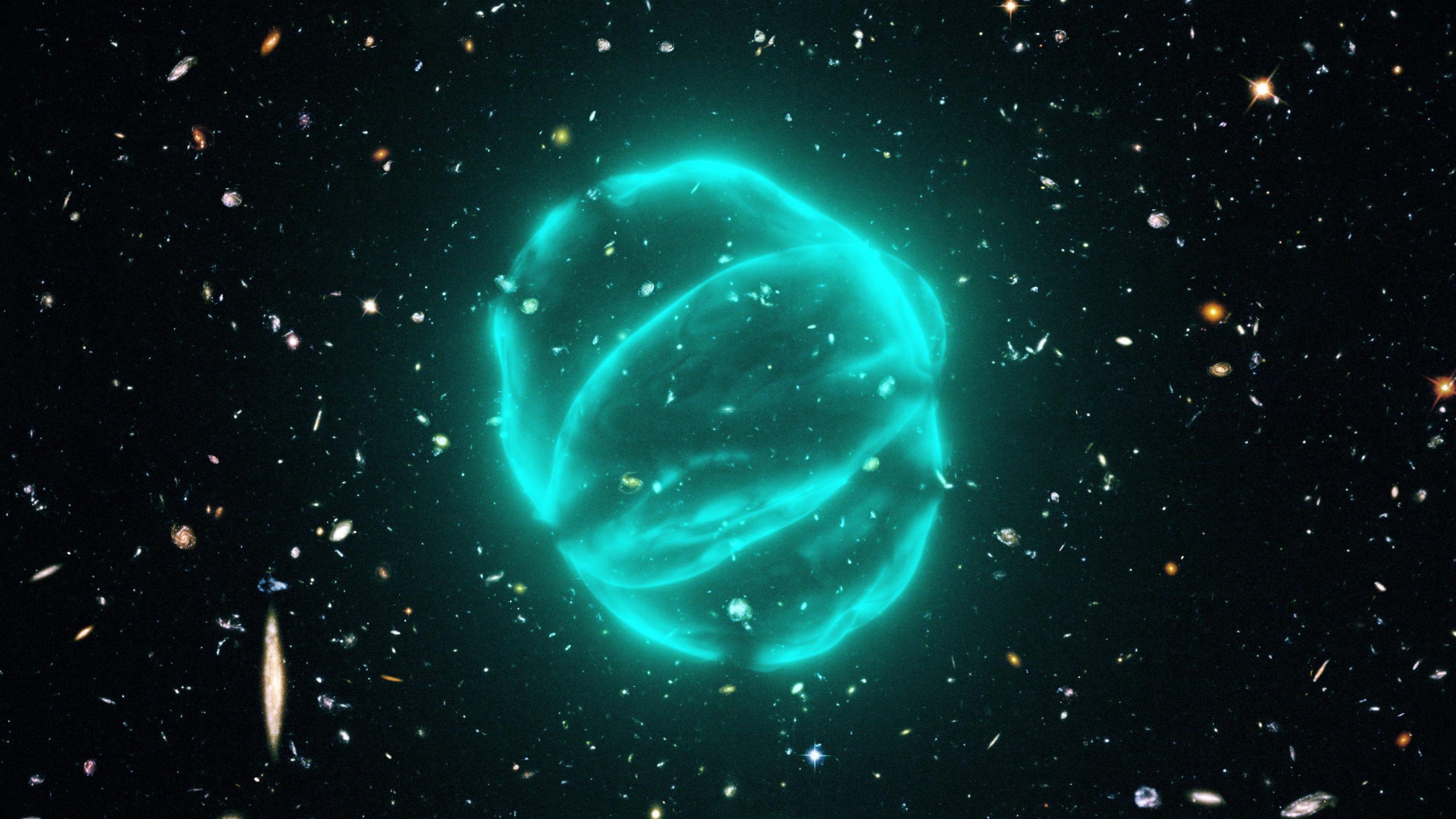
Astronomy’s newest mystery objects, odd radio circles or ORCs, have been pulled into sharp focus by an international team of astronomers using the world’s most capable radio telescopes.
First revealed by the ASKAP radio telescope, owned and operated by Australia’s national science agency CSIRO, odd radio circles quickly became objects of fascination. Theories on what caused them ranged from galactic shockwaves to the throats of wormholes.
A new detailed image, captured by the South African Radio Astronomy Observatory’s MeerKAT radio telescope and published on March 21, 2022, in Monthly Notices of the Royal Astronomical Society, is providing researchers with more information to help narrow down those theories.
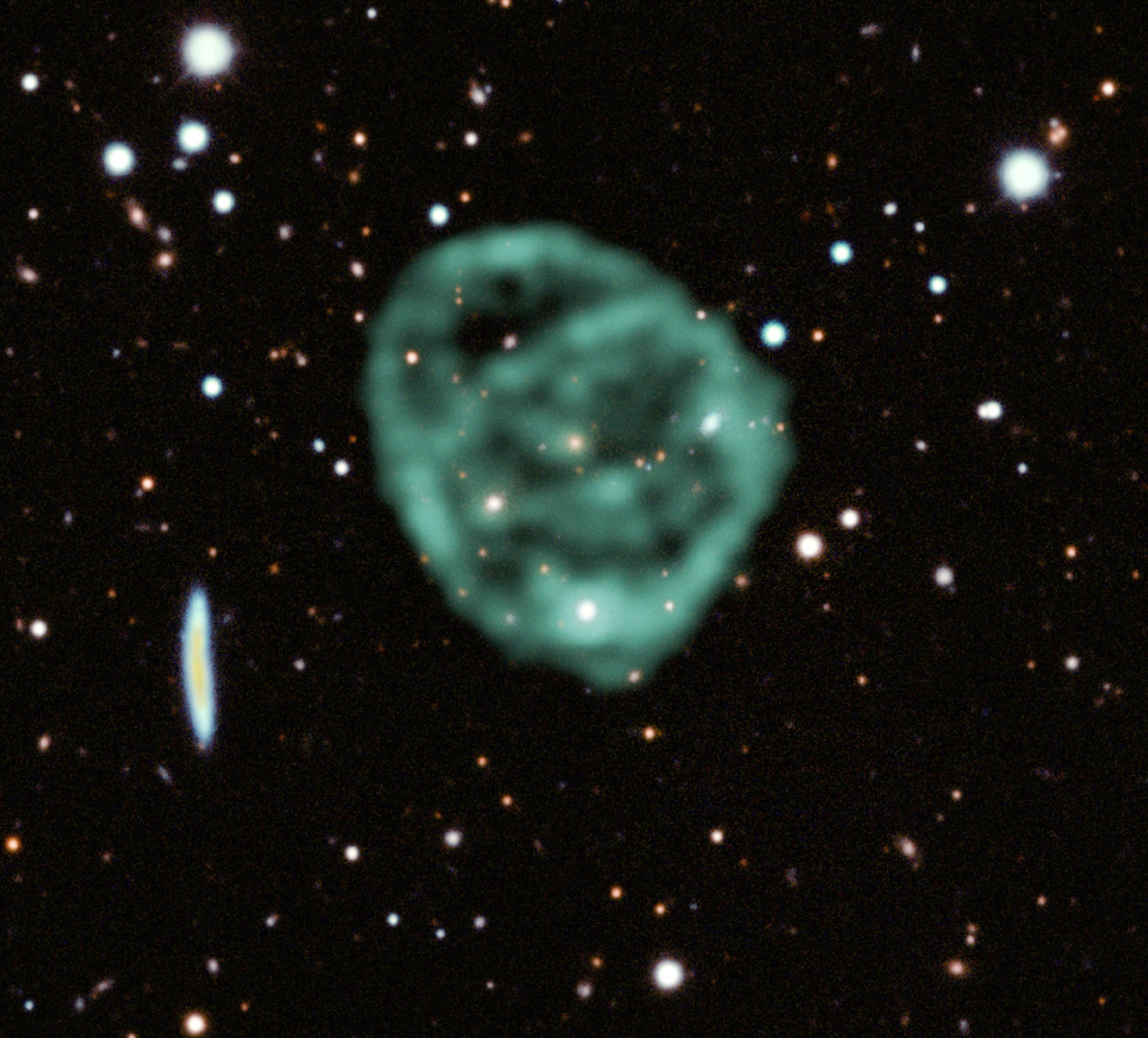
There are now three leading theories to explain what causes ORCs:
- They could be the remnant of a huge explosion at the center of their host galaxy, like the merger of two supermassive black holes;
- They could be powerful jets of energetic particles spewing out of the galaxy’s center; or
- They might be the result of a starburst ‘termination shock’ from the production of stars in the galaxy.
To date ORCs have only been detected using radio telescopes, with no signs of them when researchers have looked for them using optical, infrared, or X-ray telescopes.
Dr. Jordan Collier of the Inter-University Institute for Data Intensive Astronomy, who compiled the image from MeerKAT data said continuing to observe these odd radio circles will provide researchers with more clues.
Artist’s impression of odd radio circles exploding from a central galaxy. It is thought to take the rings 1 billion years to reach the size we see them today. The rings are so big (millions of light years across), they’ve expanded past other galaxies. Credit: Sam Moorfield/CSIRO
“People often want to explain their observations and show that it aligns with our best knowledge. To me, it’s much more exciting to discover something new, that defies our current understanding,” Dr. Collier said.
The rings are enormous – about a million light-years across, which is 16 times bigger than our own galaxy. Despite this, odd radio circles are hard to see.
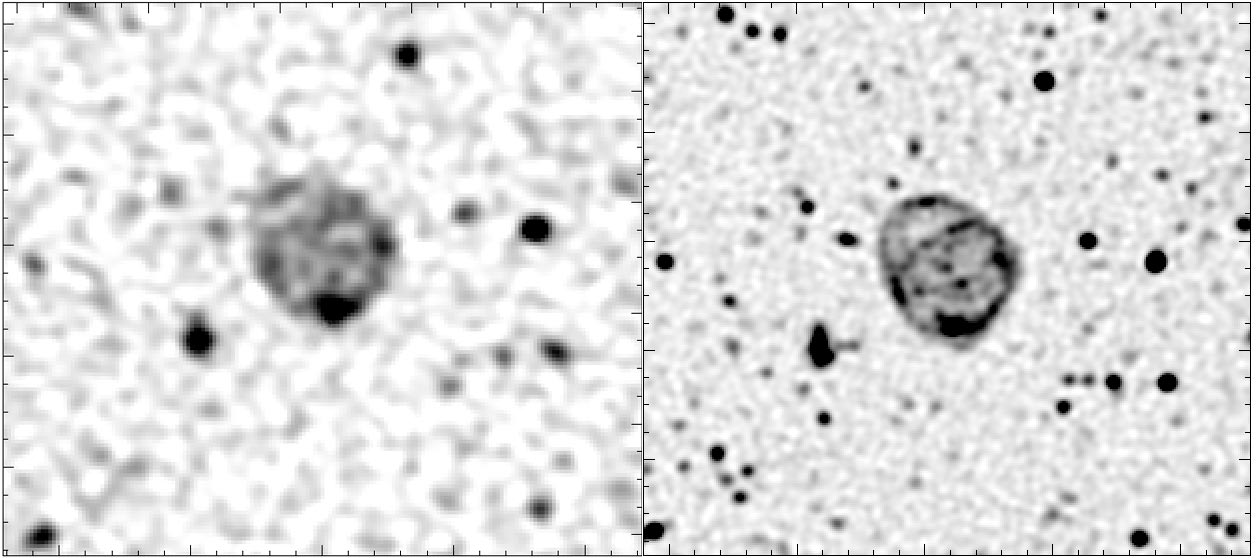
Professor Ray Norris from Western Sydney University and CSIRO, one of the authors on the paper, said only five odd radio circles have ever been revealed in space.
“We know ORCs are rings of faint radio emissions surrounding a galaxy with a highly active black hole at its center, but we don’t yet know what causes them, or why they are so rare,” Professor Norris said.
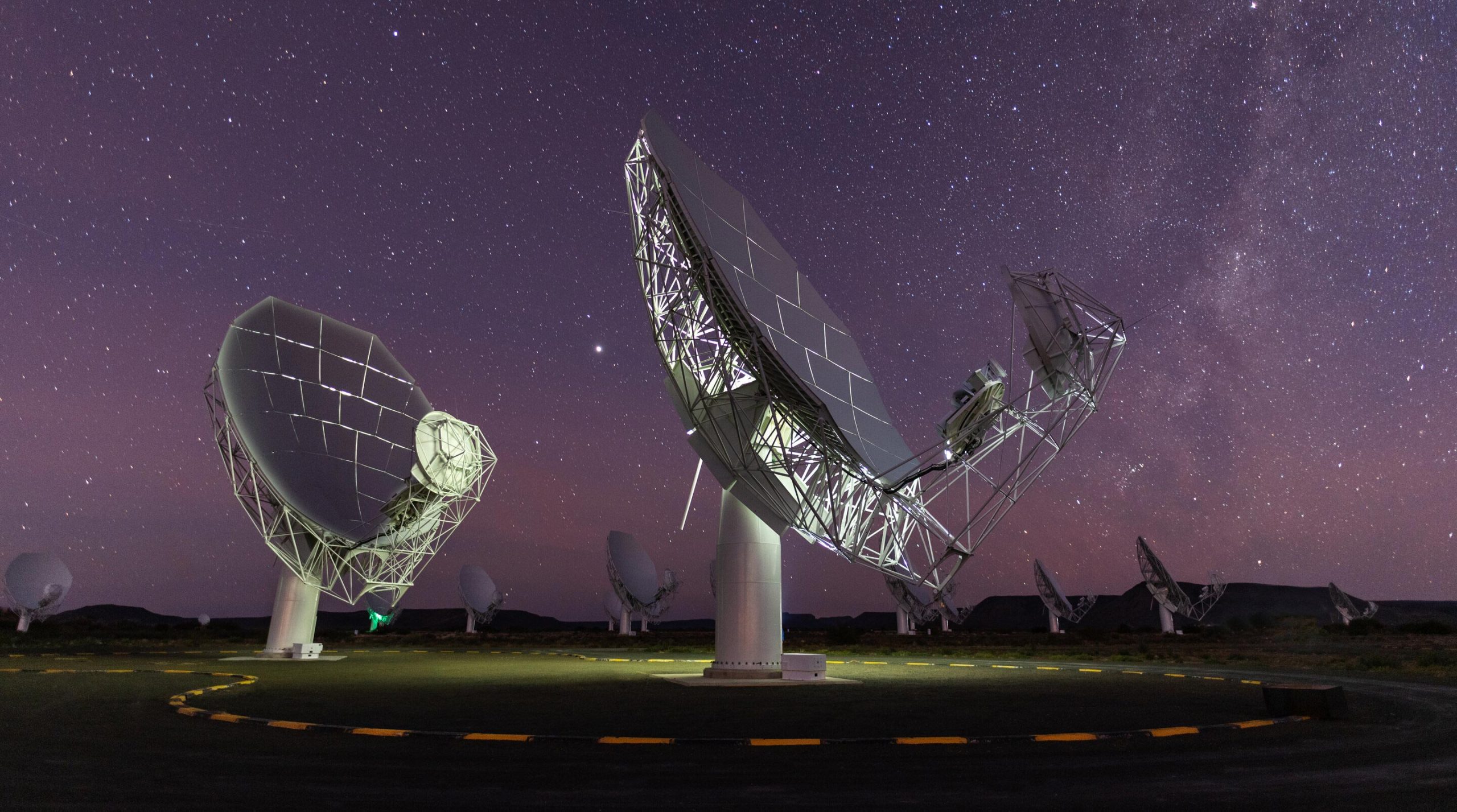
Professor Elaine Sadler, Chief Scientist of CSIRO’s Australia Telescope National Facility, which includes ASKAP, said for now, ASKAP and MeerKAT are working together to find and describe these objects quickly and efficiently.
“Nearly all astronomy projects are made better by international collaboration – both with the teams of people involved and the technology available,” Professor Sadler said.
“ASKAP and MeerKAT are both precursors to the international SKA project. Our developing understanding of odd radio circles is enabled by these complementary telescopes working together.”
To really understand odd radio circles scientists will need access to even more sensitive radio telescopes such as those of the SKA Observatory, which is supported by more than a dozen countries including the UK, Australia, South Africa, France, Canada, China, and India.
“No doubt the SKA telescopes, once built, will find many more ORCs and be able to tell us more about the lifecycle of galaxies,” Professor Norris said.
“Until the SKA becomes operational, ASKAP and MeerKAT are set to revolutionize our understanding of the Universe faster than ever before.”

Dr Fernando Camilo, Chief Scientist, SARAO:
“MeerKAT was conceived, designed, and built over 15 years through the dedicated effort of hundreds of people in South African research organizations, industry, universities, and government. It’s a testament to their skill and dedication, and of those SARAO colleagues who maintain, operate, and continue to develop MeerKAT, that it’s now a much sought-after telescope by astronomers world-wide.”
Prof. Bärbel Koribalski, CSIRO, who discovered an odd radio circle in 2021:
“Research into odd radio circles makes for exciting discussions, as it involves reaching out to colleagues around the world with expertise in many different areas. My team is very diverse and includes everyone from students to senior researchers, working in observing, data processing, modeling or visualizations.”
Reference: “MeerKAT uncovers the physics of an Odd Radio Circle” by Ray P. Norris, J. D. Collier, Roland M. Crocker, Ian Heywood, Peter Macgregor, L. Rudnick, Stas Shabala, Heinz Andernach, Elisabete da Cunha, Jayanne English, Miroslav Filipovic, Baaerbel S. Koribalski, Kieran Luken, Aaron Robotham, Srikrishna Sekhar, Jessica E. Thorne and Tessa Vernstrom, 24 March 2022, Monthly Notices of the Royal Astronomical Society.
DOI: 10.1093/mnras/stac701
ASKAP is located on Wajarri Yamatji country in Western Australia, and MeerKAT is located in the Northern Cape province of South Africa.
Never miss a breakthrough: Join the SciTechDaily newsletter.
Follow us on Google and Google News.
2 Comments
Radio circles 🔵 or green 🟢 accept only five founds so far, a rare find indeed. Unsolved mystery. Or like the rings around planets n oortcloud. Much much longer scale of the radiation of galaxies devouring hugh mass, ,a black ⚫ hole blown fuse…like house fuse or the electric pole transmitter. Positive negative and ground ✨ 😌 ⚡⚡♾👾👽🤓🤖
Interesting.
1. Radio Telescopes are used detect radio-frequency radiation between wavelengths of about 10 metres (30 megahertz [MHz]) and 1 mm (300 gigahertz [GHz]) emitted by extraterrestrial sources, such as stars, galaxies, and quasars.
2. On Planet Earth we tune into radio stations broadasting to the local area on the planet. FM stations and AM stations to listen to News and Music. Our sense of hearing has a limited range. Dogs have a better sense of hearing , Hence Dog Whistle. Mostly on radio Receivers we get static, like electricity cracking and making noise. It is all Sound energy.
3. May be a Good Idea to Narrow the range for Radio Telescopes into manageable chunks, to try and decipher patterns, and see if other life forms out their are transmitting useful messages from Times -Past,Present whih could be useful. Maybe they have fifured out how to send SOS messages and we are not listening carefully enough!
Views expressed are personal and not bindng of anyone.