
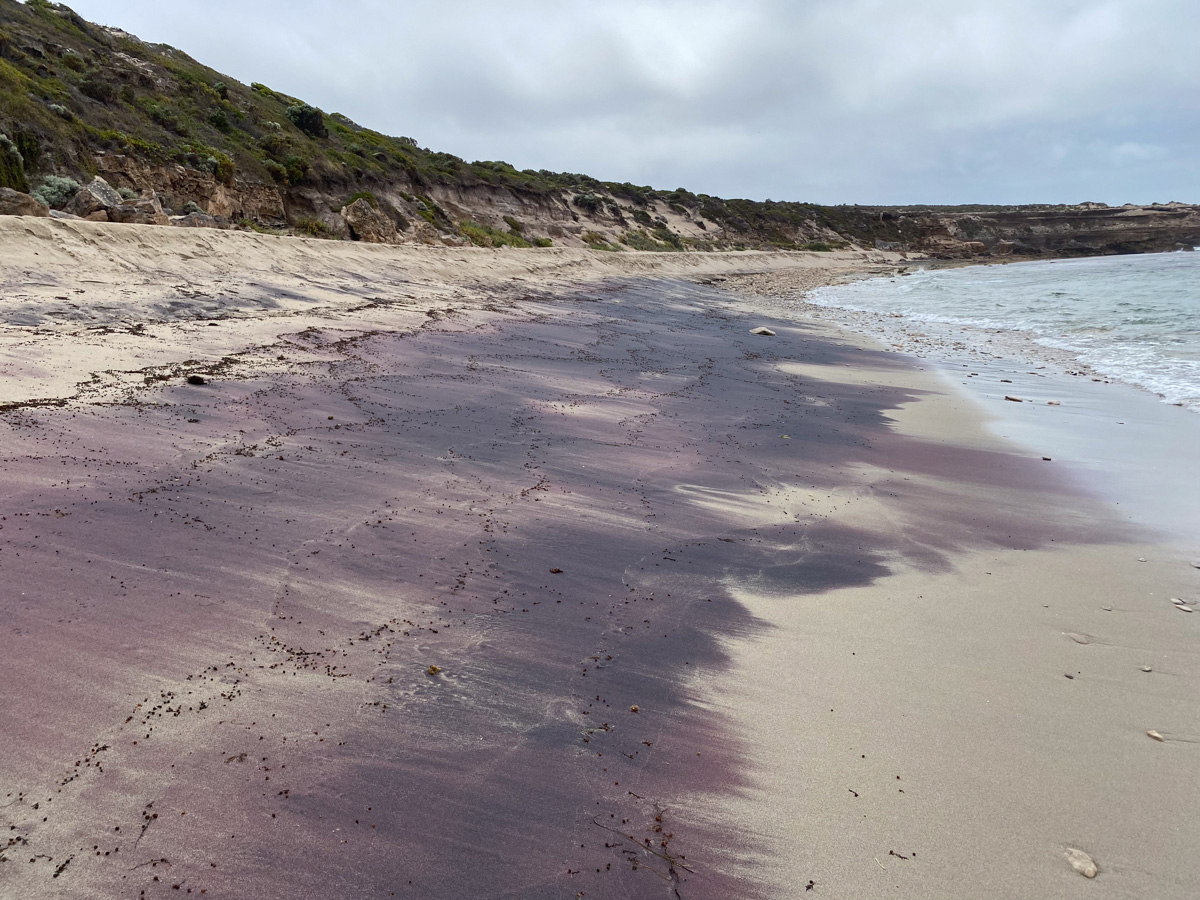
Australian researchers have discovered that pink garnet sand on South Australian beaches originates from ancient Antarctic mountains, redefining the known geological history and the formation timeline of the Pacific Ocean.
Deep-pink sand deposits found on the shores of South Australia have provided new insights into the timing of the subduction of the Australian tectonic plate beneath the Pacific plate and have revealed the existence of previously unknown ancient mountains in Antarctica.
The pink sand is composed of a mineral called garnet, and a University of Adelaide research team, led by PhD candidate Sharmaine Verhaert and Associate Professor Stijn Glorie, used a new, cutting-edge method to show the garnet grains are around 590 million years old.
Garnet is known to have formed locally during the Delamerian orogeny, an event which created the Adelaide Fold Belt around 514–490 million years ago, and during the formation of the Gawler Craton in western South Australia between 3.3–1.4 billion years ago. These ages don’t match the garnet sand on South Australian shores.
Geological Implications of Findings
“The garnet is too young to have come from the Gawler Craton and too old to have come from the eroding Adelaide Fold Belt,” says Verhaert.
“Garnet requires high temperatures to form and is usually associated with the formation of large mountain belts, and this was a time when the South Australian crust was comparatively cool and non-mountainous.”
The researchers, who published their findings in the journal Communications Earth & Environment, established the garnet does not originate from local source rocks, but they knew it had traveled from nearby as garnet is typically destroyed through prolonged exposure to the marine environment.
They discovered that the glacial sedimentary deposits of the Cape Jervis Formation, cropping out along the South Australian shorelines, contain layers of sand with garnet that is also around 590 million years old.
Ice-flow indicators in these glacial sedimentary deposits tell us that the garnet-rich glacial sands were brought to Australia by a north-west moving ice sheet during the Late Palaeozoic Ice Age, when Australia and Antarctica were connected in supercontinent Gondwana.
Connection to Antarctic Geology
Garnet dating to the same period has been found previously in an outcrop in the Transantarctic Mountains in East Antarctica, at the edge of a colossal area that is completely concealed by a thick ice sheet. Researchers believe this area hosts evidence of a 590-million-year-old mountain belt hiding below the Antarctic ice.
“While it is currently not possible to sample directly under this ice sheet, it is conceivable that millions of years of ice transport eroded the bedrock underneath and transported this cargo of garnet north-westwards, towards the conjugate Antarctic-Australian margin,” says Associate Professor Glorie.
“The garnet deposits were then locally stored in glacial sedimentary deposits along the southern Australian margin until erosion liberated them and the waves and tides concentrated them on the South Australian beaches.
“We have effectively uncovered a major mountain-building event that redefines the timing of the onset of convergence in the Pacific Ocean.”
The new University of Adelaide-developed approach to lutetium-hafnium dating, which uses a laser system attached to a mass-spectrometer, allowed this momentous discovery to be made from a simple inquiry.
“This journey started with questioning why there was so much garnet on the beach at Petrel Cove,” says Dr Jacob Mulder, who was also in the research team.
“It is fascinating to think we were able to trace tiny grains of sand on a beach in Australia to a previously undiscovered mountain belt under the Antarctic ice.”
Reference: “An Ediacaran orogeny in subglacial East Antarctica is uncovered by detrital garnet geochronology” by Sharmaine Verhaert, Stijn Glorie, Martin Hand, Jacob A. Mulder, Anthony R. Milnes and Jacqueline A. Halpin, 11 June 2024, Communications Earth & Environment.
DOI: 10.1038/s43247-024-01467-8
Never miss a breakthrough: Join the SciTechDaily newsletter.
Follow us on Google and Google News.