
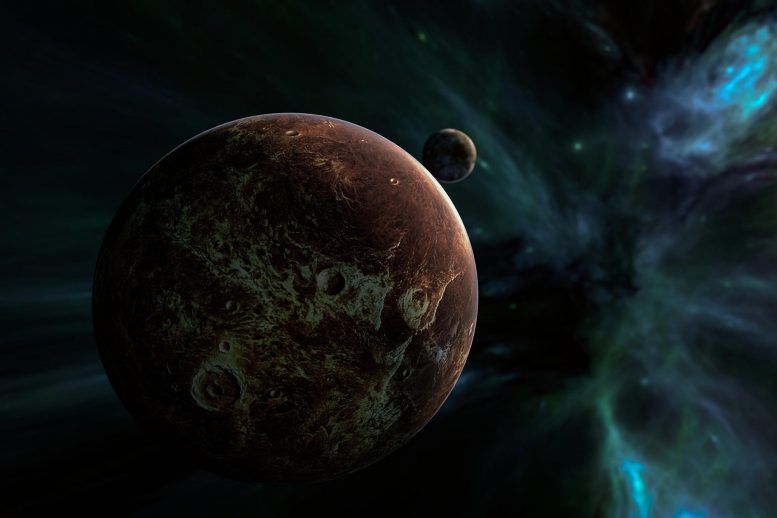
Kepler data revealed evidence of four Earth-mass rogue planets drifting without stars.
Tantalizing evidence has been uncovered for a mysterious population of “rogue” (or “free-floating”) planets, planets that may be alone in deep space, unbound to any host star. The results include four new discoveries that are consistent with planets of similar masses to Earth, published today (July 6, 2021) in Monthly Notices of the Royal Astronomical Society.
The study, led by Iain McDonald of the University of Manchester, UK, (now based at the Open University, UK) used data obtained in 2016 during the K2 mission phase of NASA’s Kepler Space Telescope. During this two-month campaign, Kepler monitored a crowded field of millions of stars near the center of our Galaxy every 30 minutes in order to find rare gravitational microlensing events.
The study team found 27 short-duration candidate microlensing signals that varied over timescales of between an hour and 10 days. Many of these had been previously seen in data obtained simultaneously from the ground. However, the four shortest events are new discoveries that are consistent with planets of similar masses to Earth.
Origins of Free-Floating Worlds
These new events do not show an accompanying longer signal that might be expected from a host star, suggesting that these new events may be free-floating planets. Such planets may perhaps have originally formed around a host star before being ejected by the gravitational tug of other, heavier planets in the system.
Predicted by Albert Einstein 85 years ago as a consequence of his General Theory of Relativity, microlensing describes how the light from a background star can be temporarily magnified by the presence of other stars in the foreground. This produces a short burst in brightness that can last from hours to a few days. Roughly one out of every million stars in our Galaxy is visibly affected by microlensing at any given time, but only a few percent of these are expected to be caused by planets.
Kepler was not designed to find planets using microlensing, nor to study the extremely dense star fields of the inner Galaxy. This meant that new data reduction techniques had to be developed to look for signals within the Kepler dataset.
An Astronomical Needle in a Haystack
Iain notes: “These signals are extremely difficult to find. Our observations pointed to an elderly, ailing telescope with blurred vision at one of the most densely crowded parts of the sky, where there are already thousands of bright stars that vary in brightness, and thousands of asteroids that skim across our field. From that cacophony, we try to extract tiny, characteristic brightenings caused by planets, and we only have one chance to see a signal before it’s gone. It’s about as easy as looking for the single blink of a firefly in the middle of a motorway, using only a handheld phone.”
Co-author Eamonn Kerins of the University of Manchester also comments, “Kepler has achieved what it was never designed to do, in providing further tentative evidence for the existence of a population of Earth-mass, free-floating planets. Now it passes the baton on to other missions that will be designed to find such signals, signals so elusive that Einstein himself thought that they were unlikely ever to be observed. I am very excited that the upcoming ESA Euclid mission could also join this effort as an additional science activity to its main mission.”
Confirming the existence and nature of free-floating planets will be a major focus for upcoming missions such as the NASA Nancy Grace Roman Space Telescope, and possibly the ESA Euclid mission, both of which will be optimized to look for microlensing signals.
Reference: “Kepler K2 Campaign 9 – I. Candidate short-duration events from the first space-based survey for planetary microlensing” by I McDonald, E Kerins, R Poleski, M T Penny, D Specht, S Mao, P Fouqué, W Zhu and W Zang, 6 July 2021, Monthly Notices of the Royal Astronomical Society.
DOI: 10.1093/mnras/stab1377
Never miss a breakthrough: Join the SciTechDaily newsletter.
Follow us on Google and Google News.
7 Comments
What detail, if any, is known?
I do hope they haven’t a detectable line around the equator and a large dimple in the surface north of it….
(with apologies)
relax, it probably won’t be fully operational.
Maybe a black hole ate their star and they escape
Planets held the central space of milkyway is true,even while we cite some Alien power, like presence of type 1A supernova.
Some planets are in fixed state near the centre of our gaĺaxy arìse curicity.
Wonderful Information.
Love to hear more.
I picture an intelligent civilization on a distant sister Earth. And then I picture the dumbfounded masses panicking without end, helpless as their home world is gravitationally tugged and flung far from their host star. Watching it helplessly recede from the sky as they are flung aimlessly into the cold, dark void of interstellar space… Imagine the madness. How would they die? From the harsh sub-zero cold of space? Any thing the human mind can conceive, in an infinite Universe, has surely happened.
How long would the inhabitants of such a world survive? Could they retain an atmosphere in deep space? I’m looking for an expert opinion because now I’m super curious about their ultimate fate.