
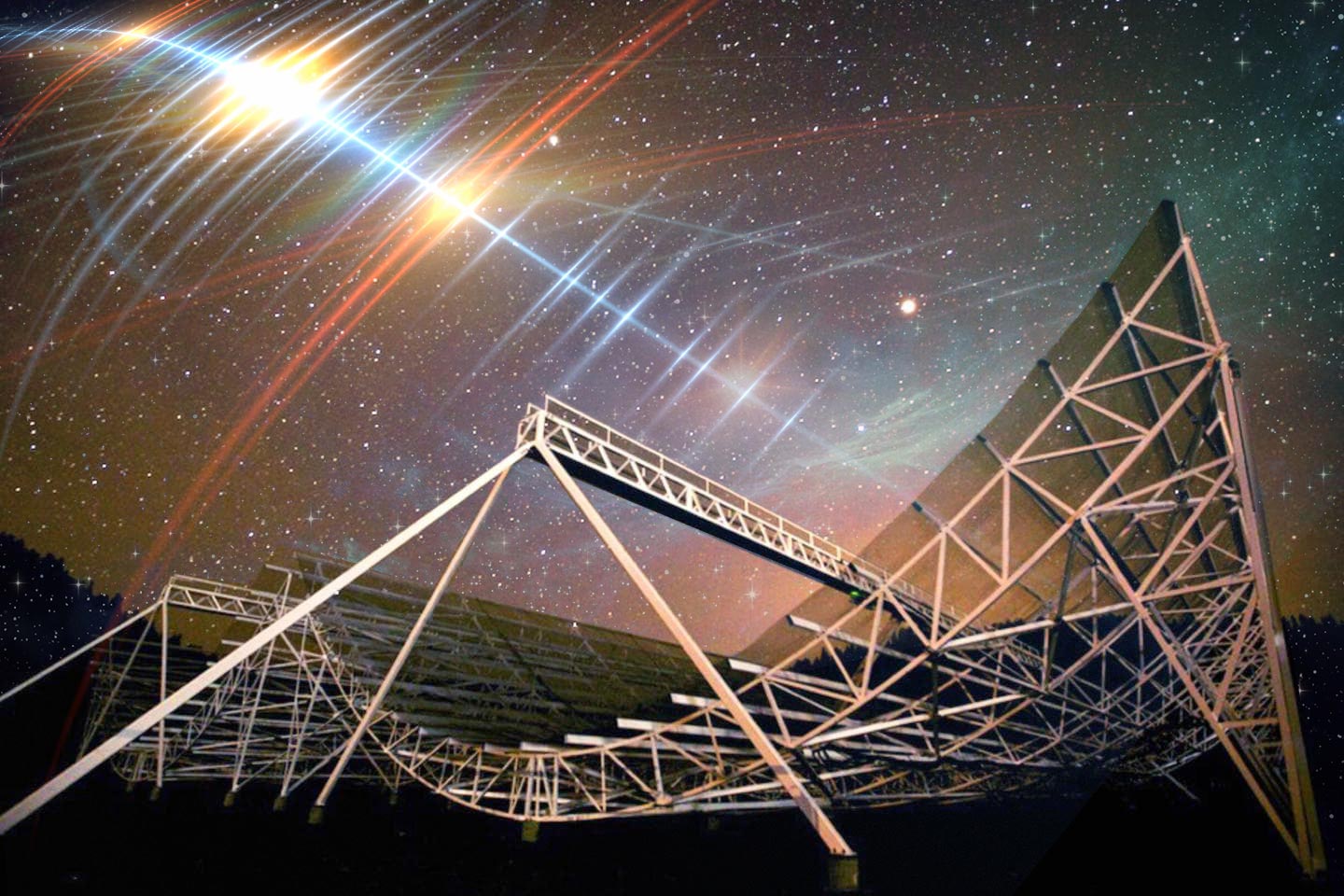
Astronomers have traced a mysterious fast radio burst to an unexpected place — an ancient, massive galaxy far removed from active star formation.
This revelation shakes up the conventional wisdom that such cosmic phenomena exclusively arise from younger, star-rich regions, hinting at the unknown complexities of the universe and sparking a fresh wave of scientific inquiry into the origins and environments of FRBs.
Unprecedented Discovery in the Cosmos
For the first time, astronomers have traced a fast radio burst (FRB) to the outskirts of an ancient, dead, elliptical galaxy — an unprecedented home for a phenomenon previously associated with much younger galaxies.
Detailed in two complementary studies led by Northwestern University and McGill University, the discovery shatters assumptions that FRBs solely emanate from regions of active star formation. The new observational evidence, instead, hints that the origins of these mysterious cosmic events might be more diverse than previously thought.
Both studies were published today (January 21) in the Astrophysical Journal Letters.
Challenging Previous Theories
“The prevailing theory is that FRBs come from magnetars formed through core-collapse supernovae,” said Northwestern’s Tarraneh Eftekhari, who led one of the studies and coauthored the other. “That doesn’t appear to be the case here. While young, massive stars end their lives as core-collapse supernovae, we don’t see any evidence of young stars in this galaxy. Thanks to this new discovery, a picture is emerging that shows not all FRBs come from young stars. Maybe there is a subpopulation of FRBs that are associated with older systems.”
“This new FRB shows us that just when you think you understand an astrophysical phenomenon, the universe turns around and surprises us,” said Northwestern’s Wen-fai Fong, a senior author on both studies. “This ‘dialogue’ with the universe is what makes our field of time-domain astronomy so incredibly thrilling.”
Eftekhari is a NASA Einstein Fellow at Northwestern’s Center for Interdisciplinary Exploration and Research in Astrophysics (CIERA). Fong is an associate professor of physics and astronomy at Northwestern’s Weinberg College of Arts and Sciences and a member of CIERA.
Advanced Detection Techniques
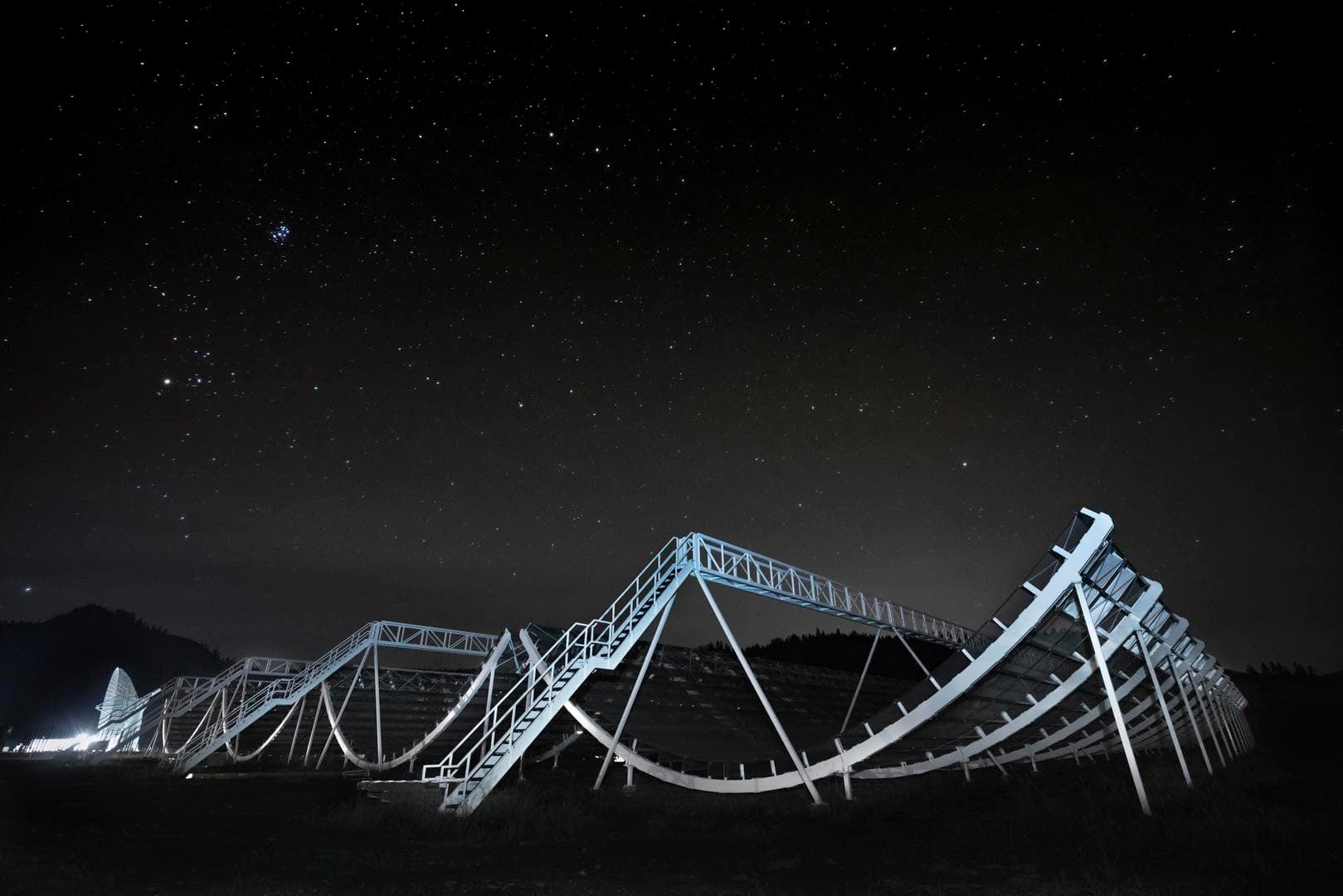
Astronomers first detected the new FRB, dubbed FRB 20240209A, in February 2024 with the Canadian Hydrogen Intensity Mapping Experiment (CHIME). Flaring up and disappearing within milliseconds, FRBs are brief, powerful radio blasts that generate more energy in one quick burst than our sun emits in an entire year.
But this event flared up more than once. Between the initial burst in February through July 2024, the same source produced another 21 pulses — six of which were also detected by an outrigger telescope located 60 kilometers away from CHIME’s main station. Smaller versions of CHIME, the outriggers enable astronomers to precisely confine the specific locations of FRBs on the sky.
The Mystery of the Massive Host Galaxy
After the team pinpointed the FRB’s position, Eftekhari and her collaborators hurried to use telescopes at the W.M. Keck and Gemini observatories to explore the event’s surrounding environment. In a specialized room on the Evanston campus, Northwestern astronomers have remote access to Keck, which enables them to quickly observe phenomena of high interest.
Instead of finding a young galaxy, these observations surprisingly revealed that the FRB originated at the edge of an 11.3-billion-year-old neighboring galaxy, located just 2 billion lightyears from Earth.
To learn more about this unusual host galaxy, the team used high-performance computers to run simulations. They found that the galaxy is extremely luminous and incredibly massive — 100 billion times the mass of our sun.
“It seems to be the most massive FRB host galaxy to date,” Eftekhari said. “It’s among some of the most massive galaxies out there.”
Unlikely Location for Cosmic Events
But, while most FRBs originate well within their galaxies, the team traced FRB 20240209A to the outskirts of its home — 130,000 lightyears from the galaxy’s center where few other stars exist.
“Among the FRB population, this FRB is located the furthest from the center of its host galaxy,” said Vishwangi Shah, a graduate student at McGill, who led the effort to pinpoint the FRB’s origins. “This is both surprising and exciting, as FRBs are expected to originate inside galaxies, often in star-forming regions. The location of this FRB so far outside its host galaxy raises questions as to how such energetic events can occur in regions where no new stars are forming.”
Unveiling Cosmic Twins
Before this discovery, astronomers had traced only one other FRB to the outer fringes of a galaxy. In 2022, an international team of astronomers detected an FRB, which emanated from a tight cluster of stars on the edge of Messier 81 (M81), a grand design spiral galaxy located about 12 million light years from Earth. Although FRB 20240209A occurred in an elliptical galaxy, the two events share several other similarities.
“A few years ago, the M81 FRB was surprisingly discovered within a dense cluster of stars called a globular cluster,” Fong said. “That event single-handedly halted the conventional train of thought and made us explore other progenitor scenarios for FRBs. Since then, no FRB had been seen like it, leading us to believe it was a one-off discovery — until now.
“In fact, this CHIME FRB could be a twin of the M81 event. It is far from its home galaxy (far away from where any stars are being born), and the population of stars in its home galaxy is extremely old. It’s had its heyday and is now coasting into retirement. At the same time, this type of old environment is making us rethink our standard FRB progenitor models and turning to more exotic formation channels, which is exciting.”
Out of the nearly 100 FRBs that have been pinpointed to a galaxy so far, most have likely originated from magnetars, which are formed through core-collapse supernovae. Astrophysicists posit FRB 20240209A’s origin, however, might be similar to the FRB found in M81.
Possible Explanations
The McGill-led study discusses the likelihood that the new FRB originated within a dense globular cluster. Such clusters are promising sites for magnetars possibly formed through other mechanisms and associated with older stars, including through the merger of two neutron stars or from a white dwarf collapsing under its own gravity.
“A globular cluster origin for this repeating FRB is the most likely scenario to explain why this FRB is located outside its host galaxy,” Shah said. “We do not know for a fact if there is a globular cluster present at the FRB position and have submitted a proposal to use the James Webb Space Telescope for follow-up observations of the FRB location. If yes, it would make this FRB only the second FRB known to reside in a globular cluster. If not, we would have to consider alternative exotic scenarios for the FRB’s origin.”
“It’s clear that there’s still a lot of exciting discovery space when it comes to FRBs,” Eftekhari said, “and that their environments could hold the key to unlocking their secrets.”
References:
“A Repeating Fast Radio Burst Source in the Outskirts of a Quiescent Galaxy” by Vishwangi Shah, Kaitlyn Shin, Calvin Leung, Wen-fai Fong, Tarraneh Eftekhari, Mandana Amiri, Bridget C. Andersen, Shion Andrew, Mohit Bhardwaj, Charanjot Brar, Tomas Cassanelli, Shami Chatterjee, Alice Curtin, Matt Dobbs, Yuxin Dong, Fengqiu Adam Dong, Emmanuel Fonseca, B. M. Gaensler, Mark Halpern, Jason W. T. Hessels, Adaeze L. Ibik, Naman Jain, Ronniy C. Joseph, Jane Kaczmarek, Lordrick A. Kahinga, Victoria M. Kaspi, Bikash Kharel, Tom Landecker, Adam E. Lanman, Mattias Lazda, Robert Main, Lluis Mas-Ribas, Kiyoshi W. Masui, Ryan Mckinven, Juan Mena-Parra, Bradley W. Meyers, Daniele Michilli, Kenzie Nimmo, Ayush Pandhi, Swarali Shivraj Patil, Aaron B. Pearlman, Ziggy Pleunis, J. Xavier Prochaska, Masoud Rafiei-Ravandi, Mawson Sammons, Ketan R. Sand, Paul Scholz, Kendrick Smith and Ingrid Stairs, 21 January 2025, The Astrophysical Journal Letters.
DOI: 10.3847/2041-8213/ad9ddc
“The Massive and Quiescent Elliptical Host Galaxy of the Repeating Fast Radio Burst FRB 20240209A” by T. Eftekhari, Y. Dong, W. Fong, V. Shah, S. Simha, B. C. Andersen, S. Andrew, M. Bhardwaj, T. Cassanelli, S. Chatterjee, D. A. Coulter, E. Fonseca, B. M. Gaensler, A. C. Gordon, J. W. T. Hessels, A. L. Ibik, R. C. Joseph, L. A. Kahinga, V. Kaspi, B. Kharel, C. D. Kilpatrick, A. E. Lanman, M. Lazda, C. Leung, C. Liu, L. Mas-Ribas, K. W. Masui, R. Mckinven, J. Mena-Parra, A. A. Miller, K. Nimmo, A. Pandhi, S. S. Patil, A. B. Pearlman, Z. Pleunis, J. X. Prochaska, M. Rafiei-Ravandi, M. Sammons, P. Scholz, K. Shin, K. Smith and I. Stairs, 21 January 2025, The Astrophysical Journal Letters.
DOI: 10.3847/2041-8213/ad9de2
The studies were supported by Gordon & Betty Moore Foundation, NASA, the Space Telescope Science Institute, the National Science Foundation, the David and Lucile Packard Foundation, the Alfred P. Sloan Foundation, the Research Corporation for Science Advancement, the Canadian Institute for Advanced Research, The Canadian Natural Sciences and Engineering Council of Canada, the Canada Foundation for Innovation and the Trottier Space Institute at McGill.
Never miss a breakthrough: Join the SciTechDaily newsletter.
Follow us on Google and Google News.
3 Comments
A fine comparison of evolution of galaxies at the two ends of universe has been presented,taking FRB in to the consideration.This,can also help to understand the accelerated expansion rate of universe at different time periods.
Ghost/zombie aliens!!! 😏
Other formation channels have been considered before, for various reasons:
“A fast radio burst (FRB) localized to a globular cluster (GC) challenges FRB models involving ordinary young magnetars. … The high inferred isotropic luminosity of most FRBs is challenging to explain in spin-down powered pulsars. A recent observation of a GP from the Crab pulsar, on the other hand, suggests highly Doppler-beamed emission, making the required energy orders of magnitude smaller than estimated with isotropic assumptions. Considering this strong beaming effect, GPs from a recycled pulsar with a modest magnetic field could explain the energetics and burst rates for a wide range of FRBs. The short life span accounts for a paucity of bright FRBs in the Milky Way neighbourhood.”
FRBs from rapid spin-down neutron stars
Dongzi Li, Ue-Li Pen
Monthly Notices of the Royal Astronomical Society, Volume 531, Issue 2, June 2024, Pages 2330–2334