

Astronomers tracking mysterious fast radio bursts (FRBs) stumbled upon an unexpected cosmic puzzle. A burst was detected from the outskirts of an ancient, dead galaxy — far from any young stars thought to create such phenomena.
This baffling discovery challenges current FRB theories and raises new questions about their true origins. With the help of a powerful new radio telescope system, scientists are now closer than ever to solving this cosmic enigma.
Mysterious Radio Bursts in Ursa Minor
Astronomer Calvin Leung was eager to analyze data from a newly launched radio telescope last summer. His goal was to precisely locate the source of repeated bursts of intense radio waves, known as fast radio bursts (FRBs), coming from the northern constellation Ursa Minor.
As a Miller Postdoctoral Fellow at the University of California, Berkeley, Leung hopes to unravel the origins of these mysterious signals. He also aims to use them as tools to map the large-scale structure of the universe, which could provide insights into its formation and evolution. To achieve this, he developed much of the software that allowed his team to combine data from multiple telescopes and pinpoint an FRB’s location with remarkable accuracy — down to the equivalent of a hair’s width at arm’s length.

Unexpected Discovery in a Dead Galaxy
What began as an exciting discovery soon turned puzzling. When Leung’s collaborators at the Canadian Hydrogen Intensity Mapping Experiment (CHIME) used optical telescopes to examine the source, they found something unexpected. The FRB originated from the distant outskirts of an ancient, inactive elliptical galaxy — one that should no longer contain the type of star believed to produce these powerful bursts.
Instead of finding an expected “magnetar” — a highly magnetized, spinning neutron star left over from the core collapse of a young, massive star — “now the question was: How are you going to explain the presence of a magnetar inside this old, dead galaxy?” Leung said.
A Puzzling Location for an FRB
The young stellar remnants that theorists think produce these millisecond bursts of radio waves should have disappeared long ago in the 11.3-billion-year-old galaxy, located 2 billion light years from Earth and weighing more than 100 billion times the mass of the sun.
“This is not only the first FRB to be found outside a dead galaxy, but compared to all other FRBs, it’s also the farthest from the galaxy it’s associated with. The FRB’s location is surprising and raises questions about how such energetic events can occur in regions where no new stars are forming,” said Vishwangi Shah, a doctoral student at McGill University in Montreal, Canada, who refined and extended Leung’s initial calculations about the location of the burst, called FRB 20240209A.
Shah is the corresponding author of a study of the FRB published on January 21 in the Astrophysical Journal Letters along with a second paper by colleagues at Northwestern University in Evanston, Illinois. Leung, a co-author of both papers, is a lead developer of three companion telescopes — so-called outriggers — to the original CHIME radio array located near Penticton, British Columbia. He mentored Shah at McGill while Leung was a doctoral student at the Massachusetts Institute of Technology (MIT) and subsequently held an Einstein Postdoctoral Fellowship at UC Berkeley prior to his Miller fellowship.
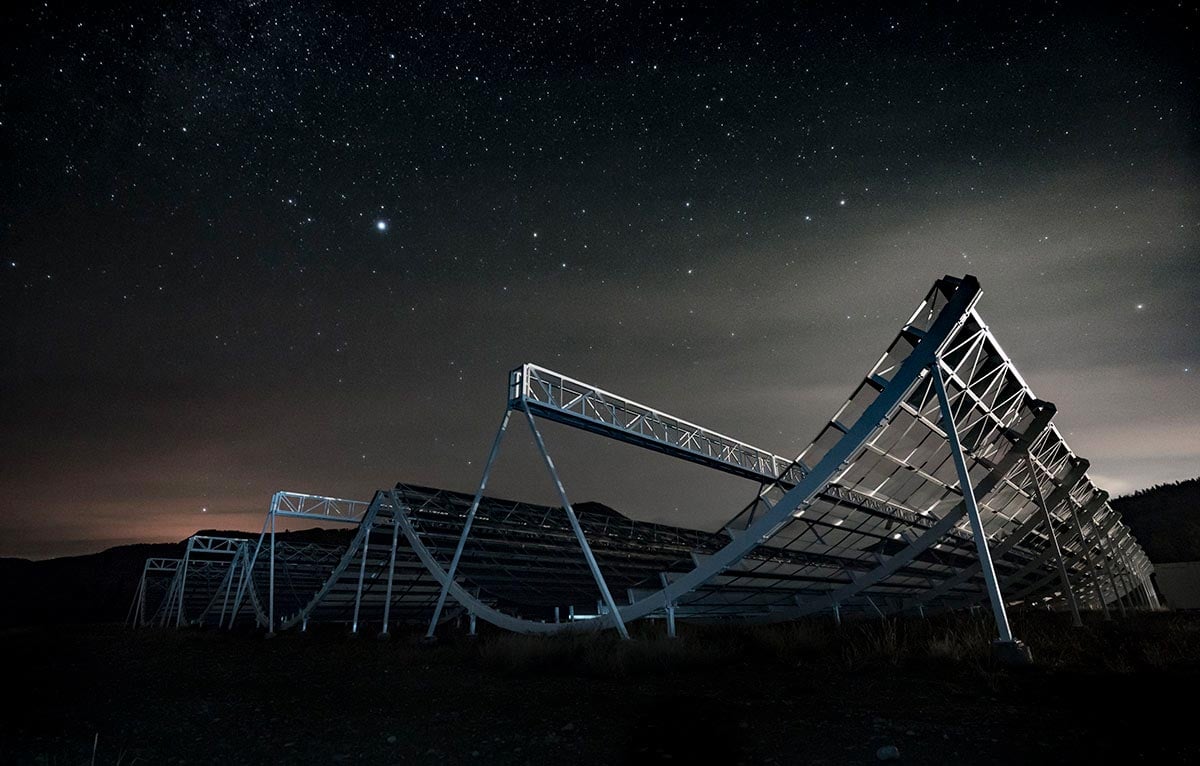
New CHIME Outriggers Enhance Precision
A third outrigger radio array will go online this week at Hat Creek Observatory, a facility in Northern California formerly owned and operated by UC Berkeley and now managed by the SETI Institute in Mountain View. Together, the four arrays will immensely improve CHIME’s ability to precisely locate FRBs.
“When paired with the three outriggers, we should be able to accurately pinpoint one FRB a day to its galaxy, which is substantial,” Leung said. “That’s 20 times better than CHIME, with two outrigger arrays.”
With this new precision, optical telescopes can pivot to identify the type of star groups — globular clusters, spiral galaxies — that produce the bursts and hopefully identify the stellar source. Of the 5,000 or so sources detected to date — over 95% of which were detected by CHIME — few have been isolated to a specific galaxy, which has hindered efforts to confirm whether magnetars or any other type of star are the source.
As detailed in the new paper, Shah averaged many bursts from the repeating FRB to improve the pinpointing accuracy provided by the CHIME array and one outrigger array in British Columbia. After its discovery in February 2024, astronomers recorded 21 more bursts through July 31. Since the paper was submitted, Shion Andrew at MIT incorporated data from a second outrigger at the Green Bank Observatory in West Virginia to confirm Shah’s published position with 20 times the precision.
Challenging Existing FRB Theories
“This result challenges existing theories that tie FRB origins to phenomena in star-forming galaxies,” said Shah. “The source could be in a globular cluster, a dense region of old, dead stars outside the galaxy. If confirmed, it would make FRB 20240209A only the second FRB linked to a globular cluster.”
She noted, however, that the other FRB originating in a globular cluster was associated with a live galaxy, not an old elliptical in which star formation ceased billions of years ago.
Unlocking the Secrets of FRBs
“It’s clear that there’s still a lot of exciting discovery space when it comes to FRBs and that their environments could hold the key to unlocking their secrets,” said Tarraneh Eftekhari, who has an Einstein Postdoctoral Fellowship at Northwestern and first author of the second paper.
“CHIME and its outrigger telescopes will let us do astrometry at a level unmatched by the Hubble Space Telescope or the James Webb Space Telescope. It’ll be up to them to drill down to find the source,” Leung added. “It’s an amazing radio telescope.”
Explore Further:
“A Repeating Fast Radio Burst Source in the Outskirts of a Quiescent Galaxy” by Vishwangi Shah, Kaitlyn Shin, Calvin Leung, Wen-fai Fong, Tarraneh Eftekhari, Mandana Amiri, Bridget C. Andersen, Shion Andrew, Mohit Bhardwaj, Charanjot Brar, Tomas Cassanelli, Shami Chatterjee, Alice Curtin, Matt Dobbs, Yuxin Dong, Fengqiu Adam Dong, Emmanuel Fonseca, B. M. Gaensler, Mark Halpern, Jason W. T. Hessels, Adaeze L. Ibik, Naman Jain, Ronniy C. Joseph, Jane Kaczmarek, Lordrick A. Kahinga, Victoria M. Kaspi, Bikash Kharel, Tom Landecker, Adam E. Lanman, Mattias Lazda, Robert Main, Lluis Mas-Ribas, Kiyoshi W. Masui, Ryan Mckinven, Juan Mena-Parra, Bradley W. Meyers, Daniele Michilli, Kenzie Nimmo, Ayush Pandhi, Swarali Shivraj Patil, Aaron B. Pearlman, Ziggy Pleunis, J. Xavier Prochaska, Masoud Rafiei-Ravandi, Mawson Sammons, Ketan R. Sand, Paul Scholz, Kendrick Smith and Ingrid Stairs, 21 January 2025, The Astrophysical Journal Letters.
DOI: 10.3847/2041-8213/ad9ddc
“The Massive and Quiescent Elliptical Host Galaxy of the Repeating Fast Radio Burst FRB 20240209A” by T. Eftekhari, Y. Dong, 雨欣 董, W. Fong, V. Shah, S. Simha, B. C. Andersen, S. Andrew, M. Bhardwaj, T. Cassanelli, S. Chatterjee, D. A. Coulter, E. Fonseca, B. M. Gaensler, A. C. Gordon, J. W. T. Hessels, A. L. Ibik, R. C. Joseph, L. A. Kahinga, V. Kaspi, B. Kharel, C. D. Kilpatrick, A. E. Lanman, M. Lazda, C. Leung, C. Liu, L. Mas-Ribas, K. W. Masui, R. Mckinven, J. Mena-Parra, A. A. Miller, K. Nimmo, A. Pandhi, S. S. Patil, A. B. Pearlman, Z. Pleunis, J. X. Prochaska, M. Rafiei-Ravandi, M. Sammons, P. Scholz, K. Shin, K. Smith and I. Stairs, 21 January 2025, The Astrophysical Journal Letters.
DOI: 10.3847/2041-8213/ad9de2
The studies were supported by Gordon and Betty Moore Foundation, NASA, the Space Telescope Science Institute, the National Science Foundation, the David and Lucile Packard Foundation, the Alfred P. Sloan Foundation, the Research Corporation for Science Advancement, the Canadian Institute for Advanced Research, the Natural Sciences and Engineering Council of Canada, the Canada Foundation for Innovation and the Trottier Space Institute at McGill.
Never miss a breakthrough: Join the SciTechDaily newsletter.
Follow us on Google and Google News.
6 Comments
I just have a question. If this Galaxy is two billion light-years away, that means that the light takes two billion years to get here, right? If the light from there takes two billion years to get to us, how do we know that there aren’t any new stars forming in that galaxy?
we don’t. but that isn’t relevant because FRBs move at lightspeed, not faster
This is perhaps not directly related, but this more recent idea that time moves faster here than in more gravity dense parts of the universe raises some questions in my mind.
What if one of the reasons we’re not detecting alien transmissions on radio telescopes is due to that time dilation effect? If you examine radio waves passing from a younger part of the universe to an older part, wouldn’t they likely be shifted into another part of the spectrum?
In other words, we’re looking for radio waves, but they would likely appear elsewhere in the band (like a transformer shifts voltage higher or lower with a difference in the coil turns).
What if we calculated the shift from a point in another galaxy and then altered its frequency to match our radio one? We might need an entirely different type of telescope to lick the signals up. Transmissions from our own galaxy or nearby Andromeda may not be affected at a, but surely a galaxy 10 billion light years away is going to get some shift.
It might affect red shift values of distant objects as well, making their distances incorrect as well as their apparent age. By how much? I don’t know. But it might be something that’s being overlooked using conventional methodology.
The galaxy was 2 billion light years away when this light started its journey. Now it is even farther away because in the last 2 billion years the galaxy has moved away from us.
What if it hasn’t moved at all, but it only appears that way due to the time dilation effects of space/time moving faster in less dense parts of the universe than in more dense parts as has recently been speculated to disprove Dark Energy? Red Shift would have to be affected by time differences as frequency is 1/t!
thank you