
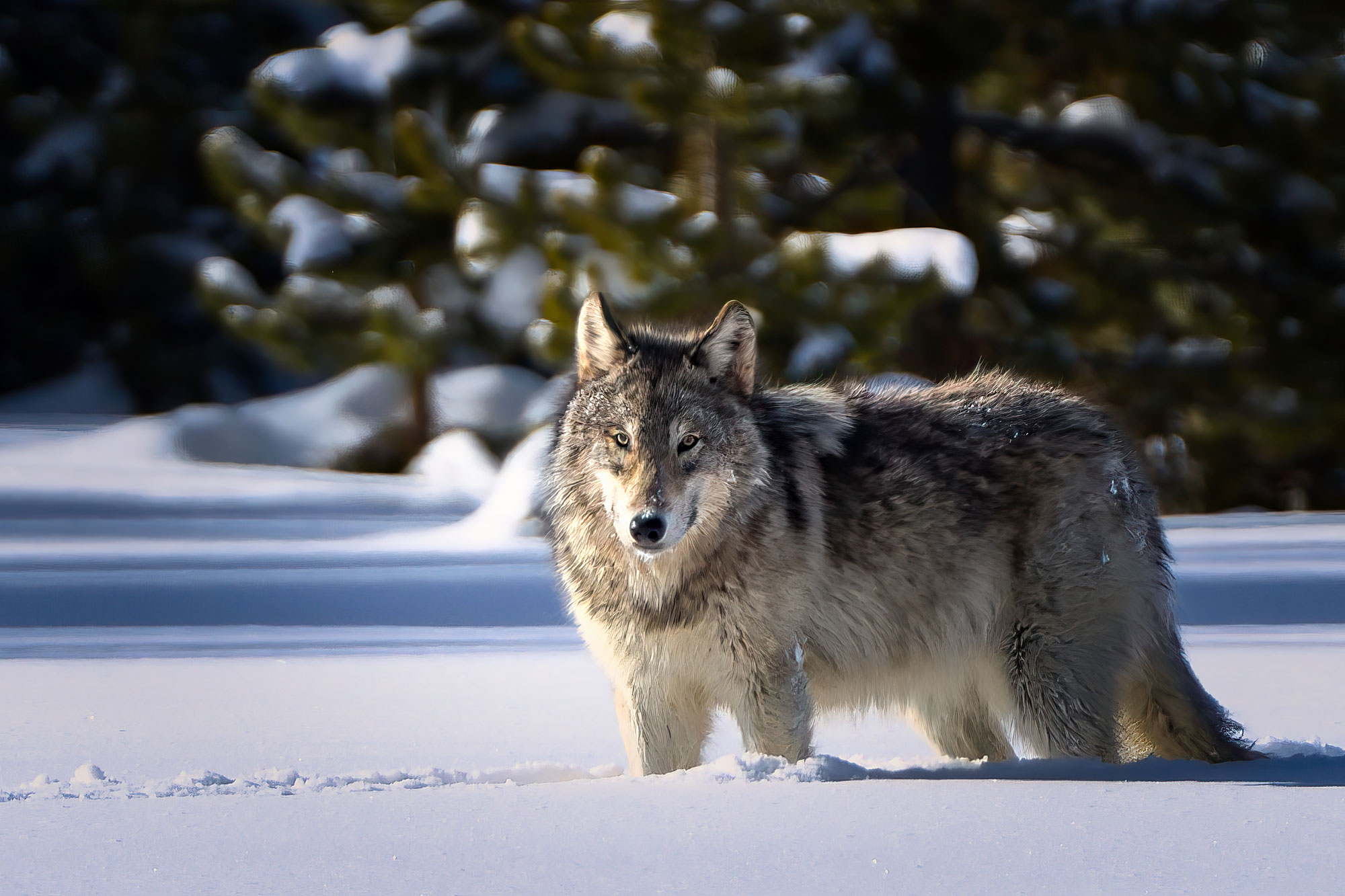
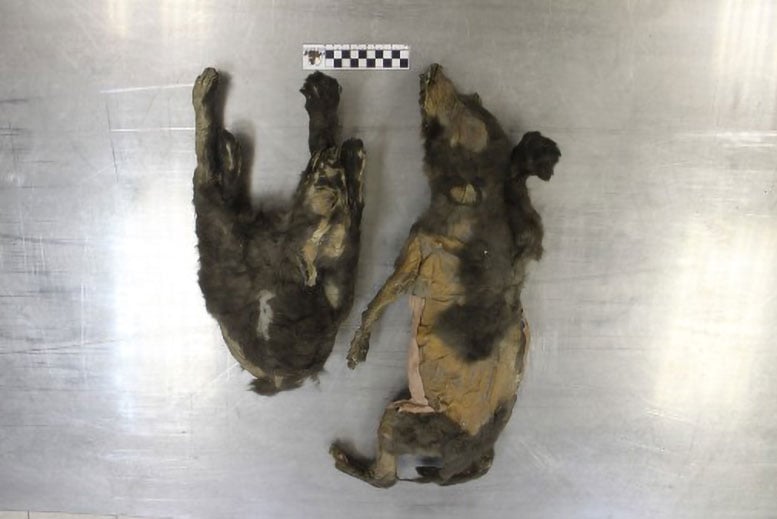
A pair of Ice Age “puppies” preserved in Siberian permafrost for over 14,000 years have turned out to be wolves, not early domesticated dogs.
A recent study of two ancient “puppies” dating back more than 14,000 years suggests they were actually wolves, not early domestic dogs as once believed.
Genetic testing revealed that the cubs were sisters, around two months old. Like modern wolves, they ate a combination of meat and plants. What surprised researchers most was the discovery of woolly rhinoceros remains in their stomachs, since such a massive animal would have been a difficult target for wolves to hunt.
The pair, known as the “Tumat Puppies,” were discovered in northern Siberia about 40 kilometers from the village of Tumat. One was uncovered in 2011 and the other in 2015 at the site now known as Syalakh.
Their remarkably preserved bodies were found frozen in layers of soil alongside bones of woolly mammoths. Some of the mammoth remains appeared to have been burned or processed by humans. This raised new questions about whether the location had once served as a mammoth butchering site, and if the puppies might have interacted with humans, perhaps as wild wolves lingering near camps or as early attempts at domestication.
A Sudden Tragedy
There are no visible injuries or signs of attack to the cubs, and so they were likely to have been inside an underground den, resting after their meal, until a potential landslide collapsed their home, trapping the cubs inside.
A new study, led by the University of York, however, has shown that, based on genetic data from the animals’ gut contents and other chemical ‘fingerprints’ found in their bones, teeth and tissue, that the way they were living, what they were eating, and the environment they existed in, points to the puppies being wolf cubs and not early domesticated dogs.
Both were already eating solid food, including woolly rhinoceros meat and, in one case, a small bird called a wagtail. However, their bodies still showed signs of having nursed, meaning they were likely still getting milk from their mother, too.
Despite being found near human-modified mammoth bones, there was no evidence of the cubs consuming mammoth, but the piece of woolly rhinoceros skin found in the stomach of one of the cubs had not been fully digested, suggesting they died not long after their last meal.
It is thought that the woolly rhinoceros may have been a young calf, rather than a fully grown adult, and likely hunted by the adult pack and fed to the cubs, but even if this was the case, a young woolly rhinoceros would have been considerably bigger than prey modern-day wolves typically hunt.
This has led researchers to think that these Pleistocene wolves may have been somewhat bigger than the wolves of today. Previous DNA testing suggests that the cubs most likely belonged to a wolf population that eventually died out and didn’t lead to today’s domestic dogs.
Anne Kathrine Runge, from the University of York’s Department of Archaeology, who analyzed the cubs as part of her PhD, said: “It was incredible to find two sisters from this era so well preserved, but even more incredible that we can now tell so much of their story, down to the last meal that they ate.”
Challenging the Dog Evolution Theory
The original hypothesis that the Tumat Puppies were dogs is also based on their black fur color, which was believed to have been a mutation only present in dogs, but the Tumat Puppies challenge that hypothesis as they are not related to modern dogs.
Anne Kathrine added: “Whilst many will be disappointed that these animals are almost certainly wolves and not early domesticated dogs, they have helped us get closer to understanding the environment at the time, how these animals lived, and how remarkably similar wolves from more than 14,000 years ago are to modern-day wolves.
“It also means that the mystery of how dogs evolved into the domestic pet we know today deepens, as one of our clues – the black fur color – may have been a red herring given its presence in wolf cubs from a population that is not related to domestic dogs.”
Tiny fossilized plant remains were discovered in the cubs’ stomachs, indicating that they lived in a diverse environment with a variety of plants and animals to consume, including prairie grasses, leaves from the shrub genus Dryas, and willow twigs. This suggests the landscape they inhabited included different types of habitats that could support rich and varied ecosystems.
Dr Nathan Wales, from the University of York’s Department of Archaeology, said: “We know gray wolves have been around as a species for hundreds of thousands of years based on skeletal remains from paleontological sites, and researchers have done DNA testing of some of those remains to understand how the population changed over time. The soft tissues preserved in the Tumat Puppies, however, gives us access to other ways of investigating wolves and their evolutionary line.
“We can see that their diets were varied, consisting of both animal meat and plant life, much like that of modern wolves, and we have an insight into their breeding behaviors too. The pair were sisters and likely being reared in a den and cared for by their pack – all common characteristics of breeding and raising of offspring in wolves today.
“Today, litters are often larger than two, and it is possible that the Tumat Puppies had siblings that escaped their fate. There may also be more cubs hidden in the permafrost or lost to erosion.
“The hunting of an animal as large as a woolly rhinoceros, even a baby one, suggests that these wolves are perhaps bigger than the wolves we see today, but still consistent in many ways, because wolves still tend to hunt easy prey while some of the pack is engaged in cub rearing.”
The research findings, however, mean that the hunt for the oldest dog, and its place of origin, is still on.
Reference: “Multifaceted analysis reveals diet and kinship of Late Pleistocene ‘Tumat Puppies’” by Anne Kathrine Wiborg Runge, Jonas Niemann, Mietje Germonpré, Dorothée G. Drucker, Hervé Bocherens, Kseniia Boxleitner, Jazmín Ramos-Madrigal, Anna Linderholm, David W.G. Stanton, Alexandr Kandyba, Jonathan Brecko, Martine Van den Broeck, Robert Losey, Jannikke Räikkönen, Mikhail Sablin, Julia Stagegaard, Shyam Gopalakrishnan, Sergey Fedorov, Mikkel-Holger S. Sinding, M. Thomas P. Gilbert and Nathan Wales, 12 June 2025, Quaternary Research.
DOI: 10.1017/qua.2025.10
Never miss a breakthrough: Join the SciTechDaily newsletter.
Follow us on Google and Google News.
6 Comments
“The hunting of an animal as large as a woolly rhinoceros, even a baby one, suggests that these wolves are perhaps bigger than the wolves we see today, …”
That speculation should be easy to answer by looking at the bones of fossilized Pleistocene wolves.
How people believe dogs came from wolves is idiotic. Breeding a wolf to a wolf gets another wolf. If it was true they evolved into dogs eventually then it would still be happening today. Breeding dogs to dogs doesn’t get wolves either. Not in a million years. It’s not possible.
Wolves exhibit a range of behaviors towards humans. The prevailing theory is that humans and wolves began cooperating as independent species – humans helped wolves finish off a hunt, wolves helped humans finish off a hunt of a much larger animal that neither could safely bring down on their own. Humans allowed the wolves to scavenge what the humans didn’t want, or perhaps there was some spiritual belief that caused the humans to share the kill more equitably. Either way, wolves that were naturally more curious of their “friends” might develop a closer relationship with the human group, and breed pups that carry that familiarity, which eventually led to those wolves preferring the company of their human pack to that of other wolves. When they’re cared for by humans, they live longer. Quickly, within a few tens of generations of wolves, humans can select for behavior and appearance traits that are preferable for a companion animal rather than a competitor on the landscape. Scientific studies have already shown that selective breeding can yield dog-like coloring and traits like floppy ears rather quickly.
Silly folks still trying to find evidence to support their theories about evolution. Species do undergo changed based on the environment but a species becoming a new species is going to be extremely difficult to prove.
Dogs and wolves are closer genetically than humans and chimpanzees and can interbreed. Not sure why that’s so hard to believe.
It’s also quite possible, likely even, that the wolf pack had been in the area when the wooly rhinoceros was hunted or died of natural causes. Perhaps the pack followed the animal until it collapsed and then scavenged it, or perhaps they followed humans who hunted it, and then scavenged its fresh remains.