

The Jurassic fossil Juracanthocephalus reveals a key evolutionary link between rotifers and parasitic acanthocephalans, resolving debates about their origins and anatomy.
A research team from the Nanjing Institute of Geology and Palaeontology at the Chinese Academy of Sciences has discovered a fossil acanthocephalan named Juracanthocephalus in the 160-million-year-old Daohugou Biota in Inner Mongolia, China. The discovery was published in Nature.
Acanthocephalans, also known as thorny-headed or spiny-headed worms, are endoparasitic organisms that live in both marine and terrestrial environments. These medically important parasites infect a wide range of hosts, including humans, pigs, dogs, cats, and fish.
They are defined by their elongated, worm-like bodies and a retractable proboscis covered in rows of backward-facing hooks, which help them attach to the digestive tracts of their hosts. Although they were once considered a separate animal phylum, their unique and highly specialized anatomy has sparked continued debate over their evolutionary relationships.
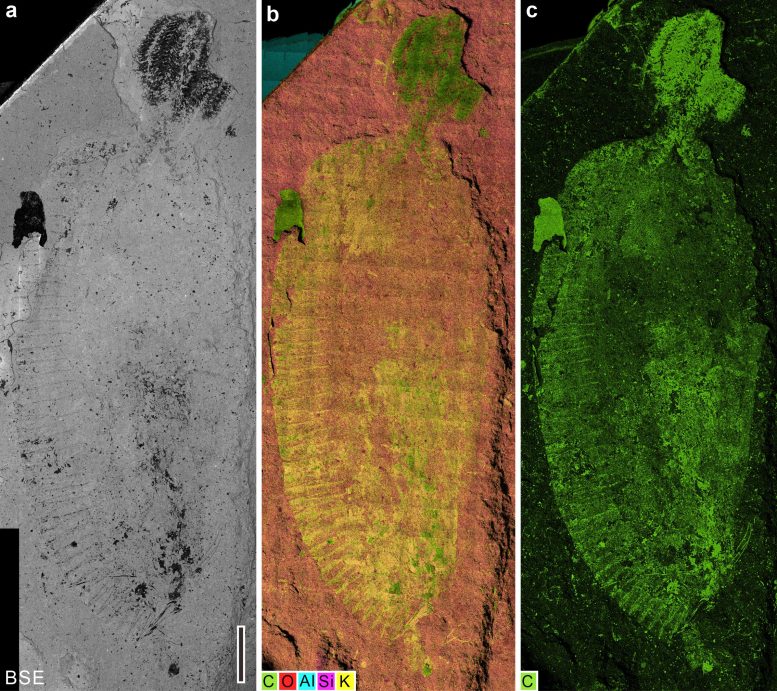
Morphological studies have suggested links between acanthocephalans and various groups such as Platyhelminthes (flatworms), Priapulida (penis worms), or Rotifera (wheel animals). However, molecular phylogenetic evidence strongly supports the idea that acanthocephalans are a highly derived subgroup within Rotifera. Still, the differences in form between parasitic acanthocephalans and free-living rotifers remain notably large.
Challenges in the fossil record of acanthocephalans
Furthermore, the fossil record of acanthocephalans is exceptionally sparse due to their soft bodies—which were less likely to fossilize than harder ones—and concealed habitats. Until now, the only known fossil evidence consisted of four putative acanthocephalan eggs discovered in the coprolites of a Late Cretaceous crocodyliform. Due to the lack of body fossils, the origin and early evolution of acanthocephalans thus remain poorly understood.
Using scanning electron microscopy (SEM) and energy-dispersive spectroscopy (EDS), the research team conducted a detailed anatomical analysis of Juracanthocephalus and updated the morphological matrix of worm-like animals to support a comprehensive phylogenetic analysis.
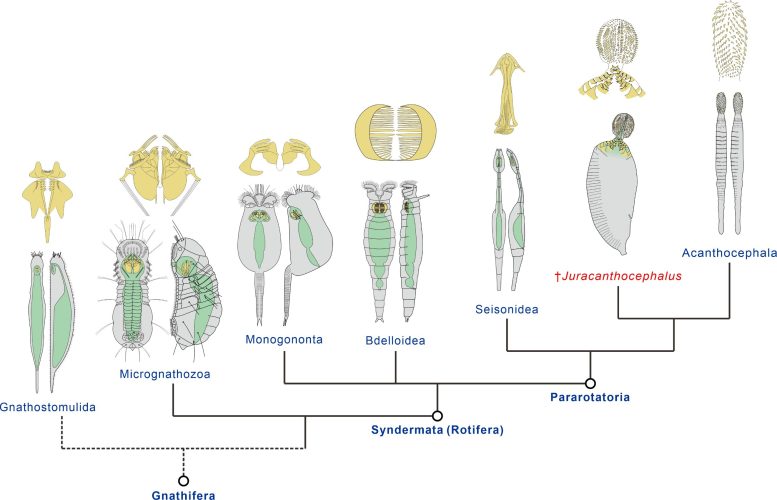
The results indicate that Juracanthocephalus represents a transitional form between free-living, jawed rotifers and jawless, endoparasitic acanthocephalans, bridging an evolutionary gap. This finding provides the first direct fossil evidence to help resolve the long-standing mystery of acanthocephalan origins.
Distinctive anatomy and body plan features
Juracanthocephalus has a fusiform body divided into a proboscis, neck, and trunk. The proboscis is equipped with strongly sclerotized, slightly curved hooks, while the ventral surface of the trunk features 38 lines of transverse, setaceous combs—a trait comparable to modern acanthocephalans. A possible alimentary tract is preserved in the proboscis, though no clear gut is visible in the trunk. The terminal end of the fossil displays a structure resembling the bursa of male acanthocephalans.
Notably, Juracanthocephalus has a jaw apparatus composed of clustered, tooth-like units arranged in converging paired rows, with the jaws increasing in size posteriorly. This structure closely resembles that found in Gnathifera, a group that includes Gnathostomulida, Micrognathozoa, and Syndermata (which encompasses Rotifera and Acanthocephala).
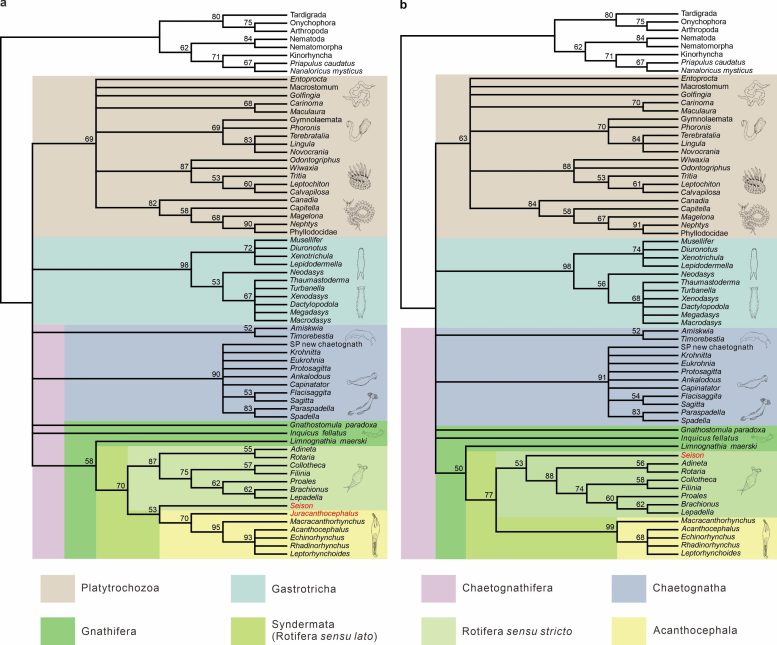
To determine the phylogenetic position of Juracanthocephalus, the research team compiled an updated morphological matrix incorporating both extant and extinct worm-like animals. The analysis identifies Juracanthocephalus as a stem-group acanthocephalan, sister to all extant acanthocephalans. This finding aligns with molecular phylogenetic analyses, which place acanthocephalans within Rotifera (including Monogononta, Bdelloidea, and Seisonidea).
Competing hypotheses within rotifera relationships
However, the precise placement of acanthocephalans within Rotifera remains contentious, with six competing hypotheses arising from molecular and morphological studies. When Juracanthocephalus is excluded from the morphological matrix, the results support Seisonidea as the sister group to all other Rotifera, consistent with previous morphological analyses but conflicting with molecular data.
Conversely, incorporating Juracanthocephalus into the matrix positions Seisonidea as the sister group to Juracanthocephalus and all extant acanthocephalans, reconciling morphological and molecular phylogenetic analyses.
The discovery of Juracanthocephalus provides a crucial reference for understanding the evolutionary innovations and body plan of acanthocephalans. Its hooked proboscis and large body size suggest that it was an endoparasite during the Jurassic period. Furthermore, this fossil implies that acanthocephalans may have originated in terrestrial environments and diverged from Rotifera no later than the Middle Jurassic.
This study underscores the importance of transitional fossils in elucidating radical morphological changes in animal body plans. While molecular phylogenetics has revolutionized our understanding of evolutionary relationships, Juracanthocephalus highlights the indispensable role of fossil evidence in reconstructing the history of life.
Reference: “A Jurassic acanthocephalan illuminates the origin of thorny-headed worms” by Cihang Luo, Luke A. Parry, Brendon E. Boudinot, Shengyu Wang, Edmund A. Jarzembowski, Haichun Zhang and Bo Wang, 9 April 2025, Nature.
DOI: 10.1038/s41586-025-08830-5
The research was supported by the National Natural Science Foundation of China, the IUGS “Deep-time Digital Earth” Big Science Program, and the Jiangsu Innovation Support Plan for International Science and Technology Cooperation Programme.
Never miss a breakthrough: Join the SciTechDaily newsletter.
Follow us on Google and Google News.